Commodore Callback 8020 is a $399 Sailfish OS flip phone
Commodore is returning to mobile phones with the Callback 8020, and there is an interesting Nokia connection hiding inside this rather unusual flip phone. The Callback 8020 runs Sailfish OS from Jolla, the Finnish company founded by former Nokia engineers after Nokia abandoned MeeGo. Commodore and Jolla describe Sailfish as being built on the Nokia MeeGo lineage, making this new device particularly interesting for those who still remember the Nokia N9 and what MeeGo could have become. Jolla itself was founded in 2011 by former Nokia engineers and has continued developing Sailfish OS for more than a decade.
This is not a Nokia phone, of course. But there is certainly some Nokia software DNA inside it. The Callback 8020 sits somewhere between a traditional dumbphone and a smartphone. Commodore deliberately blocks web browsers and major social media services at the system level. Facebook, Instagram, TikTok, X, YouTube, Reddit, Snapchat and several others are on the blocked list, and Commodore says those restrictions cannot simply be switched off.
At the same time, this is considerably more capable than a normal feature phone. Sailfish OS provides Android application compatibility through its sandboxed Android AppSupport environment. Commodore claims that more than 99% of Android apps can run this way, although apps heavily dependent on Google Play Services may still cause problems. There is no Google Play Store or Google Play Services. WhatsApp comes preinstalled, while Signal, Telegram and several other messaging apps are also listed as compatible.
The hardware is surprisingly respectable for a phone designed around digital minimalism:
- MediaTek Helio G81 processor
- 4 GB RAM and 64 GB internal storage
- 3.25-inch 480 × 640 IPS main display
- 1.77-inch external VFD-style display
- 48 MP Sony rear camera with autofocus and flash
- removable 1,850 mAh battery
- microSD expansion, with a 32 GB card included
- dual physical SIM support
- 4G LTE and VoLTE
- Wi-Fi, Bluetooth, GPS and Wi-Fi hotspot
- USB-C charging and data
- FM radio
- five programmable notification LEDs
- IP44 splash resistance
The main screen is actually touch-sensitive, although touch input is disabled by default to keep the phone focused on its physical T9 keypad. It can be enabled when an application requires it. There is also a dedicated privacy switch, programmable function keys and an SOS/multifunction button.
Some modern smartphone features are intentionally missing. There is no 5G, NFC or eSIM, and Android Auto is currently unsupported. RCS is also absent. Commodore instead seems determined to make the Callback useful enough to replace a smartphone for basic daily tasks without turning it back into another endlessly connected touchscreen.
Maps are handled through Pure Maps, while the phone also includes music and podcast players, SMS, WhatsApp, a QR reader, voice notes, calendar, documents, weather, FM radio and even Commodore games. There is also a remote-control application for the Commodore 64 Ultimate.
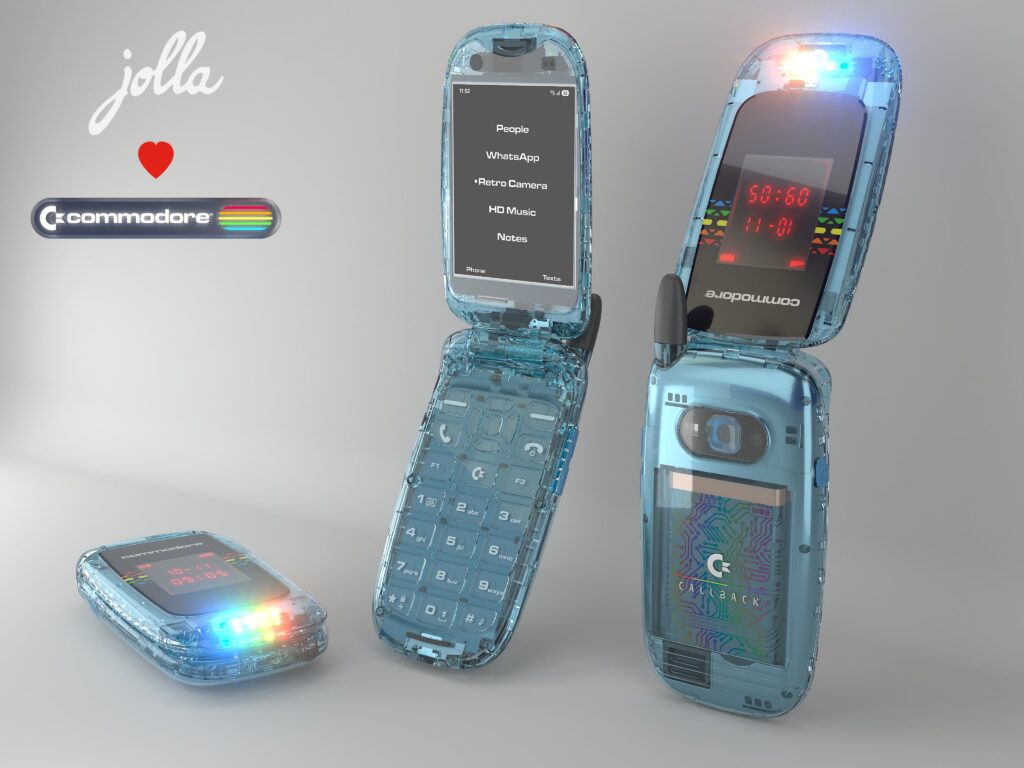
The other unusual part is the design. The translucent Starlight Edition shown in the press images looks like something that could have come from the late 1990s or early 2000s, complete with visible internals and illuminated notification LEDs. Other versions include BASIC Beige, ProtoPET White and SX Silver.
Pricing now starts at $399 before tax. Commodore initially announced higher prices but subsequently reduced the price of the four regular versions to $399. The more elaborate Founders Edition, which includes a 24-karat gold-plated Commodore key and additional accessories, remains considerably more expensive.
Pre-orders are already open. At the time of writing, Commodore’s store lists the current production batch with an estimated December–January shipping window.
At $399, the Callback 8020 is clearly not competing with inexpensive Nokia-style feature phones. It is closer to an intentionally restricted smartphone packaged as a classic flip phone.
And for Nokia fans, that may be the most interesting part of the whole story. More than a decade after Nokia abandoned MeeGo, one branch of that software family is still alive — now powering a transparent Commodore flip phone.
Technology timelines can be wonderfully strange.
Source Jolla


