
Tecno Pova 8 Pro vs Realme 16x 5G: Which Mid-Range Phone Should You Buy?
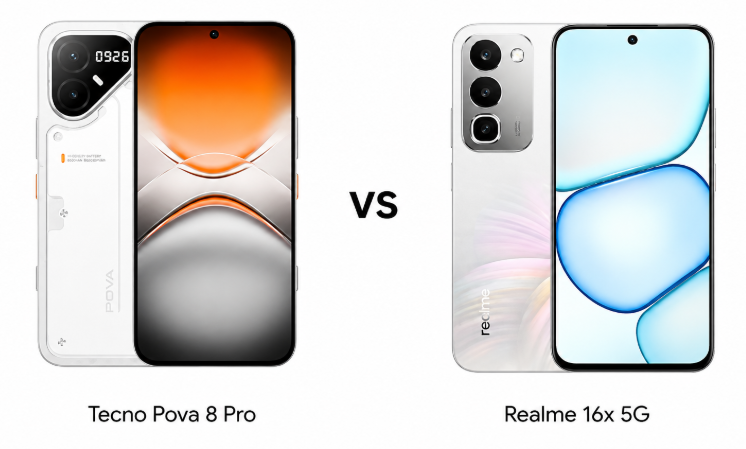
The Tecno Pova 8 Pro and Realme 16x 5G may share a similar broad purpose — offering capable 5G hardware below flagship pricing — but they pursue very different priorities. Tecno is targeting buyers who want a high-refresh-rate AMOLED display, stronger performance, more versatile cameras and premium extras. Realme, meanwhile, focuses on lower cost, a huge battery and practical durability.
The result is not a straightforward winner-takes-all comparison. The Tecno Pova 8 Pro is the more capable and feature-rich phone, but the Realme 16x 5G offers a substantially lower entry price and stronger battery capacity. The right choice depends on whether buyers value performance and display quality more than endurance and affordability.
Tecno Pova 8 Pro vs Realme 16x 5G Specs Compared
Specifications and pricing are based on currently available information. Actual performance, pricing and availability may differ by region and configuration.
Design and durability
Tecno has positioned the Pova 8 Pro as the more premium-looking device. It combines an in-display fingerprint scanner with IP68 and IP69K protection, giving it a higher level of resistance against dust and water than the Realme 16x 5G. The phone also includes a distinctive rear Matrix display, adding a more unconventional visual element to a category where most devices increasingly look interchangeable.
The Realme 16x 5G takes a more practical approach. It carries an IP65 rating, MIL-STD-810H compliance and added drop resistance. It does not match Tecno’s water-protection credentials, but its durability profile could appeal to users who care more about surviving daily knocks and accidental drops than having a decorative rear display.
Tecno wins on premium appeal and stronger protection against water and dust. Realme still deserves credit for offering a more utilitarian durability package.
Display: Tecno has a clear lead
The display is one of the biggest differences between the two phones.
The Tecno Pova 8 Pro uses a 6.78-inch AMOLED panel with a 144Hz refresh rate, HDR support, one billion colours and a claimed peak brightness of up to 4,500 nits. Its 1208 x 2644-pixel resolution should also provide a considerably sharper image than the Realme.
The Realme 16x 5G also supports a 144Hz refresh rate, but it uses a 6.81-inch IPS LCD panel with a 720 x 1570-pixel resolution and up to 1,200 nits of high-brightness mode output.
That means Tecno should offer deeper blacks, higher contrast, more vivid colours and greater detail. The difference will be noticeable in games, video streaming, scrolling, social media and general multimedia use.
For users who spend a lot of time looking at their phone screen, the Pova 8 Pro is clearly the more premium option.
Performance and storage
The Tecno Pova 8 Pro is powered by MediaTek’s 4nm Dimensity 7400 Ultimate chipset, paired with Mali-G615 graphics and up to 12GB of RAM. Storage reaches up to 512GB.
By comparison, the Realme 16x 5G uses the older 6nm Dimensity 6300 chipset with Mali-G57 graphics, up to 6GB of RAM and up to 256GB of internal storage. It does, however, include microSD expansion, which may matter to buyers who need inexpensive additional storage.
Tecno’s hardware gives it a substantial advantage in demanding games, multitasking, image processing and heavier applications. More RAM and a newer processor should also make it the more convincing option for buyers who plan to keep their phone for several years.
The Realme is still likely to be capable for basic use, including messaging, social media, web browsing, video playback and everyday apps. But it is not designed to compete with the Pova 8 Pro on raw speed.
Battery and charging
This is the area where Realme pushes back.
The Realme 16x 5G has a 7,000mAh battery, giving it a 500mAh capacity advantage over Tecno’s 6,500mAh cell. For users who want maximum endurance, particularly those who travel often or spend long days away from a charger, Realme has the stronger headline specification.
Both phones support 45W wired charging, but Tecno offers more charging flexibility. The Pova 8 Pro supports 50W wired reverse charging and bypass charging, allowing the phone to power other devices or run demanding tasks while reducing battery stress during charging.
Realme supports 45W PPS charging and 7W reverse charging, which is useful but considerably less ambitious than Tecno’s setup.
The Realme 16x 5G is the better pick for buyers who simply want the largest possible battery. Tecno is the stronger choice for users who want more versatile charging tools, especially gamers and power users.
Cameras: Tecno offers more flexibility
The Tecno Pova 8 Pro has a more complete camera system. Its 50MP main camera includes optical image stabilisation and dual-pixel PDAF, while an 8MP ultra-wide camera adds flexibility for landscapes, group photos and wider scenes.
The Realme 16x 5G also has a 50MP main camera with autofocus, but it does not include either OIS or an ultra-wide lens. That makes its camera hardware more limited, particularly in low-light conditions and video recording.
Tecno’s OIS should help reduce blur in handheld shots and stabilise footage. The added ultra-wide camera also makes the Pova 8 Pro more useful for people who want more than a basic single-camera experience.
The difference continues at the front. Tecno includes a 13MP selfie camera, compared with an 8MP front camera on the Realme. While megapixel counts alone do not guarantee better results, Tecno’s front camera should offer more detail for selfies, video calls and social content.
Software and extras
Both phones run Android 16, with Tecno using HiOS 16 and Realme offering Realme UI 7.0. The preferred interface will mostly come down to personal taste, app features and brand ecosystem preferences.
Tecno has the more generous hardware package, adding stereo speakers, Dolby Atmos, Hi-Res audio certification, NFC, an infrared blaster, Wi-Fi 6 and Bluetooth 5.4.
The Realme 16x 5G uses a single loudspeaker, lacks NFC and infrared support, and uses older Wi-Fi 5 and Bluetooth 5.3 standards. These are not deal-breakers at its price level, but they reinforce the fact that Tecno is targeting a more demanding buyer.
Price and value
The biggest advantage for Realme is price.
The Realme 16x 5G is listed at approximately $310 or Rs 26,000, while the Tecno Pova 8 Pro costs around $530 or Rs 50,000. That is a difference of roughly $220, or about Rs 24,000.
Realme’s pricing makes it an obvious choice for budget-conscious buyers who want a large battery, 5G connectivity, basic reliability and expandable storage without paying for flagship-style extras.
Tecno costs substantially more, but it also includes a much better display, stronger chipset, more RAM, more internal storage, better cameras, superior water resistance, better audio and more connectivity options. For users who will take advantage of those features, the premium is easier to justify.
Which phone should you buy?
Choose the Tecno Pova 8 Pro if you want:
-
A sharper 144Hz AMOLED display
-
Stronger gaming and multitasking performance
-
More RAM and larger internal storage options
-
OIS, an ultra-wide camera and a higher-resolution selfie camera
-
IP68/IP69K protection
-
Stereo speakers, NFC, infrared and newer connectivity standards
-
Bypass charging and powerful reverse charging
Choose the Realme 16x 5G if you want:
-
A significantly lower purchase price
-
The larger 7,000mAh battery
-
Expandable microSD storage
-
A durable everyday phone with MIL-STD-810H compliance
-
Basic 5G performance without paying for premium extras
Final verdict
The Tecno Pova 8 Pro is the better overall smartphone. It offers a substantially stronger display, faster hardware, more camera flexibility, better connectivity and a more premium feature set. It is the clear choice for buyers who prioritise gaming, multimedia, photography and long-term performance.
The Realme 16x 5G wins on affordability and battery capacity. It is better suited to buyers who want reliable everyday performance, a huge battery and lower upfront cost.
Put simply, Tecno delivers more phone, while Realme delivers more battery for less money.


