
Minecraft Pixel Circle Generator: Create Circle Designs
Pixel art and circular builds share the same problem in Minecraft: the block grid fights you. Straight lines are easy. Curves require planning. The right tool makes both feel the same.
What Makes Pixel Circles Different From Regular Circles
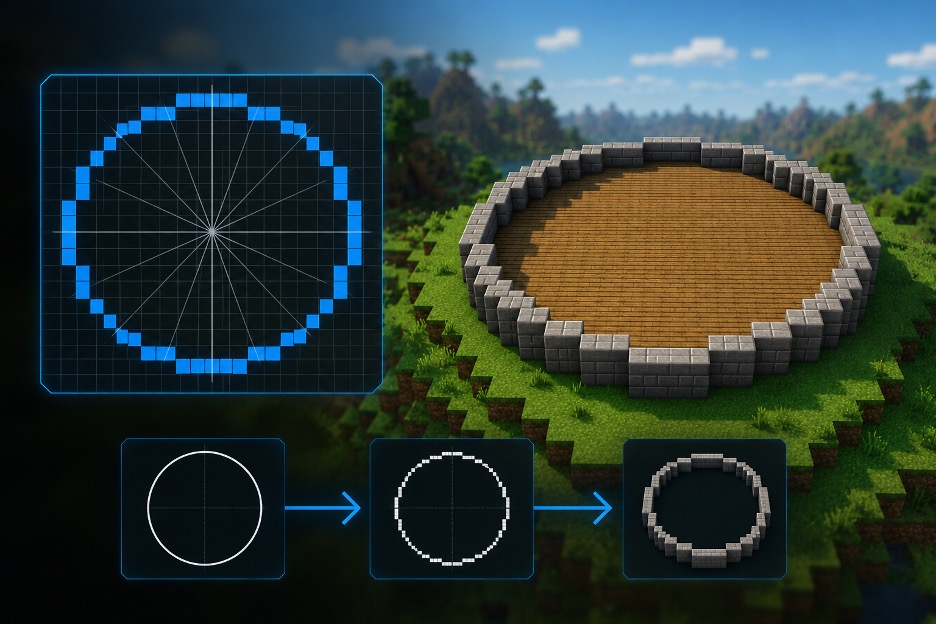
A pixel circle is a specific type of circle approximation designed for grid-based environments. Unlike a true mathematical circle, it uses stepped blocks to create the impression of a curve.
The generator uses a Bresenham-style algorithm to determine which blocks in the grid form the best approximation. The result is a circle pattern that reads as round from normal viewing distance — which is how it works in Minecraft at any scale. PCMag’s guide-tool coverage has flagged pixel-approximation generators like this as some of the more genuinely time-saving utilities in the building-game space, since the alternative — manual row-by-row calculation — scales badly once diameters climb past 20 or 30 blocks.
Circle Pattern Options the Generator Supports
A good minecraft pixel circle generator turns any diameter into a precise block pattern. No estimation, no rebuilding, no wasted materials. Just a clean circle design minecraft you can follow directly. Most builds need one of a handful of specific variants:
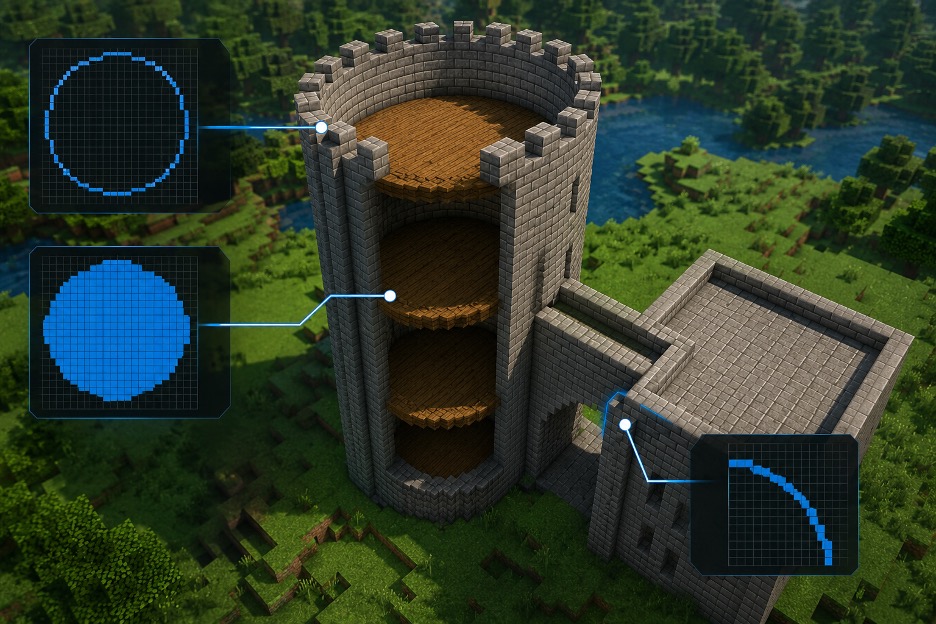
- Outline only — just the border, for walls and towers
- Filled — solid circles for floors and platforms
- Half circle — for arches, alcoves, and domed ceilings
- Quarter circle — for corners in rounded rectangular builds
- Ellipse — for oval shapes when a perfect circle is too wide
Switching between these in the generator takes one click. The circle design minecraft you need is usually one of these five variants.
Using Circle Designs Minecraft for Different Projects
Circle designs minecraft builders use tend to fall into a few recurring categories.
Towers are the most common. A round tower looks more organic than a square one and fits naturally into landscape builds. Diameters between 15 and 30 work best for structural towers with interior space.
Arenas use large circles — typically 50 blocks and above — to create fighting spaces that feel proportional. The generator handles these sizes without any quality loss.
Decorative elements like windows, floor medallions, and portal frames use smaller circles, usually between 5 and 12 blocks. Even at small sizes the generator keeps the shape consistent.
Minecraft circle patterns also appear in roads, courtyards, and garden designs. Any curved feature benefits from a generator rather than freehand guessing.
Combining Variants in a Single Build
The five pattern variants aren’t mutually exclusive within one project. A round tower might use an outline circle for the outer wall, a filled circle for the floor at each level, and a quarter circle where it connects to an adjoining rectangular structure. Planning all three ahead of time, rather than generating them one at a time mid-build, keeps the proportions consistent — a floor generated at a slightly different diameter than the wall it sits inside will either leave a gap or clip through the blocks, and that’s a much more annoying fix after the fact than it is to plan for up front.
Big Pattern Builds and Server Performance
Large circle designs involve a lot of simultaneous block placements. In survival, that’s manual work. On creative servers, players sometimes use build tools that place blocks faster — which increases server load dramatically.
Builder and architect Grian, one of Minecraft’s most-watched content creators, has said that the difference between a good build and a great one is “planning the shape before placing the first block.” The generator is that planning step.
Have the pattern ready. Make sure the server can handle it when the blocks go down.


