
iPhone Duo vs. Xiaomi 18 Fold: The Ultimate Specs & Price Comparison
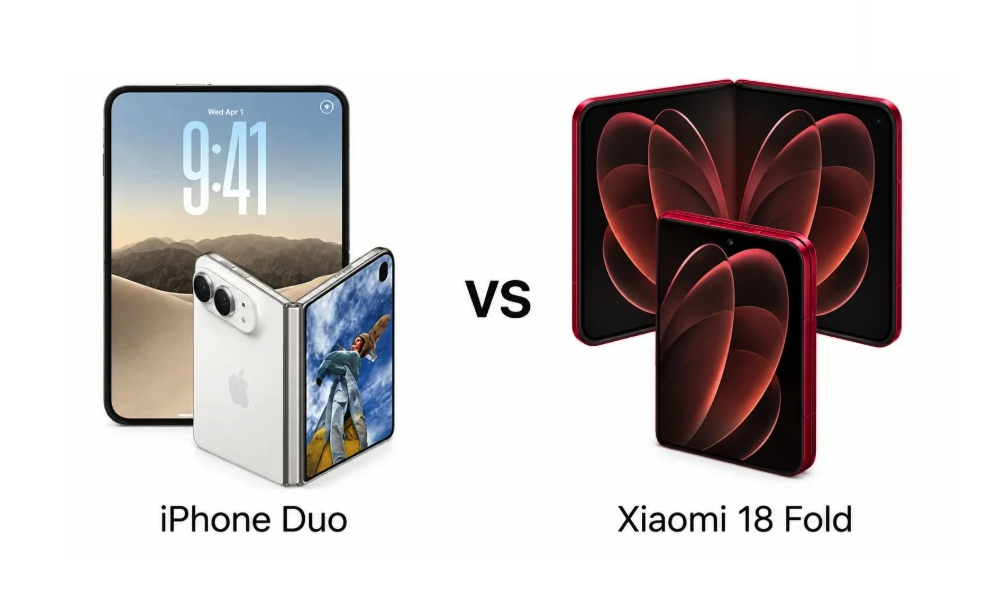
The foldable smartphone arena has a new heavyweight rivalry: the iPhone Duo and the Xiaomi 18 Fold. These two flagship devices represent vastly different philosophies in mobile engineering. Apple leans into its signature ecosystem, prioritizing luxury materials, seamless software integration, and top-tier video capabilities. Xiaomi, conversely, flexes its hardware muscle, delivering a spec-sheet powerhouse featuring a massive battery, lightning-fast charging, and a versatile Leica-branded camera array.
With a substantial price gap separating the two, this clash is about more than just form factor—it is a battle of raw value versus refined ecosystem integration.
iPhone Duo vs. Xiaomi 18 Fold Specifications
| Feature | iPhone Duo | Xiaomi 18 Fold | Advantage |
| Build Materials | Titanium frame, Ceramic Shield, IP68, stylus support | Dragon Crystal Glass 3, aluminium frame, IP58/IP59 | Apple (Durability & water resistance) |
| Inner Display | 7.6″ LTPO OLED, 120Hz, nano-texture anti-reflective | 7.58″ LTPO AMOLED, 120Hz, 4000-nit peak brightness | Xiaomi (Brightness & resolution) |
| Cover Display | 5.4″ LTPO OLED, 120Hz, Dolby Vision | 5.38″ LTPO AMOLED, 120Hz, Dolby Vision | Apple (Pixel density & anti-reflective) |
| Processor | A20 Pro (2nm) | XRing O3 (3nm) | Apple (Fabrication & efficiency) |
| Memory/Storage | 12GB RAM, up to 2TB | Up to 16GB RAM, 1TB, UFS 4.1 | Xiaomi (RAM & storage speed) |
| Rear Cameras | 48MP Wide + 48MP Ultrawide | 200MP Wide + 50MP Ultrawide + 50MP 3x Telephoto | Xiaomi (Versatility & optical zoom) |
| Video Recording | Up to 4K 120fps, ProRes, Spatial Video | Up to 8K 24fps, 4K 60fps | Apple (Professional video features) |
| Selfie Cameras | Under-display (inner), 12MP (cover) | 16MP (inner), 16MP (cover) | Apple (Unobtrusive design & 4K video) |
| Battery & Charging | Li-Ion, 25W wireless, MagSafe | 6000mAh, 67W wired, 50W wireless | Xiaomi (Capacity & charging speed) |
| Estimated Price | ~$2,000 / ₹3,00,000 | ~$1,600 / ₹1,55,000 | Xiaomi (Overall value) |
Design and Display: Tactile Luxury vs. Vibrant Brilliance
Apple’s iPhone Duo takes an uncompromising, premium-first approach. Encased in a titanium frame and protected by Ceramic Shield glass, it offers robust IP68 water and dust resistance. Notably, its 7.6-inch LTPO OLED inner panel features a nano-textured, anti-reflective coating, making it exceptionally readable in harsh lighting. The addition of stylus support further positions it as a serious productivity tool.
Xiaomi counters with a lighter, slightly more conventional approach, utilizing an aluminum frame and Dragon Crystal Glass 3. While its IP58/IP59 rating is slightly less comprehensive than Apple’s, the Xiaomi 18 Fold makes up ground with a dazzling 7.58-inch inner AMOLED display that pushes peak brightness to an astonishing 4,000 nits.
The Verdict: While Xiaomi dominates in raw brightness and resolution, Apple delivers a more refined tactile experience. The iPhone Duo’s glare-reducing matte finish, titanium build, and superior water resistance make it feel like the more polished physical product.
Performance and Endurance: Silicon Efficiency vs. Brute Force
Under the hood, the iPhone Duo is powered by Apple’s cutting-edge 2nm A20 Pro chip. Paired with up to 2TB of storage and 12GB of RAM, this silicon marvel relies on the tight integration of iOS 27 to deliver sustained efficiency and fluid multitasking.
Xiaomi takes the brute-force route. The 18 Fold utilizes the 3nm XRing O3 processor, bolstered by up to a massive 16GB of RAM and ultra-fast UFS 4.1 storage. However, the true differentiator lies in battery tech. Xiaomi manages to cram a staggering 6,000mAh silicon-carbon battery into the 18 Fold’s chassis, supporting rapid 67W wired and 50W wireless charging. Apple’s battery relies on standard PD3.2 wired charging (hitting 50% in 20 minutes) and 25W MagSafe.
The Verdict: Apple wins the architectural race with its 2nm silicon, but Xiaomi is the undeniable champion for power users. The 18 Fold’s massive battery capacity and blazing-fast charging speeds offer significantly more practical endurance.
The Imaging Arsenal: Pro Video vs. Leica Versatility
Camera philosophies diverge sharply here. Apple equips the iPhone Duo with a dual 48MP setup (wide and ultrawide), leaning heavily into its computational photography and industry-leading video capabilities. With support for 4K Dolby Vision at 120fps, ProRes, and Spatial Video, it is a content creator’s dream. Furthermore, Apple implements an under-display camera on the inner screen, allowing for an uninterrupted, notch-free canvas.
Xiaomi opts for sheer photographic versatility. The 18 Fold boasts a triple-camera Leica system anchored by a massive 200MP main sensor, complemented by a 50MP ultrawide and a crucial 50MP 3x optical telephoto lens. While its selfie cameras are capped at 1080p, the rear setup supports 8K video recording and laser autofocus.
The Verdict: Photographers will favor the Xiaomi 18 Fold for its dedicated optical zoom and Leica color science. Videographers, however, will find the iPhone Duo’s ProRes support, superior stabilization, and clean under-display inner camera impossible to pass up.
iPhone Duo vs. Xiaomi 18 Fold: Pricing and Final Verdict
The market positioning of these devices makes the purchasing decision relatively straightforward. At an estimated $2,000, the iPhone Duo commands an ultra-premium “Apple Tax.” It justifies this cost through titanium construction, satellite SOS capabilities, an unparalleled video engine, and frictionless integration into the broader Apple ecosystem.
Priced around $1,600, the Xiaomi 18 Fold operates in a different reality. It undercuts Apple by a wide margin while offering more RAM, a larger battery, faster charging, and a superior triple-camera system.
Ultimately, the Xiaomi 18 Fold is the clear winner for hardware value. It delivers a broader, more practical feature set that gives buyers significantly more specifications per dollar. However, for users already entrenched in iOS, or those who prioritize premium build materials and professional-grade video, the iPhone Duo remains an undeniably compelling—if expensive—luxury.
(Disclaimer: Prices, specifications, and availability are based on pre-release data and may vary by region. Readers are encouraged to verify current market specifications before purchasing.)


