
Snapdragon 8 Elite Gen 5 vs Tensor G6: Specs, Benchmarks, and Features
With the launch of the highly anticipated Pixel 11 series, Google has officially unveiled the Tensor G6. Bringing serious architectural upgrades over last year’s iteration—including ARM’s latest C1-Ultra and C1-Pro cores, a revamped Tensor Processing Unit (TPU), and next-generation imaging pipelines—the new chip aims to redefine the AI smartphone experience.
However, Qualcomm’s Snapdragon processors have historically dominated the Android ecosystem with sheer, brute-force performance. As the Snapdragon 8 Elite Gen 5 continues to power rival flagships, the inevitable question arises: Has Google finally closed the performance gap, or is Qualcomm still the undisputed king of raw power?
Here is a deep dive into how the Tensor G6 stacks up against the Snapdragon 8 Elite Gen 5 on paper, in benchmarks, and in real-world philosophy.
Spec Sheet Comparison
Before diving into performance metrics, let’s look at the underlying hardware driving these two flagship processors. Both are built on TSMC’s cutting-edge 3nm process, but their architectural approaches differ wildly.
|
Tensor G6 |
Snapdragon 8 Elite Gen 5 |
|
|
Announced |
August 2026 |
September 2025 |
|
Process node |
3nm (TSMC) |
3nm (TSMC) |
|
CPU |
1 x 4.11 GHz (C1-Ultra) 4 x 3.38 GHz (C1-Pro) 2 x 2.65 GHz (C1-Pro) |
2 x 4.61 GHz (Oryon Gen 3 Prime) 6 x 3.63 GHz (Oryon Gen 3 Performance) |
|
GPU |
PowerVR CXTP-48-1536 |
Adreno 840 Ray tracing support Snapdragon Elite Gaming features |
|
NPU |
5th-gen Tensor Processing Unit (TPU) |
Qualcomm Hexagon NPU |
|
Memory |
LPDDR5X |
LPDDR5X up to 5.3 GHz |
|
Storage |
UFS 4.0, UFS 4.1 |
UFS 4.0, UFS 4.1 |
|
Camera |
up to 200MP single camera 4K portrait video support up to 8K video recording at 30fps up to 4K video recording at 120fps 120x Pro Zoom support real-time semantic segmentation |
Qualcomm Spectra Triple ISP (20-bit) up to 320MP single camera up to 8K video recording at 60fps up to 4K video recording at 120fps real-time semantic segmentation (limitless) Advanced Professional Video (APV) codec |
|
Connectivity |
MediaTek M90 5G modem up to 12 Gbps download speed Wi-Fi 7 Bluetooth 6.0 |
Snapdragon X85 5G modem up to 12.5Gbps download speed up to 3.7Gbps upload speed Wi-Fi 7 (peak speed: 5.8Gbps) Bluetooth 6.0 |
The Benchmark Battle: Raw Power vs. Reality
To see how these chips handle heavy lifting, we look at synthetic benchmarks comparing the Tensor G6-powered Pixel 11 Pro XL against the Snapdragon 8 Elite Gen 5-powered Galaxy S26 Ultra.
Geekbench 6 (CPU Performance)
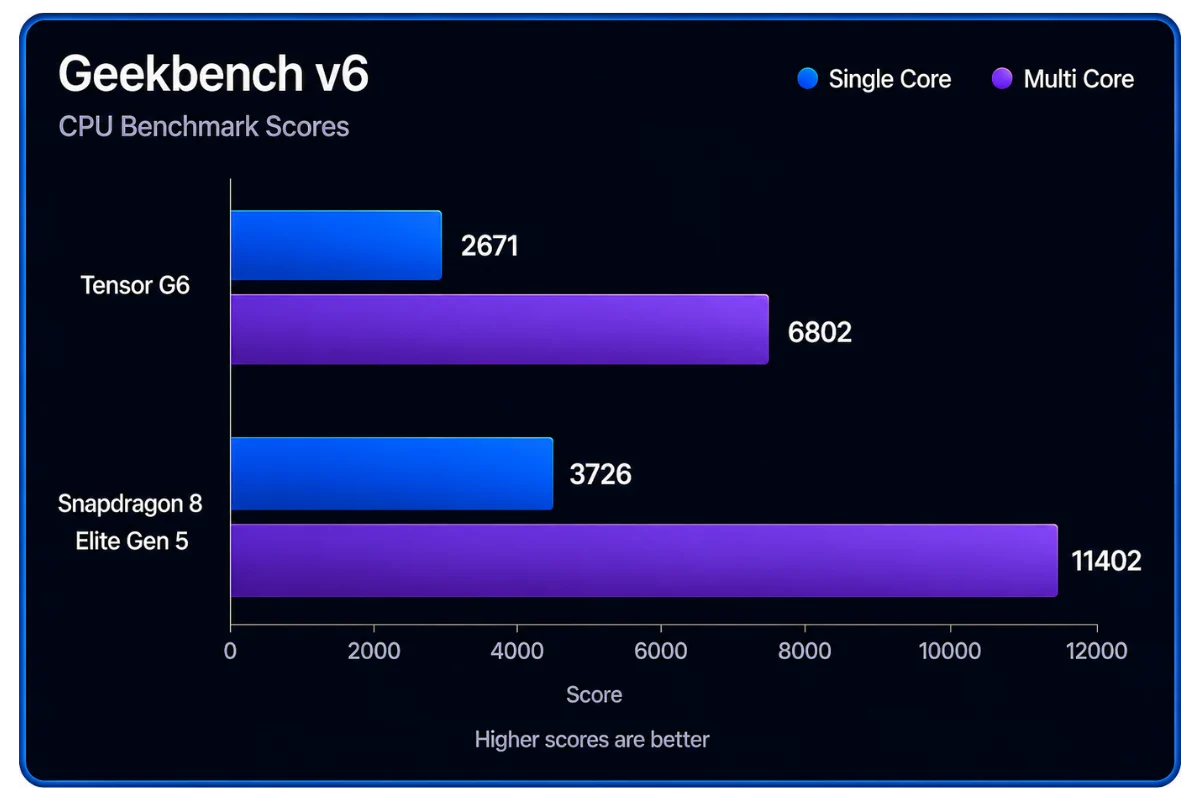
Geekbench evaluates the sheer processing power of the CPU. The Snapdragon 8 Elite Gen 5 maintains a commanding lead, outperforming the Tensor G6 by 39% in single-core tasks and a staggering 67% in multi-core workloads.
|
Tensor G6 |
Snapdragon 8 Elite Gen 5 |
|
|
Single core |
2671 |
3726 |
|
Multi core |
6802 |
11402 |
AnTuTu v11 (Overall System Performance)
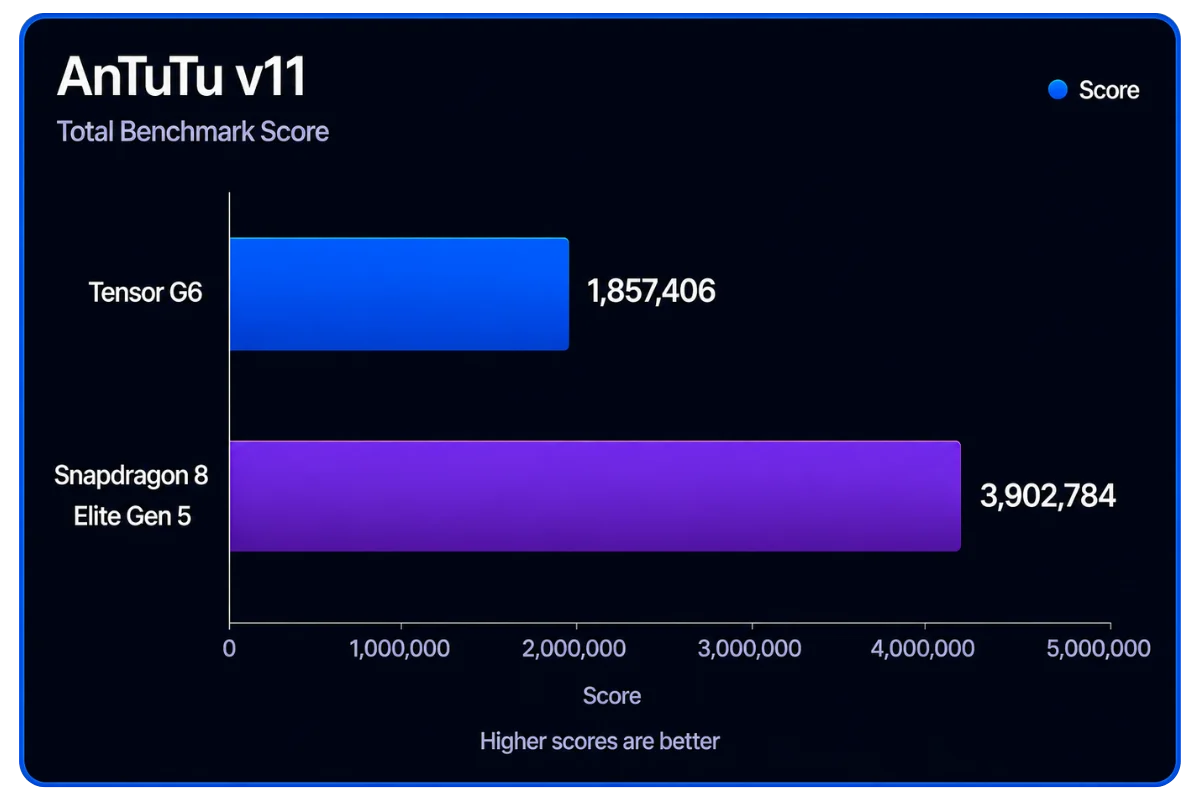
AnTuTu tests everything from CPU and GPU to memory and User Experience (UX). Here, Qualcomm’s chip scores nearly 3.9 million points, leaving the Tensor G6 trailing at 1.8 million—a massive 110% overall performance boost for Snapdragon. The GPU delta is the most striking, with the Snapdragon pulling ahead by an eye-watering 263%, clearly marking it as the superior choice for high-end mobile gaming.DMark Wild Life Extreme Stress Test (Graphical Stability)
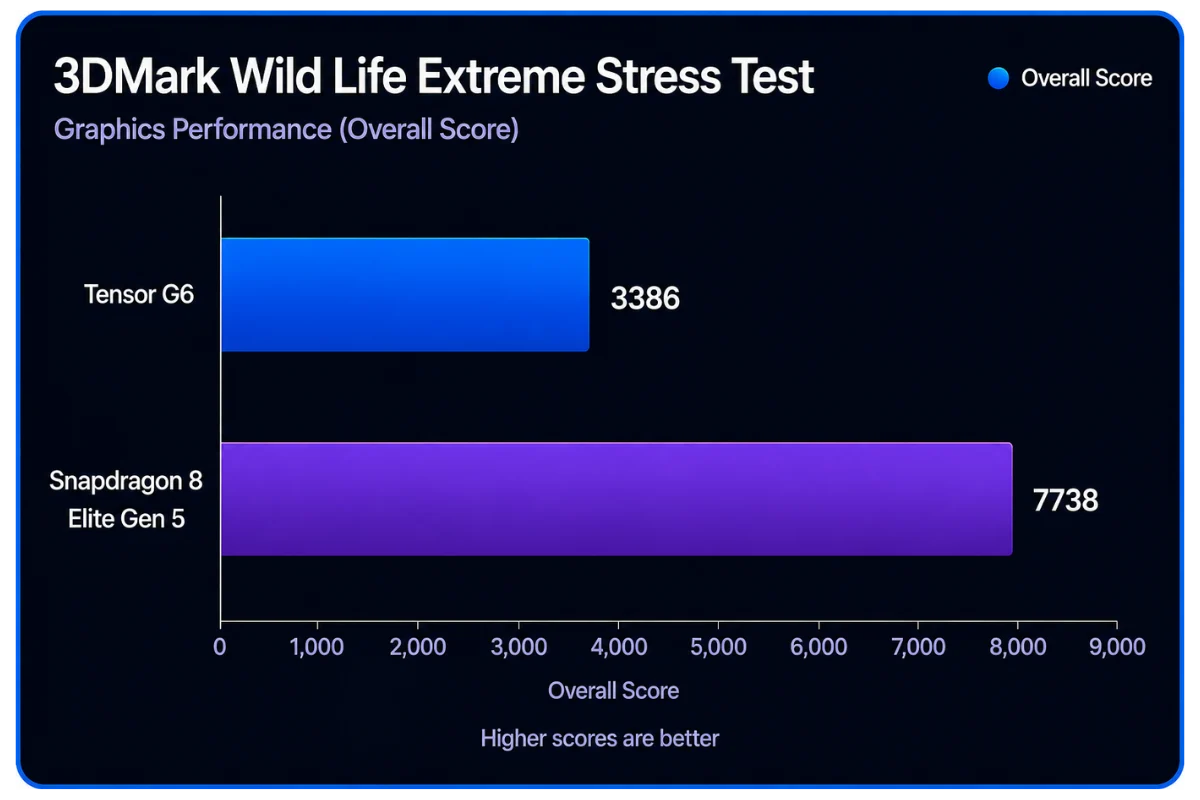
This test measures how well a device sustains graphical performance and manages heat over time. The Snapdragon 8 Elite Gen 5 achieved a score over 128% higher than the Tensor G6, while maintaining an average frame rate more than twice as high.
| Processor | Overall Score | Average FPS |
| Tensor G6 | 3,386 | 20.31 |
| Snapdragon 8 Elite Gen 5 | 7,738 | 46.34 |
Why Google Doesn’t Care About Benchmarks
Looking purely at the numbers, the Tensor G6 appears drastically outgunned. However, Google is entirely comfortable with this discrepancy.
The tech giant has explicitly stated that Tensor silicon is not engineered to win synthetic benchmark wars against Qualcomm or Apple. Instead of chasing maximum single-core clock speeds, Google prioritizes heterogeneous computing. This design philosophy ensures that the CPU, GPU, Image Signal Processor (ISP), and TPU work in harmony to execute specific, complex tasks hyper-efficiently.
The true beating heart of the Tensor G6 is its 5th-generation Tensor Processing Unit (TPU). This purpose-built neural engine is what allows the Pixel 11 series to run complex AI models locally on the device. It is the invisible force behind Google’s celebrated “software magic,” powering features like Live Translate, Magic Eraser, Real Tone computational photography, and on-device generative AI.
Which Processor is Right for You?
Choosing between these two chips ultimately comes down to what you value most in a smartphone.
-
Choose the Snapdragon 8 Elite Gen 5 if you demand uncompromising raw power, sustained high-framerate gaming, and the fastest rendering speeds available.
-
Choose the Tensor G6 if you prioritize a deeply integrated, highly intelligent user experience, unmatched computational photography, and intuitive AI assistants that make daily tasks seamless.
Leading Tensor G6 Devices:
-
Google Pixel 11
-
Google Pixel 11 Pro
-
Google Pixel 11 Pro XL
-
Google Pixel 11 Pro Fold
Leading Snapdragon 8 Elite Gen 5 Devices:
-
Samsung Galaxy S26 Ultra
-
Oppo Find X9 Ultra
-
Vivo X300 Ultra
-
Xiaomi 17 Ultra
-
iQOO 15 Ultra


