
iPhone 18 Pro Max vs. Google Pixel 11 Pro XL: The $1,300 Flagship Showdown
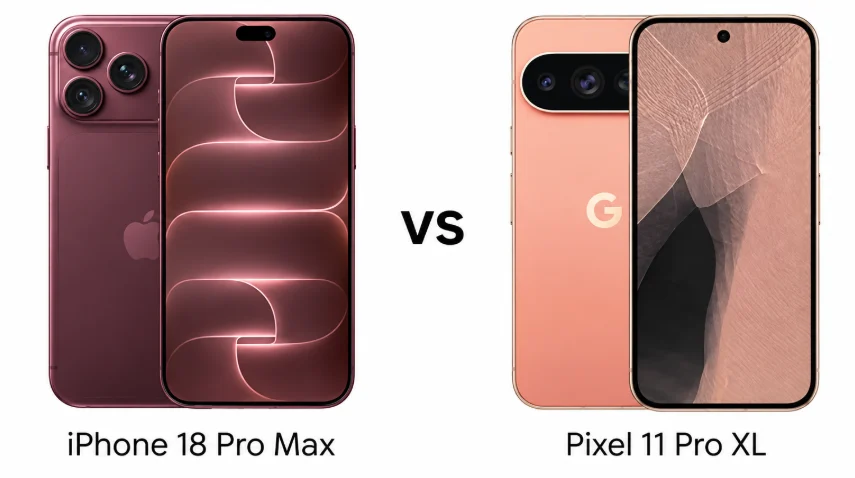
The ultimate smartphone battle lines have been drawn. The iPhone 18 Pro Max and the Google Pixel 11 Pro XL both demand roughly $1,300 of your hard-earned cash, but their philosophies couldn’t be more different.
Apple remains hyper-focused on raw silicon performance, elite video production, and its impenetrable ecosystem. Google, on the other hand, leans heavily into its computational photography magic, AI-driven daily conveniences, and the flexible freedom of the Android platform.
When you are dropping this much money on a device meant to last for years, nuance matters. Here is our definitive breakdown of how these two heavyweights stack up.
Design and Display: Durability Meets Dazzling Brightness
Build Quality Both devices are undeniable premium glass-and-metal sandwiches, but Apple goes the extra mile for durability. The iPhone 18 Pro Max is clad in Apple’s proprietary Ceramic Shield 2 on both the front and back, wrapped in an aluminum frame, and boasts an IP68 rating designed to survive deeper water immersion than its rival.
The Pixel 11 Pro XL utilizes the excellent—but slightly more common—Gorilla Glass Victus 2 alongside its own aluminum frame and IP68 rating. The Pixel feels distinctly like a Google device, carrying forward its signature camera visor styling, but Apple’s materials give it a slightly more rugged, confidence-inspiring feel for daily use.
Display Quality When it comes to screen technology, both deliver massive, gorgeous 120Hz LTPO OLED canvases. The iPhone brings a 6.9-inch Super Retina XDR display equipped with Dolby Vision and a staggering 3,000 nits of peak brightness.
Not to be outdone, Google counters with a 6.8-inch display that boasts HDR10+ and claims a searing peak brightness of 3,600 nits. If you spend a lot of time consuming HDR content or working in direct, glaring sunlight, the Pixel holds a slight visibility edge.
Performance and Battery: Brute Force vs. Smart Software
The Silicon Race This is where the two philosophies diverge sharply. The iPhone 18 Pro Max is powered by the A20 Pro, fabricated on an ultra-efficient 2nm process, and paired with 12GB of RAM. It is a brute-force monster, designed for sustained heavy workloads, high-end gaming, and on-device video rendering.
The Pixel 11 Pro XL relies on the 3nm Tensor G6 chip, backed by up to a massive 16GB of RAM. Google isn’t trying to win synthetic benchmark wars against Apple. Instead, the Tensor chip is custom-built to effortlessly handle Google’s complex computational photography and on-device AI tasks.
Battery and Charging Apple has prioritized burst charging this generation, allowing the iPhone to hit 50% capacity in just 15 minutes, alongside 25W MagSafe wireless charging. Google’s 5,115mAh battery takes a slightly different approach, hitting 75% in 30 minutes via 45W wired charging. Crucially, the Pixel adds highly practical features like reverse wireless charging and bypass charging (which powers the phone directly from the wall to reduce heat during gaming).
Cameras: The Studio vs. The Photographer
The Lens Loadout Apple has unified its rear camera system into a triple 48MP array (Main, Ultrawide, and a 4x periscope telephoto). Google answers with a 50MP main sensor paired with a 48MP ultrawide and a 48MP periscope lens capable of a longer 5x optical reach.
Photography vs. Video If still photography is your priority, the Pixel remains incredibly compelling. Its longer native zoom, combined with Google’s legendary computational tricks like Ultra-HDR, Best Take, and Zoom Enhance, make it a point-and-shoot dream.
However, if you shoot video, the iPhone is arguably the only choice. With support for 4K at 120fps, ProRes RAW, Apple Log 2, and Dolby Vision, the iPhone 18 Pro Max isn’t just a phone; it is a legitimate B-camera for professional film production. Furthermore, Apple brings those professional video tools to its 18MP selfie camera, easily outpacing the video capabilities of Google’s high-resolution 42MP front-facing shooter.
Pricing and Value
In the United States, both phones occupy the same $1,300 premium tier. However, international pricing dramatically shifts the value equation. In markets like India, the Pixel 11 Pro XL (approx. ₹135,000) significantly undercuts the iPhone 18 Pro Max (approx. ₹180,000).
If you are buying outside the US, the Pixel offers a vastly more accessible entry point to flagship features, making it the undisputed value champion in those regions.
iPhone 18 Pro Max vs. Pixel 11 Pro XL: The Winner/Loser Breakdown
-
Build and Durability: Winner — iPhone 18 Pro Max. Ceramic Shield 2 provides superior peace of mind.
-
Raw Performance: Winner — iPhone 18 Pro Max. The 2nm A20 Pro chip is a benchmarking beast.
-
Video Recording: Winner — iPhone 18 Pro Max. ProRes RAW, Apple Log 2, and Dolby Vision make it the undisputed king of mobile video.
-
Still Photography: Winner — Pixel 11 Pro XL. A longer 5x optical zoom and Google’s superior AI computational photography take the crown.
-
Software Updates: Winner — Pixel 11 Pro XL. Google explicitly promises 7 major OS updates, offering incredible long-term peace of mind.
-
Overall Value (Global Markets): Winner — Pixel 11 Pro XL. Significantly cheaper pricing outside the US makes Google’s flagship a smarter financial decision for international buyers.
-
Overall Champion: Winner — iPhone 18 Pro Max. While the Pixel puts up a valiant fight and wins on value, the iPhone’s superior silicon, unmatched video capabilities, and polished ecosystem make it the most complete premium package on the market today.


