
Nokia Unveils New AI Strategy and Restructuring

Nokia held its Capital Markets Day 2025 today and announced a major shift in strategy as the company prepares for what it calls the AI supercycle. The Finnish networking giant is reorganising its business, setting new long-term financial goals, and reshaping its leadership team to strengthen its position in the fast-growing AI and cloud era.
A simpler Nokia: two main business segments from 2026
To move faster and serve customers more effectively, Nokia will streamline its entire structure into two primary operating segments starting 1 January 2026:
1. Network Infrastructure
This becomes Nokia’s main growth engine, driven by surging global demand for data centres, cloud infrastructure, and high-capacity optical and IP networks.
The segment will include:
- Optical Networks
- IP Networks
- Fixed Networks
This segment will continue to be led by David Heard.
2. Mobile Infrastructure
This new segment brings together:
- Core Networks
- Radio Networks
- Technology Standards (formerly Nokia Technologies)
It will focus on AI-native mobile networks and the path toward 6G, backed by strong licensing revenues. Nokia CEO Justin Hotard will lead it on an interim basis.
“Connecting intelligence”: Nokia’s new strategic priorities
Nokia says its next chapter is about enabling AI-driven connectivity. The company has set five strategic pillars:
- Accelerate growth in AI & cloud
- Lead the next era of mobile connectivity with AI-native networks and 6G
- Co-innovate with customers and partners
- Focus investments only where Nokia can differentiate
- Deliver sustainable long-term returns
Non-core units moved to a new Portfolio Businesses segment
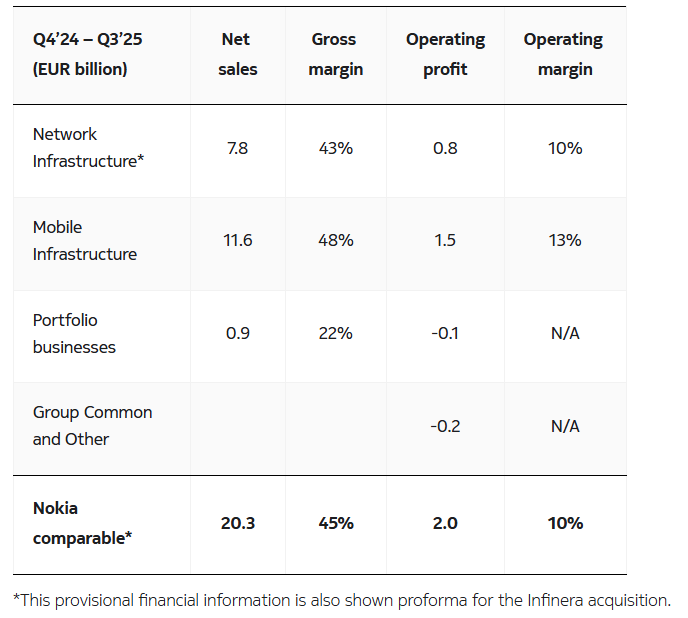
After reviewing its entire portfolio, Nokia identified several units that are not essential for its future strategy. These will be placed into a separate segment called Portfolio Businesses while Nokia evaluates options such as partnerships, restructuring, or divestment.
Units moved into this category include:
- Fixed Wireless Access CPE
- Site implementation & outside plant services
- Enterprise campus edge solutions
- Microwave radio
Together these generated about €0.9 billion in revenue in the last 12 months but also a small operating loss.
Nokia launches dedicated defense unit
Nokia is also creating Nokia Defense, an incubation unit focused on defence-grade solutions based on Nokia’s core technologies. The company sees growth opportunities in the US, Finland, and allied countries.
New financial targets: more profit by 2028
Nokia’s new long-term goal is to grow its comparable operating profit from €2.0 billion today to €2.7–3.2 billion by 2028.
Other key targets include:
- Network Infrastructure: 6–8% annual sales growth
- Mobile Infrastructure: 48–50% gross margin
- Group-level operating expenses reduced from €350M → €150M
- Free cash flow conversion of 65–75%
Leadership changes from 1 January 2026:
- Raghav Sahgal becomes Chief Customer Officer
- Patrik Hammarén continues as President of Technology Standards
- Tommi Uitto will step down from the Group Leadership Team
What this means?
Nokia is entering (again, for the third time since 2014) a multi-year transformation that aims to simplify the organisation, cut costs, focus on the most profitable technologies, and prepare for an AI-driven networking future. The company expects this new setup to create a stronger, more focused Nokia ready to lead the next era of connectivity.


