
Are You Paying $1,300 Just for a Hinge? iPhone Duo vs. iPad Mini 8 Comparison
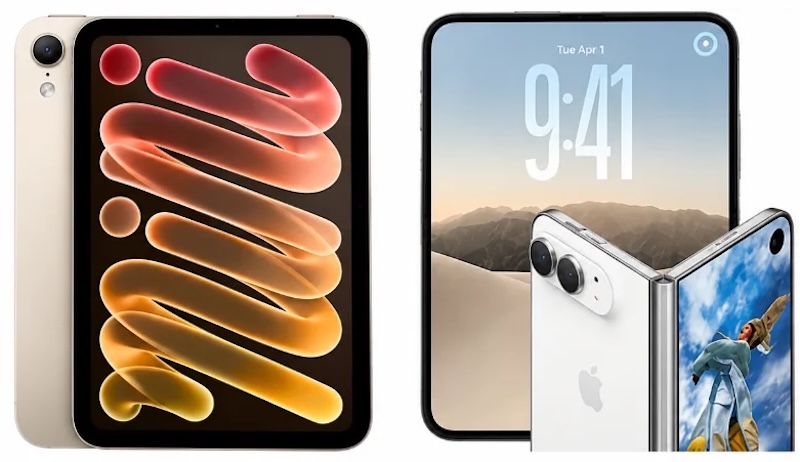
Apple’s mobile lineup now presents buyers with a fascinating ergonomic and financial dilemma. For $700, the iPad Mini 8 delivers a pure, flagship-tier tablet experience wrapped around an 8.5-inch OLED display. For nearly three times that price, the $2,000 iPhone Duo folds a comparable workspace into a pocketable smartphone.
While their primary screens and overall weights are surprisingly similar, their practical purposes are entirely different. One maximizes the potential of a dedicated secondary device, while the other attempts to consolidate your digital life into a single piece of hardware.
Here is how Apple’s compact tablet and premium foldable stack up on paper and in practice.
| Feature | iPad Mini 8 | iPhone Duo |
| Design | Compact tablet, 5.4mm thin | Foldable, 5.2mm unfolded / 11.3mm folded |
| Weight | 255g (Wi-Fi) / 263g (Cellular) | 254g |
| Main Display | 8.5-inch OLED, 1200 nits peak | 7.6-inch foldable OLED, 3000 nits peak |
| Cover Display | — | 5.4-inch OLED, 120Hz |
| Processor | Apple A20 Pro, 2nm | Apple A20 Pro, 2nm |
| RAM | 12GB | 12GB |
| Storage | 128GB / 256GB / 512GB | 256GB / 512GB / 1TB / 2TB |
| Rear Cameras | 12MP wide | 48MP wide + 48MP ultrawide |
| Front Cameras | 12MP ultrawide | 4MP under-display + 12MP cover camera |
| Video | Up to 4K 60fps | Up to 4K 120fps, Dolby Vision, ProRes |
| Battery | 4900mAh | 4883mAh |
| Charging | 50% in 30 minutes | 50% in 20 minutes, 25W wireless |
| Connectivity | Wi-Fi 7, Bluetooth 6.0, cellular option | 5G, Wi-Fi 7, Bluetooth 6.0, NFC, UWB |
| Durability | IP67 | IP68 |
| Biometrics | Top-mounted fingerprint sensor | Side-mounted fingerprint sensor |
| Price | ~$700 / ₹83,000 | ~$2,000 / ₹3,00,000 |
Form Factor and Portability
Despite targeting completely different form factors, the engineering tolerances here are remarkably tight. Both devices weigh roughly a quarter of a kilogram (255g for the iPad, 254g for the Duo). How they integrate into a daily commute, however, highlights their divergence.
The iPad Mini 8 retains the traditional slate design at a remarkably thin 5.4mm. Its chassis is ideal for two-handed gaming, reading, and media consumption, but it fundamentally remains a secondary device that requires a bag or large jacket pocket.
The iPhone Duo functions as a standard, albeit thick (11.3mm), smartphone while closed. Unfolded, it slims down to 5.2mm, revealing a 7.6-inch canvas. The Duo effectively eliminates the need to carry a separate tablet, offering expansive screen real estate strictly on demand.
Display Technology and Real Estate
The iPad Mini 8 holds a slight edge in sheer size, utilizing an 8.5-inch Super Retina XDR OLED display. Its 3:2 aspect ratio is optimized for documents, reading, and browsing. With a peak HDR brightness of 1200 nits, an anti-reflective coating, and an optional nano-texture glass upgrade on the 512GB tier, it is a highly refined panel for sustained indoor consumption.
The iPhone Duo relies on sheer technological force. Its 7.6-inch inner foldable screen is a 120Hz LTPO OLED panel that hits a blinding 3000 nits of peak brightness, supporting HDR10 and Dolby Vision. It couples this with a 5.4-inch cover screen, allowing users to handle calls, texts, and quick navigation without ever stressing the folding hinge.
The Performance Equalizer
The most compelling argument for the iPad Mini 8 lies inside its chassis. Despite the $1,300 price gap, the iPad Mini 8 and iPhone Duo share identical core processing platforms. Both run on Apple’s cutting-edge 2nm A20 Pro chipset, paired with 12GB of RAM and a seven-core GPU.
Whether rendering 4K video, pushing high-framerate games, or heavily multitasking, the $700 tablet will match the $2,000 foldable beat for beat. Buyers prioritizing raw computing power are not penalized for choosing the cheaper device; the foldable’s premium price tag is strictly financing its moving parts, dual screens, and advanced camera array.
Cameras and Connectivity
Photography and cellular connectivity are where the iPhone Duo fiercely justifies its flagship pricing.
The iPad Mini 8 is equipped for basic utility. Its 12MP rear camera handles document scanning and casual photos, while the 12MP ultrawide front camera excels at video conferencing. It caps out at 4K 60fps video recording. Connectivity is robust—Wi-Fi 7 and Bluetooth 6.0 are standard—but it lacks NFC, UWB, and satellite communication capabilities.
The iPhone Duo is a fully equipped mobile studio. It boasts a 48MP main shooter with sensor-shift OIS and a 48MP ultrawide lens. Video creators gain access to 4K recording at 120fps, ProRes, Dolby Vision HDR, and spatial video capabilities. It also features a 4MP under-display camera on the inner screen and a sharp 12MP cover camera. Furthermore, it operates as a primary communications hub with standard 5G, UWB, NFC for mobile payments, and satellite-based Emergency SOS.
Battery Life and Software Experience
Both devices rely on nearly identical battery capacities: 4900mAh for the iPad and 4883mAh for the Duo. While the iPad manages a single, larger screen on iPadOS 27.2, the Duo balances dual screens and constant cellular pinging on iOS 27.1.
Charging logistics favor the foldable. The Duo reaches a 50% charge in 20 minutes via a cable and supports 25W MagSafe/Qi2 wireless charging. The iPad Mini 8 requires 30 minutes to reach 50% and relies strictly on a wired connection.
Ultimately, the software highlights their distinct identities. iPadOS is structured for prolonged engagement—split-screen multitasking, creative workflows, and reading. iOS on the Duo is built for friction-free transitions, allowing a user to answer a message on the cover screen and seamlessly unfold the device to edit a spreadsheet.
For users who already own a premium smartphone and simply want a dedicated device for reading, streaming, and gaming, the iPad Mini 8 represents an exceptional value, offering zero compromises on processing power. However, for early adopters willing to pay a heavy premium to merge their phone and tablet into one uncompromised, hyper-connected device with top-tier cameras, the iPhone Duo stands in a class of its own.


