
iPad Mini 8 vs iPad Pro 11 M4: Portability or a Bigger Creative Workspace?
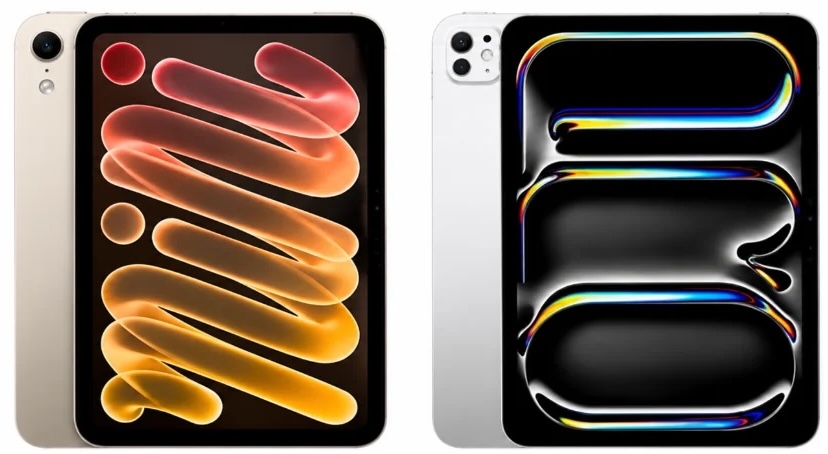
The iPad Mini 8 and 11-inch iPad Pro M4 serve different priorities. The Mini’s appeal lies in carrying less: a smaller screen, a lighter body and a lower listed price. The Pro offers more room for applications, a 120Hz Tandem OLED display and connectivity aimed at demanding creative workflows.
The central question is therefore not simply which tablet has more powerful hardware. It is whether the Pro’s additional workspace and specialist features justify the cost and size—or whether portability matters more.
This comparison follows the specifications supplied in the source article. Those details have not been independently verified, and several—particularly the Mini’s processor configurations, display technology, water-resistance rating and audio system—should be confirmed against an official specification sheet before publication or purchase.
Specifications at a Glance
| Feature | iPad Mini 8 — supplied specifications | iPad Pro 11 M4 — supplied specifications |
|---|---|---|
| Display | 8.5-inch Super Retina XDR OLED | 11-inch Ultra Retina Tandem OLED |
| Resolution | 2316 × 1512 pixels | 2420 × 1668 pixels |
| Refresh rate | Not specified | Up to 120Hz |
| Listed brightness | 600 nits typical; 1,200 nits high-brightness figure | 1,000 nits full-screen/high-brightness figure; 1,600 nits peak |
| Processor | Apple A20 Pro, listed as 2nm | Apple M4 |
| CPU configurations | Five cores on 128GB/256GB; six cores on 512GB | Nine cores on 256GB/512GB; ten cores on 1TB/2TB |
| GPU | Seven cores | Ten cores |
| RAM | 12GB | 8GB or 16GB |
| Storage | 128GB, 256GB or 512GB | 256GB, 512GB, 1TB or 2TB |
| Rear camera | 12MP, f/1.8, autofocus | 12MP, f/1.8, dual-pixel PDAF |
| Additional rear hardware | LED flash listed | LiDAR scanner and flash |
| Front camera | 12MP ultrawide, f/2.0, 122-degree field of view | 12MP ultrawide, f/2.4, 122-degree field of view |
| Rear video | Up to 4K at 60fps | Up to 4K at 60fps; ProRes support |
| Battery | 4,900mAh | 8,160mAh |
| Charging | Claimed 50% in approximately 30 minutes | Wired; comparable charging time not supplied |
| Speakers | Stereo; described as Acoustic Display audio | Four speakers |
| Wireless connectivity | Wi-Fi 7, Bluetooth 6.0 | Wi-Fi 6E, Bluetooth 5.3 |
| USB | USB-C 3.1 Gen 2, DisplayPort | USB4, Thunderbolt 3, DisplayPort |
| Stylus support | Listed; exact compatibility not specified | Listed; exact compatibility not specified |
| Biometric security | Touch ID | Face ID |
| Protection rating | IP67 claimed | Not specified |
| Dimensions | 195.3 × 132.6 × 5.4mm | 249.7 × 177.5 × 5.3mm |
| Wi-Fi model weight | 255g | 444g |
| Software listed | iPadOS 27.2 | iPadOS 27.2 |
| Indicative price | Around $700 or ₹83,000 | Around $1,000 or ₹100,000 |
The quoted prices are separate market references, not equivalent currency conversions. They also do not establish comparable storage configurations.
Design: The Mini’s Advantage Is How Little It Adds to a Bag
The supplied dimensions place the Mini well below the Pro in overall footprint. At 255g, it is also 189g lighter than the listed 444g Wi-Fi Pro.
That difference is central to their intended uses. The Mini’s smaller format lends itself to reading, checking documents, taking quick notes and carrying between locations. The Pro provides a larger surface for work but asks users to accommodate a considerably wider and taller device.
Thickness is almost identical: 5.4mm for the Mini and 5.3mm for the Pro. The practical distinction is therefore size and weight, not thinness.
The source also credits the Mini with IP67 protection. That claim deserves explicit verification; it should not be used to promise water resistance without confirmation of the rating and its conditions.
Display: Compact OLED or a Larger 120Hz Canvas?
The Mini is described as having an 8.5-inch OLED screen with a resolution of 2316 × 1512 pixels. Its listed brightness reaches 600 nits in typical use, with a separate 1,200-nit figure whose conditions are not consistently defined in the source.
The Pro’s 11-inch Tandem OLED display offers a larger workspace, a 120Hz refresh rate and listed HDR10 and Dolby Vision support. The source quotes 1,000 nits for its full-screen or high-brightness output and up to 1,600 nits peak.
The refresh-rate comparison remains incomplete because the Mini’s maximum rate is not supplied. It would be inappropriate to assign it a figure or quantify a smoothness gap from this information alone.
The clearer distinction is screen area. The Pro provides more room for timelines, drawing tools, documents and multiple application windows. The Mini prioritises a display that is easier to carry rather than one designed to maximise working space.
Performance: Core Counts Do Not Tell the Whole Story
The source pairs the Mini with an A20 Pro processor and the Pro with Apple’s M4. It also describes different CPU configurations according to storage capacity.
For the Mini, those claims are a five-core CPU in the 128GB and 256GB versions and a six-core CPU in the 512GB model, alongside a seven-core GPU. The Pro is listed with nine CPU cores in its 256GB and 512GB versions, rising to ten in the 1TB and 2TB models, with a ten-core GPU.
These configurations should not be treated as a benchmark comparison. The supplied information includes no processing times, sustained performance results or thermal measurements.
Memory allocation adds another distinction. The Mini is listed with 12GB across its range, while the Pro has 8GB in lower-capacity models and 16GB in the 1TB and 2TB versions. More RAM does not independently establish that one device will be faster in every application.
The Pro’s broader appeal rests on the combination of its processing platform, larger screen, storage ceiling and connectivity—not a simple tally of cores or memory.
Productivity: Workspace May Matter More Than Processing Power
Both tablets are listed with iPadOS 27.2, but the same operating system does not make their working experiences interchangeable.
The Mini is positioned for brief interactions: handwritten notes, reading, browsing and reviewing material while moving between classes, meetings or other locations.
The Pro offers more room for extended work. A larger display is particularly relevant when an application needs to show both content and controls, such as a drawing canvas with tool palettes or a video timeline with a preview.
Stylus support is listed for both, but the source does not identify compatible models. Keyboard compatibility and accessory costs are also unspecified. Those details need to be established before presenting either tablet as a complete work setup.
For buyers considering a partial laptop replacement, the Pro is the more plausible candidate within this comparison. Whether it can replace a particular workflow depends on the required applications and accessories, not the processor alone.
Battery and Charging: Capacity Does Not Establish Endurance
The source lists a 4,900mAh battery for the Mini and an 8,160mAh battery for the Pro.
That difference should not be interpreted as a proportional runtime advantage. Battery capacity in milliamp-hours alone is not a complete comparison of stored energy, and the tablets have different display sizes and hardware demands.
The Mini is said to reach 50 percent charge in approximately 30 minutes. However, the required adapter and test conditions are not supplied. There is also no equivalent Pro charging result.
Without comparable tests, neither tablet can be declared the battery-life or charging-speed winner.
Cameras: The Pro Adds Specialist Tools
Both tablets are listed with a 12MP rear camera, an f/1.8 aperture and support for 4K recording at up to 60fps.
The Pro adds a LiDAR scanner and ProRes recording, giving it a more specialised imaging feature set. These additions are relevant to particular capture and creative tasks rather than proof that it is the better choice for every casual photograph.
The Mini’s listed camera system is simpler, with autofocus, an LED flash and support for HDR and panorama photography.
At the front, both are described as using 12MP ultrawide cameras with a 122-degree field of view. The Mini has a listed f/2.0 aperture, compared with f/2.4 on the Pro. That difference alone does not establish video-call or selfie quality.
The source does not provide enough information to assess low-light results, stabilisation or processing consistency.
Audio and Connectivity: Different Strengths
The Pro’s four-speaker arrangement is a more extensive listed audio configuration than the Mini’s stereo system. The Mini’s “Acoustic Display” description remains insufficiently explained and should be verified before being presented as an established technology.
Wireless specifications favour the Mini on paper, with Wi-Fi 7 and Bluetooth 6.0 against the Pro’s Wi-Fi 6E and Bluetooth 5.3.
Wired connectivity points in the opposite direction. The Pro lists USB4 and Thunderbolt 3, while the Mini is described as having USB-C 3.1 Gen 2. Both list DisplayPort support.
For buyers working with wired peripherals and demanding file-transfer workflows, the Pro’s documented interface is an important part of its premium positioning. Actual compatibility still depends on the accessories and applications involved.
Price: The Pro Needs to Earn Its Premium
The supplied prices put the Mini at approximately $700 or ₹83,000, compared with around $1,000 or ₹100,000 for the Pro.
That creates an indicative difference of $300 in the dollar figures and ₹17,000 in the rupee figures. These are not matching currency conversions, and the starting storage capacities differ: 128GB for the Mini against 256GB for the Pro.
The Mini’s financial appeal is strongest for buyers who specifically want a small tablet. Paying more for the Pro makes greater sense when its screen area, connectivity, storage options or creative tools address a real need.
A larger and more expensive tablet is not automatically better value if it is less convenient for the way it will be used.
Verdict: Choose the Format Before the Specification Winner
The Mini’s strongest proposition is its compact size. On the supplied figures, it is substantially lighter and easier to accommodate than the Pro, while retaining a premium display and stylus support.
The Pro offers a more expansive working environment, a 120Hz Tandem OLED display, Thunderbolt connectivity, larger storage options and additional imaging tools. Those features make the stronger case for extended creative and productivity work.
Neither is a universal winner. The Mini is the more logical format for buyers seeking a portable reading and note-taking companion. The Pro is better positioned for those who will actively use its larger workspace and specialist features.
Before drawing a final purchase conclusion, the Mini’s unverified specifications—and the regional prices and accessory compatibility of both devices—need confirmation.


