
Motorola Signature 27 vs Samsung Galaxy S26 Ultra: Which Flagship is Better?
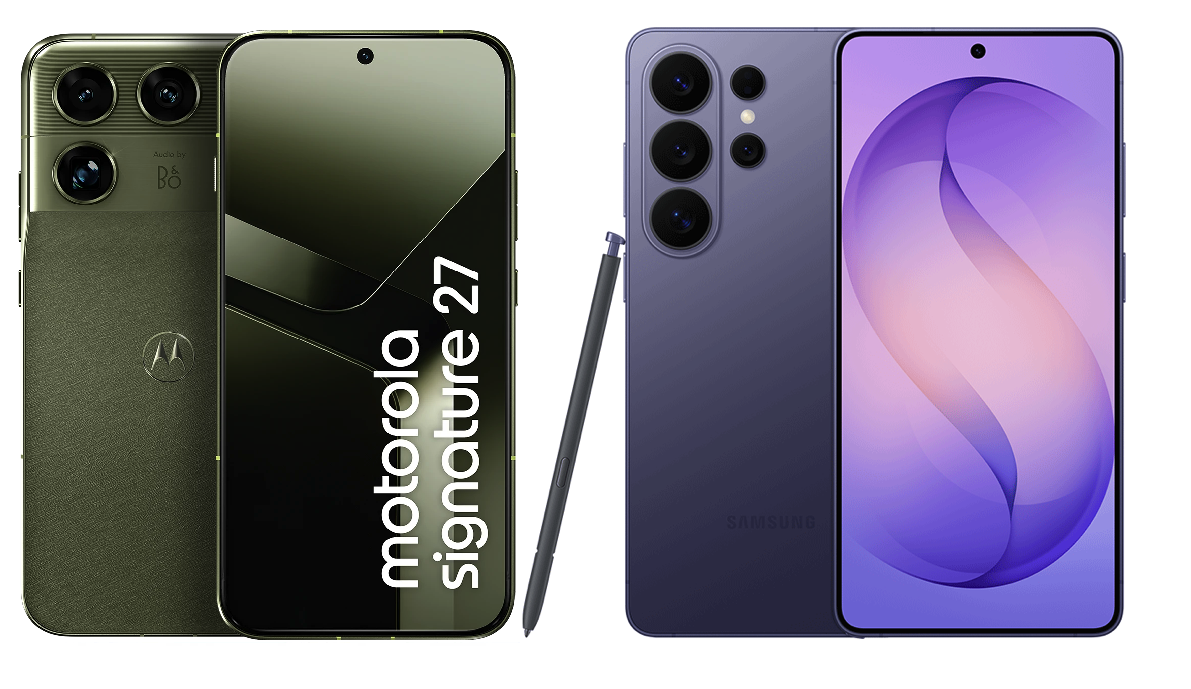
The Motorola Signature 27 and Samsung Galaxy S26 Ultra now meet at the same US list price when equipped with 512GB of storage, but they make very different arguments for that money.
Motorola prioritises newer processing hardware, a substantially larger battery and higher charging power. Samsung counters with an integrated S Pen, a sharper display with a privacy feature, and two dedicated telephoto cameras.
That makes this more than a contest between processor generations. The more useful question is whether Motorola’s hardware advantages matter more to you than Samsung’s distinctive productivity and camera features.
This comparison is based on the specifications, manufacturer claims and prices supplied in the original article. It does not represent independent hands-on testing, and current prices may vary.
Performance: Motorola Has the Newer Chip, but Testing Matters
The Signature 27 arrives with Qualcomm’s Snapdragon 8 Elite Extreme Gen 6, while the Galaxy S26 Ultra uses the Snapdragon 8 Elite Gen 5 for Galaxy.
According to the Qualcomm figures cited in the supplied material, the newer processor offers a 13% improvement in CPU performance and a 44% increase in GPU performance over the Snapdragon 8 Elite Gen 5. Its prime cores reach up to 5.01GHz.
Samsung’s customised chip is listed with a maximum clock speed of 4.74GHz. The company claims up to 19% faster CPU performance than its previous-generation flagship, although that is a different comparison from Qualcomm’s generation-to-generation figures.
Both manufacturers have also revised their cooling systems. Samsung has redesigned the Galaxy S26 Ultra’s vapour chamber to distribute heat more evenly. Motorola says the Signature 27’s ArcticMesh cooling system is 40% larger than the original Signature’s, combining diamond-infused thermal gel, liquid metal and a 3D vapour chamber.
Motorola therefore has the stronger performance proposition on paper. However, processor specifications and manufacturer benchmarks do not establish how large the difference will be between these two finished phones. Sustained gaming performance, temperatures and power consumption remain important parts of the comparison.
Display: Samsung Adds Privacy, Motorola Claims Higher Brightness
Samsung equips the Galaxy S26 Ultra with a 6.9-inch Dynamic AMOLED 2X display at 1440 × 3120 pixels, or approximately 500 pixels per inch. Its adaptive refresh rate ranges from 1Hz to 120Hz, and peak brightness is listed at 2,600 nits.
The more distinctive feature is its built-in Privacy Display. Samsung says it makes the screen harder to read from the sides, helping shield messages and other sensitive information from nearby viewers.
Motorola takes a different approach with a 6.8-inch Extreme AMOLED Duo panel. Its 1264 × 2780 resolution produces approximately 449 pixels per inch, below Samsung’s listed pixel density. It also supports Dolby Vision and carries an advertised peak brightness of up to 12,000 nits.
That brightness figure should not be treated as proof that Motorola’s screen is proportionately brighter in everyday use. The supplied information does not establish comparable measurement conditions for the two panels.
Samsung has the clearer advantage in resolution and offers a privacy function Motorola does not match. Motorola’s display stands out for its Dolby Vision support and ambitious brightness claim, but comparable testing is needed to judge visibility and image quality.
Cameras: Dual Telephoto Lenses Meet a 200MP Periscope
The two manufacturers place their highest-resolution camera sensors in different positions.
Samsung gives the Galaxy S26 Ultra a 200MP main camera with a 1/1.3-inch sensor and an f/1.4 lens. It pairs that with a 50MP ultrawide camera and two telephoto units:
-
A 10MP camera with 3x optical zoom.
-
A 50MP periscope camera with 5x optical zoom.
A 12MP front camera handles selfies. Samsung also advertises up to 100x zoom and support for the APV professional video codec, described in the supplied article as a first for the Galaxy lineup.
Motorola puts a 50MP Sony LYTIA L910 sensor in the main camera, with optical image stabilisation and LOFIC technology. The company says LOFIC helps preserve detail in both bright and dark areas of high-contrast scenes.
Its 200MP sensor sits behind the periscope telephoto lens, which provides 3x optical zoom. The system also includes a 50MP ultrawide camera and a dedicated EVS Action Sensor aimed at capturing fast-moving subjects in low light.
For longer-range shots, Motorola advertises Super Zoom Pro up to 100x, using generative AI sharpening. The company also highlights a DXOMARK Gold label, although that designation alone does not settle a direct comparison with Samsung.
Neither Camera System Wins on Specifications Alone
Samsung provides two dedicated optical zoom positions, while Motorola combines a higher-resolution telephoto sensor with a single listed 3x optical zoom level.
Those are different approaches, not automatic indicators of better photography. Likewise, the advertised 100x modes should not be confused with the phones’ optical zoom capabilities.
A meaningful verdict requires comparisons of actual photographs and video, particularly at intermediate and longer zoom levels. Independent head-to-head testing remains limited in the supplied account because the Signature 27 has only recently reached buyers.
Battery and Charging: Motorola Leads the Specification Sheet
Battery capacity is one of the largest numerical differences between the phones.
The Signature 27 advertises a 7,000mAh silicon-carbon battery, with a rated capacity of 6,790mAh. Samsung lists a 5,000mAh battery for the Galaxy S26 Ultra.
Using the advertised 7,000mAh figure, Motorola offers 2,000mAh more capacity—a 40% increase. That establishes a capacity advantage, not a guaranteed 40% improvement in battery life.
Motorola also lists higher charging power:
| Charging feature | Motorola Signature 27 | Samsung Galaxy S26 Ultra |
|---|---|---|
| Wired charging | 90W | 60W |
| Wireless charging | 50W | 25W |
Motorola claims up to 77 hours of mixed-use battery life and says a 12-minute charge can provide enough power for a day. Those are manufacturer claims rather than directly comparable test results. The charger is sold separately.
Samsung retains the battery capacity of the Galaxy S25 Ultra but raises wired charging to 60W, described in the supplied article as a first for the Ultra series.
Motorola has the stronger battery and charging specifications. Actual endurance and charging times still need to be assessed under equivalent conditions.
Design: Samsung Is Lighter, Motorola Offers Unusual Finishes
Despite having the larger display, the Galaxy S26 Ultra weighs less.
Samsung’s phone measures 163.6 × 78.1 × 7.9mm and weighs 214g. The Signature 27 measures 162.01 × 77.04 × 7.99mm and weighs 227g.
Motorola is therefore slightly shorter and narrower, but 13g heavier.
The Galaxy S26 Ultra uses an aluminium frame and comes in Black, Cobalt Violet, Sky Blue and White. Silver Shadow and Pink Gold are also listed as Samsung website options. It carries an IP68 dust- and water-resistance rating.
Motorola offers two more distinctive rear finishes: Tactical Weave on Pantone Coal Smoke and a brushed textile-style treatment on Pantone Capulet Olive.
The Signature 27 lists IP68 and IP69 ratings. Motorola also cites testing under 14 MIL-STD-810H procedures across 16 categories. Those credentials describe the company’s stated testing and protection claims; they should not be interpreted as making the phone immune to damage.
Software: Samsung’s S Pen Remains a Key Difference
The supplied specifications list the Galaxy S26 Ultra with Android 16-based One UI 8.5, alongside Galaxy AI and Samsung DeX.
Its clearest hardware-software distinction is the built-in S Pen. Users who regularly take handwritten notes, annotate documents or sign files have a capability that the Signature 27 does not directly replace.
Motorola ships the Signature 27 with Android 17, Gemini Intelligence and Motorola Qira. Qira is described as helping users locate and recall information across applications, with a Motorola or Lenovo account and at least 12GB of RAM required.
Motorola also lists RAM Boost, with available memory advertised as extendable up to 24GB. The phone’s physical RAM configuration remains 12GB.
Audio is another point of differentiation: the Signature 27 is described as Motorola’s first phone with Audio by Bang & Olufsen.
For long-term support, Motorola promises seven OS updates and up to seven years of security updates. The supplied article says Samsung maintains its existing update commitment but does not spell out the exact terms. Regional support policies should therefore be checked rather than assumed to be identical.
Pricing: Equal at 512GB, but Samsung Offers More Choice
The Signature 27 is listed in the US at $1,599.99 for its sole configuration: 12GB of RAM and 512GB of storage. It is sold unlocked with support for Verizon, AT&T and T-Mobile.
Samsung offers more storage choices. According to the supplied pricing, its revised US list prices are:
| Galaxy S26 Ultra storage | Listed US price |
|---|---|
| 256GB | $1,399.99 |
| 512GB | $1,599.99 |
| 1TB | $1,999.99 |
At 512GB, the two phones cost the same on the stated list prices. Samsung also provides a lower-priced entry point for buyers who can manage with 256GB.
The supplied article notes that Amazon and Best Buy have offered the Galaxy S26 Ultra below its revised list prices. That means the practical value comparison depends on the deal available at purchase, not simply the official price.
Motorola Signature 27 vs Galaxy S26 Ultra: Key Specifications
| Specification | Motorola Signature 27 | Samsung Galaxy S26 Ultra |
|---|---|---|
| Processor | Snapdragon 8 Elite Extreme Gen 6, listed as 2nm | Snapdragon 8 Elite Gen 5 for Galaxy, listed as 3nm |
| Display | 6.8-inch Extreme AMOLED Duo | 6.9-inch Dynamic AMOLED 2X |
| Resolution | 1264 × 2780 | 1440 × 3120 |
| Advertised peak brightness | Up to 12,000 nits | Up to 2,600 nits |
| Privacy Display | Not listed | Yes |
| Integrated stylus | No | S Pen |
| Main camera | 50MP Sony LYTIA L910 | 200MP, f/1.4 |
| Telephoto cameras | 200MP periscope, 3x optical zoom | 10MP 3x and 50MP periscope 5x optical zoom |
| Ultrawide camera | 50MP | 50MP |
| Advertised battery capacity | 7,000mAh | 5,000mAh |
| Wired charging | 90W | 60W |
| Wireless charging | 50W | 25W |
| Weight | 227g | 214g |
| Protection ratings | IP68 and IP69 | IP68 |
| Listed software | Android 17 | One UI 8.5 on Android 16 |
| Listed US price at 512GB | $1,599.99 | $1,599.99 |
Verdict: Motorola Wins the Hardware Argument, Samsung Offers Distinctive Tools
On the supplied specifications, the Motorola Signature 27 makes its strongest case through its newer processor, larger battery and higher charging power. Those are substantial differences for buyers focused on demanding workloads and battery-related features.
Samsung’s appeal is more specific. Its S Pen, Privacy Display, higher-resolution screen and dual-telephoto camera system provide capabilities that Motorola’s newer processor cannot substitute for. Its lower weight, additional storage options and potential discounts also matter.
There is no defensible overall winner without comparable testing. Motorola looks stronger in several headline hardware categories; Samsung remains compelling for buyers who will make regular use of its distinctive features. At the same 512GB list price, the better choice depends on which of those advantages has practical value to you.


