
Vivo X500 Pro Max vs Xiaomi 17 Ultra: All-Round Value or Camera-First Ambition?
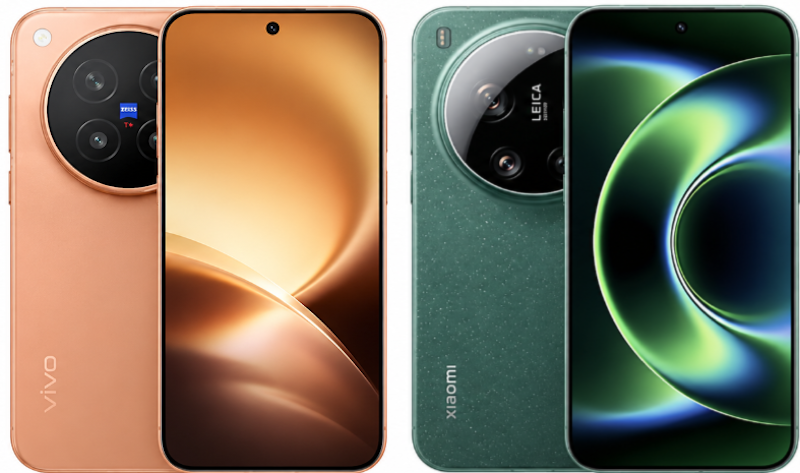
The Vivo X500 Pro Max and Xiaomi 17 Ultra take different routes to the premium smartphone market. Vivo emphasises a high-resolution display, a large battery and competitive pricing, while Xiaomi concentrates on specialised camera hardware, including a larger main sensor and continuous optical zoom.
On the supplied specifications, Vivo has the stronger claim to all-round value. Xiaomi, however, offers a more distinctive proposition for photographers willing to pay extra for its imaging system.
Neither conclusion should be mistaken for a tested verdict. Specifications reveal important differences, but they cannot establish real-world battery life, image quality or sustained performance without direct comparisons.
Vivo X500 Pro Max vs Xiaomi 17 Ultra: Key Specifications
| Feature | Vivo X500 Pro Max | Xiaomi 17 Ultra |
|---|---|---|
| Construction | Armor Glass front, aluminium frame, glass or glass-fibre rear | Glass front, aluminium frame, glass-fibre or silicone polymer rear |
| Protection rating | IP68/IP69; stated immersion resistance up to 1.5 metres for 30 minutes | IP68/IP69; stated immersion resistance up to 6 metres for 30 minutes |
| Display | 6.85-inch LTPO AMOLED | 6.9-inch LTPO AMOLED |
| Resolution | 3168 × 1440 pixels | 2608 × 1200 pixels |
| Maximum refresh rate | 144Hz | 120Hz |
| Advertised peak brightness | 4,400 nits | 3,500 nits |
| HDR support | Dolby Vision, HDR10+ | Dolby Vision, HDR10+ |
| Processor | MediaTek Dimensity 9600 Pro, 2nm | Qualcomm Snapdragon 8 Elite Gen 5, 3nm |
| GPU | Mali-G2-Ultra-NX | Adreno 840 |
| RAM and storage | Up to 16GB RAM and 1TB UFS 4.1 storage | Up to 16GB RAM and 1TB UFS 4.1 storage |
| Software listed | Android 17 with OriginOS 7 | Android 16 with HyperOS 3 |
| Stated OS update commitment | Up to five major updates | Not specified in the supplied information |
| Main camera | 50MP, 1/1.28-inch sensor, OIS | 50MP, 1-inch-type sensor, OIS |
| Telephoto camera | 200MP periscope, 3.5x optical zoom | 200MP periscope, 3.2x–4.3x continuous optical zoom |
| Ultrawide camera | 50MP, 119-degree field of view, autofocus | 50MP, 115-degree field of view, autofocus |
| Rear video | Up to 8K at 30fps or 4K at 240fps | Up to 8K at 30fps or 4K at 120fps |
| Front camera | 50MP with autofocus | 50MP with autofocus |
| Front video | Up to 4K at 60fps | Up to 4K at 60fps |
| Battery | 7,800mAh in the listed global version | 6,000mAh |
| Wired charging | 90W | 90W |
| Wireless charging | 40W | 50W |
| Reverse charging | Wired and wireless; output not specified | 22.5W wired and 10W wireless |
| USB | USB-C 3.2 | USB-C 3.2 Gen 2 with DisplayPort |
| Indicative price | Around $1,000 or ₹100,000 | Around $1,300 or ₹130,000 |
The listed prices should be treated as approximate market references rather than equivalent currency conversions or confirmed prices for every region.
Design and Durability: Similar Materials, Different Protection Claims
Both phones use aluminium frames and offer a choice of rear finishes. Vivo pairs its Armor Glass front with either glass or a glass-fibre-reinforced back. Xiaomi offers glass-fibre or silicone polymer rear panels, with the supplied description highlighting an aerospace-grade glass-fibre construction.
Those material descriptions establish different design approaches, but they do not prove that one phone is stronger, lighter or more comfortable. The comparison does not include weight, dimensions or independent durability results.
Water resistance provides a clearer distinction on paper. Both devices carry IP68 and IP69 ratings, but their stated immersion limits differ substantially: 1.5 metres for 30 minutes on the Vivo, compared with 6 metres for the same duration on the Xiaomi.
Xiaomi therefore has the more ambitious stated immersion specification. Vivo’s Armor Glass branding, meanwhile, is not enough by itself to establish a protection advantage over Xiaomi Shield Glass 3.0.
Display: Vivo Has the More Impressive Specification Sheet
Vivo equips the X500 Pro Max with a 6.85-inch LTPO AMOLED panel featuring a resolution of 3168 × 1440 pixels and a maximum refresh rate of 144Hz. Dolby Vision and HDR10+ support complete its core display package.
Xiaomi’s 6.9-inch LTPO AMOLED screen is slightly larger, but its 2608 × 1200 resolution and 120Hz refresh-rate ceiling are lower. It also supports Dolby Vision and HDR10+, while the supplied specifications list support for 68 billion colours.
For buyers prioritising fine detail, Vivo has the more compelling combination: a higher resolution on a marginally smaller screen. Its higher maximum refresh rate also gives it an advantage for supported high-frame-rate content and interactions.
Brightness needs more careful interpretation. Vivo advertises a peak of 4,400 nits, against Xiaomi’s 3,500 nits, but those headline figures do not establish how the phones compare across an entire screen or during sustained outdoor use.
Vivo leads on the listed display specifications. A definitive assessment of overall quality would still require comparable measurements and viewing tests.
Performance: Two Flagship Platforms, No Proven Winner
The Vivo X500 Pro Max uses MediaTek’s Dimensity 9600 Pro, paired with a Mali-G2-Ultra-NX GPU. Xiaomi opts for Qualcomm’s Snapdragon 8 Elite Gen 5 and Adreno 840 graphics.
Both configurations offer up to 16GB of RAM and 1TB of UFS 4.1 storage. Neither phone therefore gains a straightforward advantage in maximum memory capacity or storage technology.
Vivo’s processor is listed as using a 2nm manufacturing process, compared with 3nm for the Xiaomi chipset. That difference is noteworthy, but it does not independently prove better efficiency, lower temperatures or higher performance.
Likewise, the Snapdragon platform’s name is not sufficient evidence to award Xiaomi the gaming category. Cooling, power limits and software optimisation are not evaluated in the supplied comparison.
On paper, both belong in the flagship performance class. Without benchmarks or sustained workload testing, declaring either one the faster phone would go beyond the available information.
Software: Vivo Provides the Clearer Stated Commitment
The listed software configurations favour Vivo’s newer starting point: Android 17 with OriginOS 7, compared with Android 16 and HyperOS 3 on the Xiaomi.
Vivo also has an explicit commitment of up to five major operating-system updates. No equivalent Xiaomi policy is included in the supplied material.
That makes Vivo’s stated support position clearer, but it does not establish that Xiaomi offers fewer updates. Its policy is simply missing from this comparison. Security-update duration and regional software differences are also not specified.
Battery and Charging: Vivo Prioritises Capacity, Xiaomi Wireless Power
The Vivo’s 7,800mAh battery is one of its most substantial advantages on paper. Compared with Xiaomi’s 6,000mAh unit, it provides 1,800mAh more capacity—a 30 percent increase.
That gives Vivo a stronger starting position for users who spend long periods away from a charger. It does not guarantee 30 percent longer battery life, since the display, chipset, software and workload all affect consumption.
Both phones support 90W wired charging. Equal power ratings, however, should not be confused with equal charging times, particularly given their different battery capacities.
Xiaomi leads in rated wireless charging power at 50W, compared with Vivo’s 40W. Both also support wired and wireless reverse charging, although only Xiaomi’s outputs are specified: 22.5W wired and 10W wireless.
There is consequently no clear basis for calling Vivo’s reverse charging more flexible. The defensible distinction is simpler: Vivo offers considerably more battery capacity, while Xiaomi provides the higher wireless charging rating.
Cameras: Xiaomi Makes the Stronger Hardware Case
Both phones feature three rear cameras, but their main and telephoto systems reveal different priorities.
Vivo combines a 50MP main camera with a 1/1.28-inch sensor, a 200MP periscope telephoto offering 3.5x optical zoom, and a 50MP autofocus ultrawide. Zeiss optics, T* coating and laser autofocus form part of its imaging package.
Xiaomi also uses a 50MP main camera, but with a larger 1-inch-type sensor. Its 200MP periscope supports continuous optical zoom between 3.2x and 4.3x, alongside a 50MP autofocus ultrawide.
The Xiaomi setup stands out for its larger main sensor and adjustable optical zoom range. The supplied specifications also list Leica lenses, a dedicated zoom ring and a TOF 3D sensor, reinforcing its photography-focused positioning.
Vivo counters with a wider ultrawide field of view: 119 degrees against Xiaomi’s 115 degrees. Its camera system therefore remains versatile, even if Xiaomi offers the more specialised main and telephoto hardware.
These differences make Xiaomi the more intriguing option for photography enthusiasts on paper. They do not establish superior photographs in every situation; that would require direct assessment of detail, colour, exposure, autofocus and image processing.
Video: Vivo Lists the Higher 4K Frame Rate
Both phones support rear-camera recording at up to 8K at 30fps. Vivo’s listed 4K capability extends to 240fps, while Xiaomi reaches 120fps.
That gives Vivo the higher stated frame-rate ceiling. The supplied information does not specify which cameras support those modes or what restrictions apply, so the headline numbers should not be treated as a complete comparison of video quality.
Selfies: Closely Matched Core Specifications
Both devices have 50MP front cameras with autofocus and support for 4K video at 60fps.
Vivo lists an f/2.0 aperture and a 20mm focal length, compared with Xiaomi’s f/2.2 aperture and 21mm focal length. The supplied description also credits Xiaomi with panorama support and gyro-based electronic stabilisation.
Those differences may influence framing and recording flexibility, but there is insufficient evidence to name a clear front-camera winner. Their core specifications are closely matched.
Connectivity: Xiaomi Lists a More Specific USB Feature Set
Both phones support Wi-Fi 7. Xiaomi lists Bluetooth 6.0, while Vivo’s specification is given as Bluetooth 5.4/6.0, leaving the precise configuration unclear.
The USB descriptions also differ. Vivo lists USB-C 3.2, whereas Xiaomi specifies USB-C 3.2 Gen 2 with DisplayPort support.
Xiaomi therefore has the clearer documented feature set for buyers interested in wired display output. The less detailed Vivo listing should not automatically be interpreted as confirmation that equivalent functionality is absent.
Pricing: Vivo Has the Lower Entry Point
The quoted prices place the Vivo X500 Pro Max at approximately $1,000 or ₹100,000, compared with around $1,300 or ₹130,000 for the Xiaomi 17 Ultra.
That represents an indicative premium of $300, or ₹30,000 using the separately listed rupee prices.
Vivo’s appeal is straightforward: it combines a higher-resolution, higher-refresh-rate display with a larger battery and a versatile camera system for less money.
Xiaomi asks buyers to place greater value on its main sensor, continuous optical zoom, specialised imaging features and higher wireless charging rating. Whether that premium makes sense depends largely on how central photography is to the purchase.
Verdict: Vivo for Balance, Xiaomi for Imaging Priorities
The Vivo X500 Pro Max has the stronger all-round proposition based on the supplied specifications and prices. Its display, battery capacity, newer listed software and explicit update commitment create a persuasive package without the Xiaomi’s higher asking price.
The Xiaomi 17 Ultra is the more specialised choice. Its larger main sensor, continuous optical telephoto zoom and additional camera-focused hardware give photography enthusiasts concrete reasons to consider spending more.
For buyers choosing primarily on specifications and cost, Vivo is the more balanced option. For those prioritising camera hardware and optical flexibility, Xiaomi has the more distinctive appeal. Neither can be declared the better-performing phone in practice without comparable testing.


