
iPhone 17 vs OnePlus 16: Specs, Cameras, and Battery Life Compared
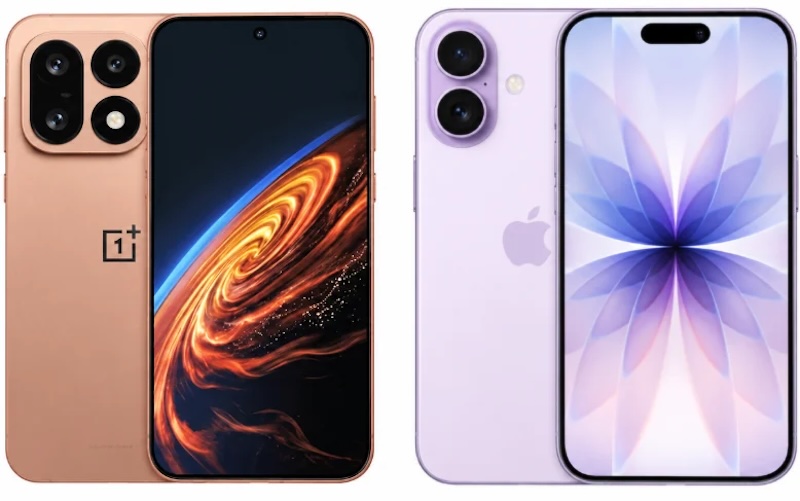
The premium smartphone market is a battleground of competing philosophies, and the latest clash between the OnePlus 16 and iPhone 17 perfectly illustrates this divide. While OnePlus throws everything it has into raw hardware power, massive battery capacity, and camera versatility, Apple counters with a highly refined, tightly integrated software experience and dependable photography.
With both devices hovering around the $900 price point, choosing between them isn’t about which phone is objectively better, but rather which phone better aligns with how you use your device. Do you want bleeding-edge specifications and multi-day endurance, or do you prefer the seamless, polished integration of the Apple ecosystem?
Here is a detailed breakdown of how the OnePlus 16 and iPhone 17 stack up against each other across all major categories.
Design, Build, and Display
Build Quality and Durability
Both smartphones utilize premium materials, but they target different types of durability. The OnePlus 16 features Crystal Shield Glass paired with an aluminum frame, giving buyers the choice between a glass or glass-fiber-reinforced plastic back. It also boasts an impressive IP68/IP69K rating, meaning it can withstand high-pressure water jets in addition to standard submersion.
The iPhone 17 opts for a minimalist aesthetic, utilizing a sleek glass back, an aluminum frame, and Apple’s new Ceramic Shield 2 on the front. While its IP68 rating doesn’t technically match the OnePlus’s resistance to high-pressure jets, it remains highly durable for everyday spills and submersion.
Display Technology
This is where the two phones diverge significantly. The OnePlus 16 sports a massive 6.78-inch LTPO AMOLED display with a staggering 185Hz refresh rate. This incredibly high refresh rate, combined with Dolby Vision, HDR10+, and HDR Vivid support, makes it a dream for mobile gamers and media consumers who demand absolute fluidity.
The iPhone 17, conversely, features a more compact 6.3-inch LTPO Super Retina XDR OLED panel. While its refresh rate caps at a still-smooth 120Hz, Apple has included a specialized anti-reflective coating and engineered the display to hit a higher peak brightness, making it exceptionally legible in direct sunlight.
OnePlus wins on sheer size and fluidity, making it ideal for gamers. Apple wins on outdoor visibility and glare reduction.
Performance and Battery Life
Processing Power
The OnePlus 16 is a powerhouse, driven by Qualcomm’s top-tier Snapdragon 8 Elite Extreme Gen 6 (2nm) chipset. Paired with the Adreno 850 GPU and up to a massive 16GB of RAM, it is built for heavy multitasking and demanding 3D games.
Apple’s iPhone 17 runs on the proprietary A19 (3nm) chip with a five-core GPU and 8GB of RAM. While the RAM count seems low on paper, Apple’s legendary hardware-software optimization via iOS 26 ensures the iPhone remains incredibly responsive and efficient, handling intensive applications just as well as its Android rival.
Battery Capacity and Charging
OnePlus completely dominates this category on paper. It packs a gargantuan 9,000mAh silicon-carbon battery, dwarfing the iPhone 17’s 3,692mAh Li-Ion cell. Furthermore, the OnePlus 16 supports 100W wired charging, 50W wireless charging, and reverse wireless charging.
The iPhone 17 supports 25W MagSafe/Qi2 wireless charging and a wired charging speed that promises 50% capacity in 20 minutes. It does support reverse wired charging (up to 4.5W), but lacks reverse wireless capabilities.
The OnePlus 16 is the undisputed champion for heavy users needing multi-day battery life and ultra-fast top-ups.
Camera Capabilities
Rear Camera Systems
The OnePlus 16 offers a highly versatile triple-camera array: a 200MP main sensor (with OIS), a dedicated 50MP telephoto lens with 3x optical zoom, and a 50MP ultrawide camera. This setup is capable of recording 8K video at 30fps and 4K at up to 120fps.
The iPhone 17 sticks to a reliable dual-camera setup, featuring a 48MP main camera with sensor-shift stabilization and a 48MP ultrawide lens. It notably lacks a dedicated optical zoom lens but supports 4K Dolby Vision video recording at up to 60fps. Apple’s strength lies in its computational photography and unmatched video consistency, while OnePlus wins on hardware flexibility.
Selfie Cameras
OnePlus equips its phone with a 50MP autofocus ultrawide front camera, perfect for group shots and capturing more background scenery. Apple utilizes an 18MP multi-aspect front camera with autofocus, paired with a depth sensor that enables Face ID and spatial audio recording.
OnePlus provides better hardware versatility and optical zoom. The iPhone remains the safer choice for consistent, point-and-shoot reliability and video creation.
iPhone 17 vs. OnePlus 16 Specs Comparison at a Glance
| Category | OnePlus 16 | iPhone 17 |
| Display | 6.78-inch LTPO AMOLED (185Hz) | 6.3-inch LTPO Super Retina XDR OLED (120Hz) |
| Processor | Snapdragon 8 Elite Extreme Gen 6 (2nm) | Apple A19 (3nm) |
| RAM | 12GB / 16GB | 8GB |
| Storage | 256GB / 512GB / 1TB (UFS 4.1) | 256GB / 512GB (NVMe) |
| Rear Cameras | 200MP Main + 50MP (3x Telephoto) + 50MP Ultrawide | 48MP Main + 48MP Ultrawide |
| Front Camera | 50MP Ultrawide (Autofocus) | 18MP Multi-aspect (Autofocus) |
| Battery | 9,000mAh | 3,692mAh |
| Charging | 100W Wired, 50W Wireless | 50% in 20 min (Wired), 25W MagSafe |
| Durability | IP68 / IP69K | IP68 |
| Security | Ultrasonic in-display fingerprint | Face ID |
| Operating System | Android 17 (OxygenOS 17) | iOS 26 |
| Estimated Price | ~$900 | ~$900 |
Final Conclusion
At roughly $900, both smartphones offer premium experiences, but they cater to very different demographics. The OnePlus 16 provides significantly more hardware for the money—boasting a dedicated telephoto lens, a massive 9,000mAh battery, lightning-fast charging, and a 185Hz display. It is the clear choice for power users and mobile gamers.
The iPhone 17, however, justifies its price tag through Apple’s cohesive ecosystem, reliable point-and-shoot camera performance, Face ID security, and satellite safety features. It remains the superior all-rounder for users who value software refinement and seamless integration with other Apple devices over raw specifications.


