
Honor Magic 9 Pro Max vs Vivo X500 Pro Max: Ultimate 2026 Flagship Comparison
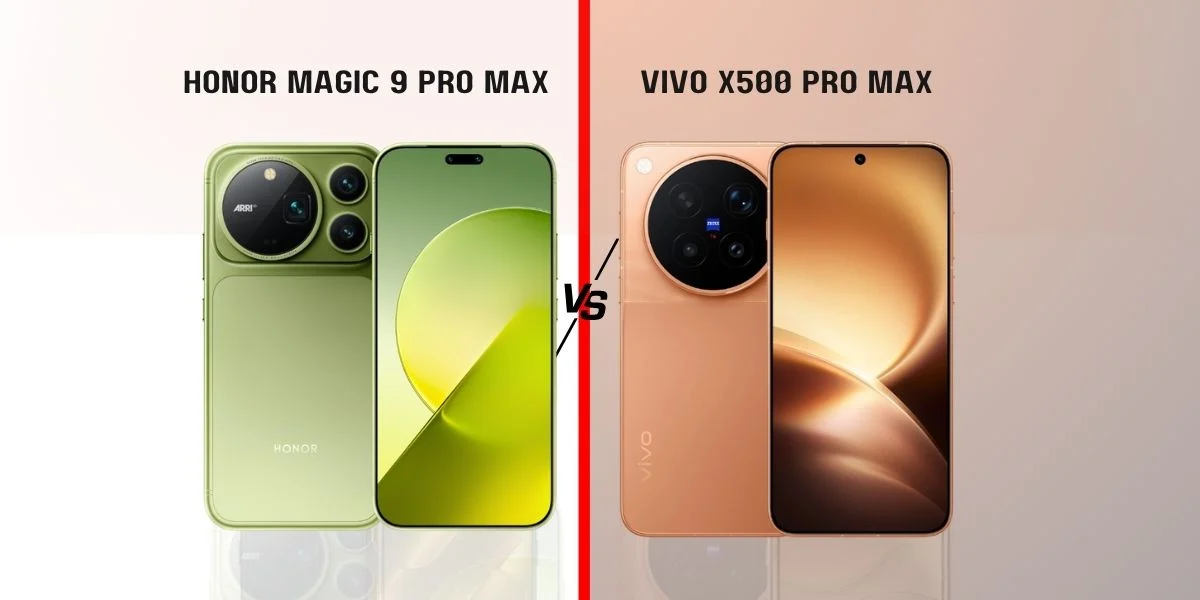
Just a week after Vivo shook the market with the X500 Pro Max, Honor has officially launched the Magic 9 Pro Max in China. Following closely behind the Oppo Find X10 Pro Max, this release makes the Magic 9 Pro Max the second flagship this week to boast multiple 200MP camera sensors.
At a glance, these ultra-premium smartphones share a striking resemblance on the spec sheet. Both are powered by next-generation 2nm processors, feature massive batteries exceeding 8,000mAh, and boast 200MP periscope telephoto lenses with optional teleconverter accessories. However, a deeper dive reveals diverging philosophies in design, imaging technology, and overall user experience. Here is a comprehensive breakdown of how these two titans compare.
Honor Magic 9 Pro and X500 Pro Max Design and Build Quality
Honor has completely revamped its design language for the Magic 9 Pro Max, abandoning its traditional circular camera module. Instead, the device features an asymmetrical camera plateau inspired by ARRI cinema cameras, complete with a precision-cut metal texture. Encased in a seamless-splice unibody metal frame, the phone is available in Moss Green, Silver Halide, and Shadow Black. It holds IP68, IP69, and IP69K ratings for ultimate durability. The front is protected by Honor’s proprietary “Giant Rhino Glass,” which the company claims is 25 times more drop-resistant than standard glass.
Vivo, on the other hand, retains its signature aesthetic on the X500 Pro Max. The rear is dominated by a massive, circular Zeiss “pancake” lens ring featuring a knurled edge. Three of its four colorways utilize a unique “Tidal Cold Carved” glass back, framed by aviation-grade aluminum. Like the Honor, it boasts rigorous IP68 and IP69 ratings.
Display Technology
The visual experience differs slightly between the two devices. The Honor Magic 9 Pro Max sports a 6.8-inch LTPO OLED screen with a 1Hz to 120Hz variable refresh rate. Honor claims an astounding peak brightness of 10,000 nits (6,000 nits at a 20% window) and a specialized 5,600-layer silicon nitride coating that reduces reflectivity to just 1.5%. It also features 4,320Hz PWM dimming and holds TÜV Rheinland’s Global Eye Protection 6.0 certification.
Vivo opts for a slightly larger 6.85-inch BOE Q11 display. While its peak brightness of 4,400 nits (at a 20% window) is lower than Honor’s, Vivo focuses heavily on color accuracy and fluidity. The screen features a 3168 × 1440 resolution, 507 ppi, and adaptive refresh rates up to 144Hz for gaming. It also includes chip-level Demura calibration and an ambient light sensor that adjusts brightness in minute 0.3-lux increments.
Camera Hardware and Processing
While both devices utilize a 1/1.28-inch main sensor with an f/1.57 aperture and gimbal-style stabilization, their approaches to resolution differ drastically. Honor relies on a massive 200MP primary sensor with CIPA 8.0 stabilization, allowing for extreme cropping capabilities. Vivo utilizes a 50MP Blueprint 900 sensor co-developed with Sony. Because the sensors are the same physical size, Vivo’s 50MP setup benefits from larger individual pixels, which generally aids in low-light performance.
For processing, Honor introduces its dedicated H1 imaging chip, capable of 18.8 TOPS per watt, specifically designed for RAW-domain noise reduction. Honor’s color science is deeply integrated with ARRI, utilizing the LogC3 curve and offering up to 87 downloadable ARRI cinematic looks.
Conversely, Vivo relies on the raw power of the Dimensity 9600 Pro and its Blueprint sensor for processing. Vivo takes the lead in video versatility, supporting 4K 240fps slow motion, 4K 120fps 10-bit Log, and 4K 60fps cinematic portraits. Upcoming updates will even unlock 8K live photos and a staggering 4K 960fps super slow-motion mode.
Performance and Battery
The Honor Magic 9 Pro Max is fueled by Qualcomm’s cutting-edge 2nm Snapdragon 8 Elite Extreme Gen 6, clocking in at up to 5.01GHz. Vivo answers with MediaTek’s 2nm Dimensity 9600 Pro, featuring an aggressive 2+3+3 all-big-core architecture. Both chips represent the absolute pinnacle of mobile processing power for 2026.
In the battery department, Honor takes a definitive lead. The Magic 9 Pro Max houses an industry-first 8,800mAh “Qinghai Lake blade battery” with 40% silicon content. It supports blazing-fast 100W wired and 80W wireless charging. Vivo is no slouch, packing a massive 8,000mAh battery capable of 90W wired and 40W wireless charging, though Honor wins the spec battle in both capacity and speed.
Honor Magic 9 Pro Max vs. Vivo X500 Pro Max Pricing
In the Chinese market, the Honor Magic 9 Pro Max is the more aggressively priced option, starting at 6,499 yuan (~$968) for the 12GB/256GB model. The Vivo X500 Pro Max starts at 6,999 yuan (~$1,044) for the same configuration. Honor also offers more storage for the money at the higher tiers; its 16GB/1TB model costs 8,499 yuan, whereas Vivo charges 8,999 yuan for just 12GB/1TB.
Ultimately, the choice comes down to priorities. The Honor Magic 9 Pro Max delivers superior battery specs, a dedicated imaging chip, ARRI cinematic color science, and a brighter display at a lower starting price. The Vivo X500 Pro Max appeals to users who prioritize extreme video frame rates, a 144Hz gaming display, and the legendary Zeiss optical tuning.
Honor Magic 9 Pro Max vs. Vivo X500 Pro Max Spec Comparison
|
Feature |
Honor Magic 9 Pro Max |
Vivo X500 Pro Max |
|
Processor |
Snapdragon 8 Elite Extreme Gen 6 (2nm) |
Dimensity 9600 Pro (2nm) |
|
Display |
6.8″ LTPO OLED, 1-120Hz, 10,000 nits peak |
6.85″ BOE Q11, 1-144Hz, 4,400 nits peak (20% window) |
|
Main Camera |
200MP (1/1.28-inch, f/1.57) |
50MP (1/1.28-inch, f/1.57) |
|
Telephoto Camera |
200MP Periscope |
200MP Periscope |
|
Imaging Tech |
H1 Imaging Chip, ARRI Color Science |
Dimensity ISP, Zeiss Color Science |
|
Battery |
8,800mAh |
8,000mAh |
|
Charging |
100W wired, 80W wireless |
90W wired, 40W wireless |
|
Biometrics |
3D Face Recognition + 3D Ultrasonic Fingerprint |
3D Ultrasonic Fingerprint |
|
Starting Price |
6,499 yuan (~$968) |
6,999 yuan (~$1,044) |


