
Phone 18 Pro Max vs Galaxy S26 Ultra: Which Flagship Should You Buy?
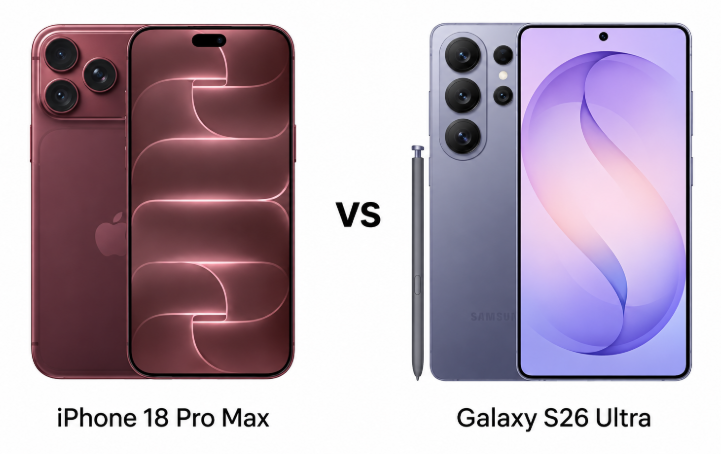
The premium smartphone arena has always been a two-horse race, but with the arrival of the iPhone 18 Pro Max and the Samsung Galaxy S26 Ultra, the divide in philosophy has never been starker.
Apple continues to double down on cinematic finesse, leaning on its cutting-edge A20 Pro silicon, deeply integrated iOS 27 ecosystem, and professional-grade video tools. Samsung, true to form, treats its flagship as a pocket-sized powerhouse—pushing the boundaries of display sharpness, camera versatility, and raw productivity via Android 16 and the iconic S Pen.
≠≠≠–At a baseline price of roughly $1,300, choosing between these two isn’t just about picking a phone; it’s about choosing an ecosystem and a workflow. Here is how the ultimate heavyweights of the mobile world stack up.
iPhone 18 Pro Max vs Galaxy S26 Ultra: Specifications
|
Category |
iPhone 18 Pro Max |
Galaxy S26 Ultra |
Winner |
|
Display |
6.9-inch LTPO OLED, 120Hz, 3000 nits peak |
6.9-inch LTPO AMOLED 2X, 120Hz, 2600 nits peak |
Samsung — Higher resolution and sharper 500ppi panel |
|
Resolution |
1320 × 2868 pixels |
1440 × 3120 pixels |
Samsung — Higher resolution |
|
Display Protection |
Ceramic Shield 2, Mohs 5 |
Gorilla Armor 2, Mohs 6 |
Samsung — Stronger rated protection |
|
Processor |
Apple A20 Pro, 2nm |
Snapdragon 8 Elite Gen 5, 3nm |
Apple — More advanced process and strong performance |
|
RAM |
12GB |
Up to 16GB |
Samsung — More RAM available |
|
Storage |
256GB–2TB |
256GB–1TB |
Apple — Offers up to 2TB |
|
Main Camera |
48MP, f/1.5–4.0, OIS |
200MP, f/1.4, OIS |
Samsung — Higher-resolution main sensor |
|
Telephoto |
48MP periscope, 4x optical zoom |
10MP 3x + 50MP 5x telephoto |
Samsung — More versatile zoom system |
|
Ultrawide |
48MP, 120° |
50MP, 120° |
Samsung — Higher-resolution ultrawide |
|
Video |
Up to 4K 120fps, Dolby Vision, ProRes RAW |
Up to 8K 30fps, 4K 120fps, HDR10+ |
Apple — More advanced professional video tools |
|
Selfie Camera |
18MP with PDAF |
12MP with PDAF |
Apple — Higher resolution and stronger video features |
|
Battery |
5391mAh–5567mAh |
5000mAh |
Apple — Larger reported battery capacity |
|
Wired Charging |
50% in 15 minutes |
60W, 75% in 30 minutes |
Samsung — Faster charging |
|
Wireless Charging |
25W MagSafe/Qi2 |
25W Qi2.2 |
Tie — Similar maximum wireless charging |
|
Reverse Charging |
4.5W wired |
4.5W wireless |
Samsung — More convenient reverse charging |
|
Software |
iOS 27 |
Android 16, One UI 8.5 |
Tie — Different strengths and ecosystems |
|
Stylus |
No |
S Pen |
Samsung — Built-in stylus support |
|
Desktop Mode |
No |
Samsung DeX and Wireless DeX |
Samsung — Full desktop experience |
|
Price |
Priced around $1,300 / ₹180,000 |
Priced around $1,300 / ₹140,000 |
Samsung — Lower Indian price |
|
Overall Value |
Premium ecosystem and creator features |
More hardware versatility and productivity features |
Samsung — More features for the money |
Design and Display: A Tale of Two Screens
Both tech giants have embraced massive 6.9-inch 120Hz LTPO displays, but their approaches diverge in the details.
Samsung equips the Galaxy S26 Ultra with a stunning 1440 x 3120 resolution panel protected by Gorilla Armor 2. It’s undeniably the sharper of the two, boasting an anti-reflective coating that makes it incredibly legible in harsh lighting. Furthermore, the Galaxy retains its unique S Pen integration, transforming the device from a mere phone into a legitimate digital notepad.
Apple answers with the Ceramic Shield 2—a slightly softer but highly shatter-resistant glass—and a display that reaches a blistering 3000 nits of peak brightness. While its 1320 x 2868 resolution trails Samsung slightly, the iPhone’s aggressive HDR10 and Dolby Vision support make it an absolute powerhouse for consuming high-end multimedia.
The Verdict: Samsung takes the crown here. The higher resolution, superior anti-reflective tech, and the unmatched utility of the S Pen give it a distinct edge in daily use.
Performance and Battery: Silicon Supremacy
Under the hood, Apple continues to push the boundaries of semiconductor manufacturing. The iPhone 18 Pro Max is powered by the A20 Pro, built on an ultra-efficient 2nm process. Paired with 12GB of RAM and storage options scaling up to a massive 2TB, it remains the gold standard for demanding workloads like rendering heavy video files or intense gaming.
Samsung’s engine room features the formidable Snapdragon 8 Elite Gen 5 (built on a 3nm process) paired with up to a staggering 16GB of RAM. While the Snapdragon is a beast in its own right, Apple’s architectural advantage gives it the edge in raw, sustained performance.
When it comes to keeping the lights on, the narrative flips. Apple packs a remarkably large battery (scaling up to 5567mAh on eSIM-only models), which translates to incredible longevity. However, Samsung wins back points in convenience, offering 60W wired charging that rockets the 5000mAh cell to 75% in just 30 minutes.
The Verdict: Apple wins the raw performance and battery longevity battle, but Samsung claims victory for power users who need faster charging turnarounds.
Cameras: The Studio vs. The Swiss Army Knife
If you are a photographer, this is where the decision gets difficult.
Samsung’s Galaxy S26 Ultra remains the king of versatility. The monstrous 200MP main sensor is backed by a highly adaptable dual-telephoto system (3x optical and a 50MP 5x periscope) and a 50MP ultrawide lens. Whether you are shooting sprawling landscapes or trying to capture a subject from across a stadium, the Galaxy offers the hardware flexibility to get the shot.
Apple, meanwhile, takes a more focused, professional approach. Its triple 48MP array (featuring a 4x periscope) relies heavily on unmatched computational consistency. Where the iPhone truly pulls ahead is video. With an upgraded 18MP selfie camera featuring PDAF, spatial audio, ProRes RAW, and Apple Log 2, the iPhone 18 Pro Max isn’t just a phone—it’s a pocket-sized Hollywood B-camera.
The Verdict: For still photography and maximum optical reach, Samsung is the undisputed winner. For content creators, vloggers, and videographers, Apple remains entirely in a league of its own.
iPhone 18 Pro Max vs Galaxy S26 Ultra: Pricing and Final Thoughts
In the US market, both flagships sit at an identical premium price point of roughly $1,300. However, in international markets like India, the story changes drastically. The Galaxy S26 Ultra comes in at around ₹140,000, while Apple’s import and local pricing strategies push the iPhone 18 Pro Max up to ₹180,000.
This pricing delta cements the Samsung Galaxy S26 Ultra as the ultimate value-for-money flagship. It delivers a sharper display, unparalleled camera versatility, desktop-class features via Samsung DeX, and the S Pen, all while undercutting Apple in key global markets.
The iPhone 18 Pro Max remains an exceptional piece of engineering. Its 2nm processor, staggering video recording capabilities, and seamless integration into the broader Apple ecosystem easily justify the price tag for entrenched iOS users and professional creatives. However, for buyers looking for maximum hardware flexibility and feature density, Samsung currently offers the more complete package.
Related Posts
-
 Tecno Pova 8 Pro Tonino Lamborghini Limited Edition: Full Specs & Details
-
 Oppo F31 Pro and F31 Pro+ Unveiled With Huge 7,000mAh Batteries
-
 HMD Crest 2 Pro Specs Leaked: 6,000mAh Battery and 120Hz AMOLED Display
-
 HMD Touch 4G launched in India: a tiny phone with a 3.2″ touchscreen, Wi-Fi hotspot, and 30-hour battery