
5 Best UK Mobile Proxies of 2026: Fast UK Proxies for Automation
5 Best UK Mobile Proxies of 2026: Fast UK Proxies for Automation
Automation engineers face a severe roadblock. Scripts run flawlessly locally, yet live accounts drop silently within hours of deployment. Security platforms detect datacenter IPs instantly. Traditional broadband builds minor trust. But aggressive multi-accounting demands the robust architecture of cellular networks.
The UK telecommunications sector relies on major carriers like EE and VodafoneThree. They provide extensive 5G coverage. Authentic UK mobile proxies route traffic directly through these networks. They leverage Carrier-Grade NAT (CGNAT) to group thousands of active clients under single public IPs. Platforms cannot ban a CGNAT IP without blocking legitimate British citizens. This generates exceptional trust scores.
Modern algorithms evaluate the entire digital identity stack. They correlate network locations with financial metadata and hardware fingerprints. This reality demands specialized infrastructure. We rank the top providers here. See exactly where standard setups fail before you deploy your budget.
TL;DR: Quick matrix of the best UK mobile proxies providers
Raw speed matters for bulk data extraction, while identity persistence keeps high-value accounts active. Selecting an incompatible network architecture fundamentally breaks automation pipelines.
| Provider | Optimal workflow | Infrastructure focus |
| CyberYozh App | Complex automated operations | Integrated ecosystem with clean ISP, datacenter and cellular pools |
| SOAX | Granular carrier data collection | City and ASN-level cellular routing |
| ProxyEmpire | Aggressive data collection loops | Rapid automated IP rotation mechanics |
| IPRoyal | Low-budget sandbox testing | Crowdsourced networks with non-expiring traffic |
| PrivateProxy | Basic static connectivity | Legacy datacenter lines with unmetered bandwidth |
1. CyberYozh App

CyberYozh App operates as a complete infrastructure ecosystem. It bundles network access directly with account management layers. Juggling third-party tools inherently leaks data; when an operator’s IP address, SMS verification number, and virtual card billing address mismatch, compliance filters flag the profile immediately.
CyberYozh neutralizes this risk by combining network routing, SMS activations, and virtual payment card issuance inside one unified dashboard, ensuring digital identities remain fully synchronized.
This setup provides advanced carrier controls. Engineers target specific UK cities and route traffic through real mobile LTE/5G proxy infrastructure on EE, VodafoneThree, or O2 networks. A strict no-logs policy, zero KYC requirements, and crypto-friendly payment gateways protect your network footprint. To guarantee session survival, operators can audit their footprint using a native Anti-Fraud Checker before interacting with target platforms.
| Key feature | Operational benefit |
| Protocol support | Route traffic using HTTP, SOCKS5, UDP, VPN, or VLESS/Xray protocols. |
| Profile isolation | Syncs with anti-detect browsers to manage OS environments and isolate sessions. |
| Local UK numbers | Rent authentic carrier numbers for 700+ platforms with upfront reputation checks. |
| Virtual cards | Issue GEO-specific tokenized cards instantly for Apple/Google Pay and ad networks. |
| Anti-Fraud audit | Evaluate risk (0-100) using direct data from IPQualityScore and ThreatMetrix. |
| Infrastructure tier | Baseline pricing | Core advantage |
| LTE/4G/5G Mobile | From $1.70/day | Unlimited traffic; maximum trust rate for farming. |
| Static Residential | From $5.29/month | Authentic ISP routing; 99.9% uptime. |
| Rotating Residential | From $0.90/1GB | 50M+ IP pool; sticky sessions up to 24 hours. |
| Datacenter | From $1.90/month | Premium corporate servers with ultra-low latency. |
2. SOAX

SOAX provides cellular routing with city-level targeting. Scripts pull local data across networks like EE and Vodafone. But the platform functions solely as a network pipe. It offers no identity management tools. Operators must buy virtual cards and SMS verifications from third-party vendors. This fragmented workflow creates metadata mismatches. Security filters flag the profile immediately.
| Key feature | Operational benefit |
| Granular targeting | Target specific UK cities and cellular carriers precisely. |
| Node-level routing | Route traffic across active 4G and 5G cellular towers. |
| Flexible IP cycling | Rotate cellular IPs automatically at fixed time intervals. |
| Plan tier | Starting price (UK / Tier 1) |
| Sandbox | From $5.00/GB |
| Builder | From $200/month |
| Team | From $500/month |
| Scale | From $1,500/month |
3. ProxyEmpire
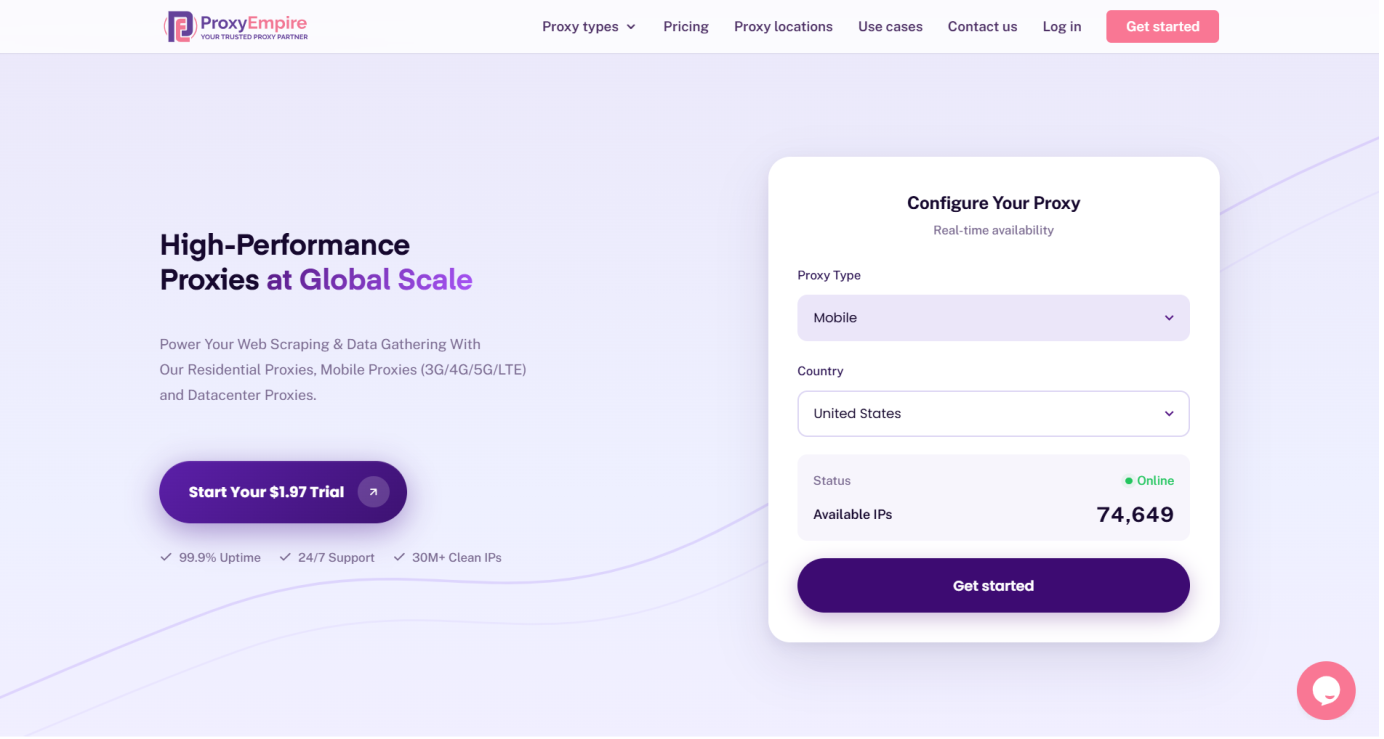
ProxyEmpire structures its network around rapid IP cycling. Automated scripts pull market data during short operational loops. But forcing automatic per-request IP rotation carries a technical tradeoff. Constant network jumping alerts UK security filters. Warmed accounts drop mid-session. The platform lacks the long-term session persistence necessary to anchor digital identities.
| Key feature | Operational benefit |
| Automatic cycling | Execute automatic per-request IP rotation natively. |
| Competitor tracking | Monitor competitor pricing via automated collection loops. |
| Global access | Access nodes globally on pay-as-you-go contracts. |
| Plan type | Starting price |
| Residential/Mobile | From $1.97/trial |
| Rotating Datacenter | From $25/month ($0.45/GB) |
| Dedicated Mobile | From $125/month |
4. IPRoyal

IPRoyal leverages crowdsourced peer-to-peer networks to keep upfront costs low, catering to entry-level testing environments. But relying on crowdsourced architecture introduces reliability flaws into production environments. Residential hosts naturally power down their routers unpredictably, causing active operational threads to drop. Hidden structural costs also impact their mobile UK proxies; rigid 24-hour billing cycles force operators to pay for a full day of access even if a validation script finishes executing in ten minutes.
| Key feature | Operational benefit |
| Crowdsourced nodes | Use residential nodes with zero minimum commitments. |
| Sandboxing | Deploy cheap infrastructure for entry-level testing. |
| Non-expiring data | Purchase non-expiring residential data blocks. |
| Plan type | Starting price |
| Rotating Residential | From $1.75/GB |
| Static Residential | From $2.40/proxy |
| Datacenter | From $1.39/proxy |
| Mobile | From $117/month |
5. PrivateProxy
PrivateProxy specializes in legacy datacenter and static residential lines. The network offers unmetered bandwidth allocations for basic scraping operations. Fixed fiber networks manage standard WebSocket connections. They lack native cellular coverage. Local ad verification in London demands high-trust UK proxies. This inventory fails that requirement. Operators must buy nodes elsewhere. This fractures their data footprint.
| Key feature | Operational benefit |
| Legacy routing | Route data traffic through legacy datacenter architecture. |
| Unmetered limits | Consume unmetered bandwidth allocations on static lines. |
| Instant activation | Connect instantly with automated port activation scripts. |
| Plan type | Starting price |
| Datacenter Static | From $3/month |
| Residential Static | From $5/month |
| Datacenter Rotating | From $1.5/month |
| Residential Rotating | From $10/month |
The best proxy infrastructure strategy
Raw bandwidth is a commodity. Scaling operations securely in 2026 requires auditing overall network stability and maintaining strict identity consistency. Choosing the best proxy providers for rotating proxies can also help businesses maintain reliable connections and manage large-scale operations more effectively.
Eliminate vendor fragmentation
Operators must stop buying infrastructure components from disparate vendors. Using independent proxy vendors, SMS tools, and card issuers shatters consistency. Algorithms flag geographic and behavioral mismatches instantaneously. Centralizing the stack fixes this. Running network routing, virtual cards, and operator lines through one unified dashboard permanently stops multi-dimensional flagging.
Prioritize persistent sessions
Rapid IP rotation is effective for scraping but destroys active operational profiles. Constant network jumping triggers security checks. Complex multi-accounting demands persistent sessions on real 4G/5G carrier IPs. Persistent routing anchors isolated cookies, ensuring the connection accurately mirrors a legitimate smartphone user maintaining a steady connection on the EE or Vodafone network.
Verify the footprint upfront
Engineers must never connect to target platforms blindly. The majority of providers assign unchecked network addresses with unknown abuse histories. Operators must evaluate IP, phone, and billing data prior to initiating logins. Using native fraud checkers to view the footprint exactly as compliance engines evaluate it is the primary factor dictating whether campaigns stay live.
FAQ: Infrastructure insights for smart buyers
What features define the best UK proxies in 2026?
Modern compliance platforms cross-reference every data point, checking proxy location against SMS numbers and virtual card billing addresses. A single mismatch drops the operational profile. Routing network connections, SMS activations, and payment cards through a unified ecosystem stops this completely.
How do premium networks manage automated sessions?
Constant rotation kills active tasks, as security systems detect rapid IP jumping immediately. Top networks supply sticky nodes to hold one cellular IP securely. Infrastructure teams should prioritize networks that support advanced routing protocols, specifically SOCKS5 and VLESS/Xray.
Why do accounts flag even on top-tier mobile IPs?
Platforms evaluate payment methods, hardware markers, and SMS history simultaneously alongside the network connection. Clean IPs still fail if the financial metadata appears suspicious. Tying the network region directly to virtual cards and active UK operator lines keeps all data completely consistent.
How do elite providers maintain pool health?
Most standard networks distribute unchecked addresses. Premium platforms embed native fraud score tools directly into their operational dashboards, revealing reputation metrics upfront. This allows engineers to assess Abuse Velocity and IPQualityScore metrics exactly as compliance algorithms do.
Can automated sessions run on cellular IPs without expensive daily commitments?
Rigid 24-hour blocks waste capital when automation scripts only require brief execution windows. The top providers supply highly flexible terms, bundling unlimited daily mobile lines with cost-effective, per-gigabyte residential pools.


