
Realme 16x vs Poco M8 Power: The Ultimate Budget 5G Showdown
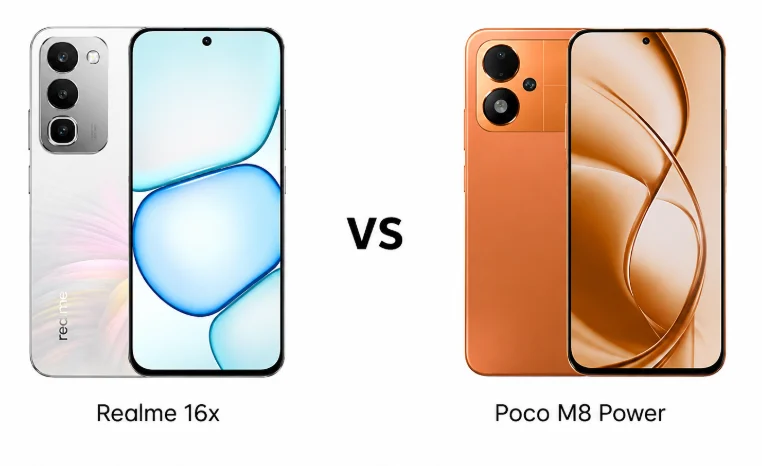
The budget 5G smartphone market is notoriously competitive, forcing manufacturers to carefully balance performance, build quality, and price. The Realme 16x and the Poco M8 Power perfectly illustrate this balancing act, albeit by taking entirely different paths. While Realme leans heavily into rugged durability and gaming-centric charging features, Poco makes a compelling play for multimedia dominance and sheer endurance.
Here is how these two budget contenders stack up against each other.
Realme 16x vs. Poco M8 Power: Design and Display
The design philosophies of these two devices are starkly contrasting. The Realme 16x is built to survive. It combines a glass front with a tough plastic chassis, boasting IP65 water resistance, MIL-STD-810H military-grade compliance, and advanced drop resistance. It even includes a nostalgic RGB notification light.
The Poco M8 Power, on the other hand, prioritizes an immersive media experience. While it matches the IP65 rating, it sacrifices extreme ruggedness for a stunning 6.99-inch 120Hz AMOLED display protected by Gorilla Glass 7i. With deeper blacks, under-display fingerprint technology, and peak brightness hitting 1,800 nits, the Poco effortlessly outshines Realme’s 6.81-inch 144Hz IPS LCD panel. Adding stereo speakers to the mix, Poco easily wins the entertainment category.
Performance and Battery: The Marathon Runners
Under the hood, Poco maintains its lead. Powered by the Snapdragon 4 Gen 4 platform with up to 8GB of RAM, the M8 Power is better equipped for multitasking and longevity compared to Realme’s MediaTek Dimensity 6300 and 6GB of RAM limit.
Endurance is where both phones push the boundaries:
-
Poco M8 Power: Packs a colossal 8,000mAh battery with 45W wired charging and an impressive 22.5W reverse wired charging, effectively turning it into a fast power bank.
-
Realme 16x: Houses a massive 7,000mAh battery and matches the 45W charging speed. It wins points for gamers by including bypass charging (powering the phone directly from the cable to reduce heat) but only offers a slow 7W reverse charge.
Cameras and Software Lifespan
Budget phone cameras rarely break boundaries, and both devices keep it simple with 50MP primary sensors and 8MP selfie cameras.
However, Realme edges out a narrow victory for mobile videographers by supporting 1080p video recording at 60fps, whereas Poco is capped at 30fps. Conversely, Poco claims a massive victory in software longevity, promising up to four major Android updates (launching on Android 16) compared to Realme’s two.
Realme 16x vs. Poco M8 Power Spec Comparison
| Feature | Realme 16x | Poco M8 Power |
| Display | 6.81″ IPS LCD (144Hz, 1200 nits) | 6.99″ AMOLED (120Hz, 1800 nits) |
| Processor | MediaTek Dimensity 6300 | Snapdragon 4 Gen 4 |
| Battery | 7,000mAh (Bypass charging) | 8,000mAh (22.5W Reverse charging) |
| Cameras | 50MP Main (1080p @ 60fps) | 50MP Main (PDAF, 1080p @ 30fps) |
| Software | Android 16 (2 major updates) | Android 16 (4 major updates) |
| Price | ~$300 | ~$250 |
The Final Verdict
Priced at approximately $250, the Poco M8 Power is a knockout value proposition. It undercuts the $300 Realme 16x while offering a superior AMOLED display, a larger battery, stereo speakers, broader connectivity (NFC, Wi-Fi 6), and double the software support.
The Realme 16x remains a highly specific, niche recommendation. If you work in harsh environments or need a rugged, drop-resistant phone that supports bypass charging for extended mobile gaming, the $50 premium might be worth it. For everyone else, Poco is the clear winner.


