
Xiaomi Xring O3 vs. Snapdragon 8 Elite Gen 5: Specs and Benchmarks Compared
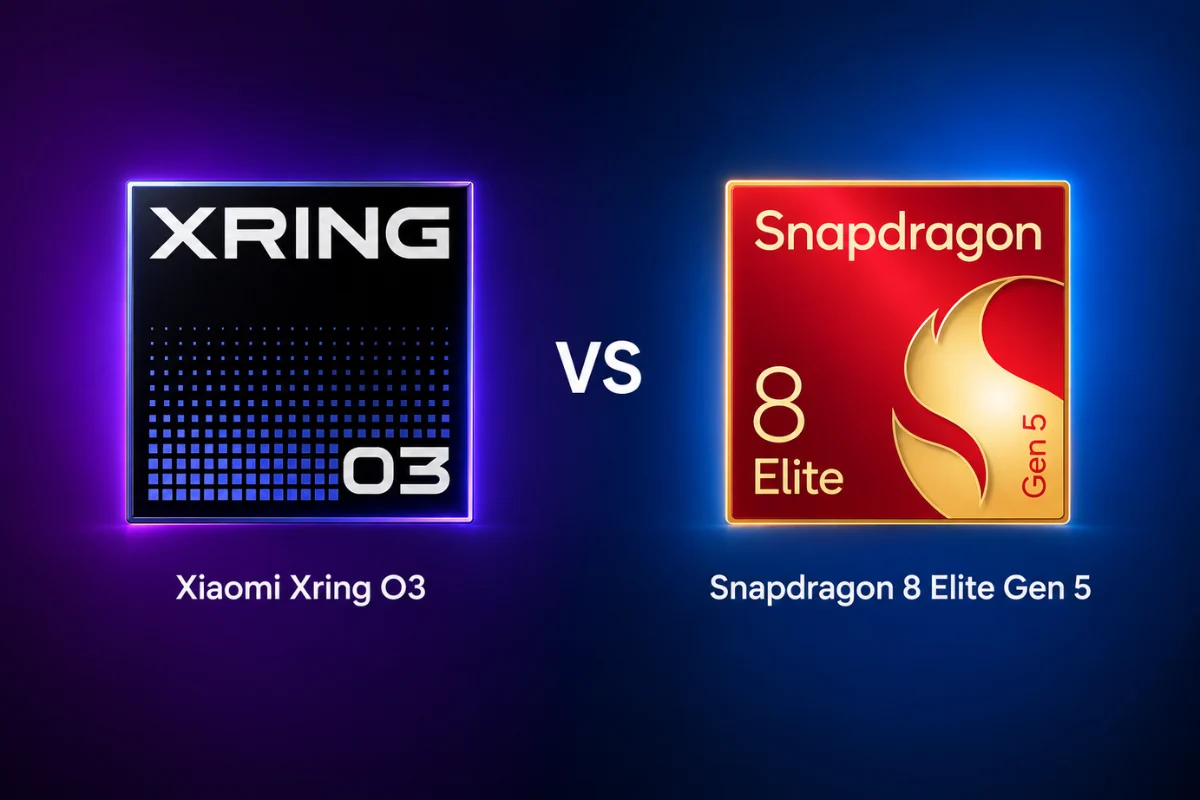
Xiaomi has officially unveiled its second-generation smartphone processor, the Xring O3, signaling a major leap forward from last year’s O1. Armed with ARM’s latest C1-series cores, a highly upgraded Neural Processing Unit (NPU), and a larger physical die size than Qualcomm’s flagship Snapdragon 8 Elite Gen 5, the Xring O3 is positioning itself as a dominant force in the premium mobile segment.
Based on Xiaomi’s internal lab testing, the new silicon doesn’t just compete with the current heavyweights—it reportedly outperforms every other mobile chip on the market, including Apple’s A19 Pro and Qualcomm’s top-tier offering.
Here is a deep dive into how Xiaomi’s ambitious new chipset compares directly with the Snapdragon 8 Elite Gen 5.
Architectural Breakdown: Xring O3 vs. Snapdragon 8 Elite Gen 5
Both processors are built on TSMC’s cutting-edge 3-nanometer manufacturing process, but their architectures take different approaches to balancing raw power and efficiency.
Notably, Xiaomi’s Xring O3 boasts a massive die size of 133 sq. mm and houses 24 billion transistors. It also adopts the next-generation LPDDR6 memory standard, whereas Qualcomm relies on LPDDR5X. However, Qualcomm retains the edge in cellular connectivity, offering a higher peak download speed via its Snapdragon X85 5G modem compared to the MediaTek T900 modem found in the Xiaomi chip.
| Specification | Xiaomi Xring O3 | Qualcomm Snapdragon 8 Elite Gen 5 |
| Process Node | 3nm (TSMC) | 3nm (TSMC) |
| Transistor Count | 24 billion | Unspecified |
| Die Size | 133 sq. mm. | 126.2 sq. mm. |
| CPU Architecture | 10-core (2x C1-Ultra @ 4.35 GHz, 4x C1-Premium @ 3.68 GHz, 4x C1-Pro @ 3.15 GHz) | 8-core (2x Oryon Gen-3 Prime @ 4.61 GHz, 6x Oryon Gen-3 Perf. @ 3.63 GHz) |
| GPU | 16-core Mali-G2 Ultra NX (1.6 GHz) | Adreno 840 (1.2 GHz) |
| NPU | Yes (Up to 200 TOPS) | Qualcomm Hexagon NPU |
| Memory Support | LPDDR6 (up to 5333 MHz) | LPDDR5X (up to 5300 MHz) |
| Storage Support | UFS 4.1 | UFS 4.0, UFS 4.1 |
| Connectivity | MediaTek T900 5G (Up to 7.4 Gbps down), Wi-Fi 7, Bluetooth 6.0 | Snapdragon X85 5G (Up to 12.5 Gbps down), Wi-Fi 7, Bluetooth 6.0 |
Benchmark Showdown: Staggering Claims from the Lab
Xiaomi has published a series of benchmark scores that, if translated to real-world performance, represent a paradigm shift in mobile computing.
Historically, Apple’s silicon has maintained an iron grip on single-core performance. However, Xiaomi’s Geekbench data indicates the Xring O3 scores a 3,945 in single-core testing, comfortably bypassing both the Apple A19 Pro (3,821) and the Snapdragon 8 Elite Gen 5 (3,726). Xiaomi even claims the chip outpaces Apple’s desktop-class M4 processor.
The multi-core gap is even wider. The Xring O3’s 10-core configuration seemingly demolishes the competition, scoring an unprecedented 15,221.
| Benchmark (Geekbench) | Xiaomi Xring O3 | Snapdragon 8 Elite Gen 5 | Apple A19 Pro |
| Single-Core | 3,945 | 3,726 | 3,821 |
| Multi-Core | 15,221 | 11,402 | 9,752 |
In the AnTuTu v11 synthetic benchmark, Xiaomi reports that the Xring O3 shattered the 5-million-point ceiling, achieving an astonishing 5.22 million points. By comparison, the Snapdragon 8 Elite Gen 5 sits at roughly 3.9 million points.
Xring O3: The Real-World Caveat
While these figures are undeniably impressive, a critical journalistic caveat applies: these benchmarks were conducted inside Xiaomi’s proprietary testing labs.
Manufacturers typically achieve these peak numbers using highly optimized prototype devices running in ideal thermal conditions. Retail smartphones operating in the real world must contend with background applications, varying ambient temperatures, and thermal throttling—a protective measure that slows the processor down to prevent overheating under sustained heavy loads.
Consumers will soon be able to put these claims to the test, as the new Xring O3 chip is officially powering the newly launched Xiaomi 18 Fold and Xiaomi Pad 9 Pro Max. Independent, real-world benchmark testing will ultimately determine if Xiaomi’s new silicon can maintain its crown outside the lab.


