
Automated Testing: Why More Teams Are Realizing They Cannot Scale Without It
Most software teams have experienced some version of the same conversation.
Before every release goes out, the testing is complete; everyone feels reasonably good about it, and the deployment moves forward.
Then a few hours later, something unexpected happens.
Maybe customers are having trouble checking out. Maybe a workflow that has worked perfectly for months suddenly behaves differently. Maybe a support ticket appears for an issue nobody was expecting to see.
What makes these situations frustrating is that the problem is often nowhere near the change that was just released.
The new feature works exactly as intended.
Something else doesn’t.
One of the reasons this keeps happening is that modern applications rarely operate as a single system anymore.
A team can spend days working on a feature, test everything they touched, and feel pretty confident about the release.
Then a few days later, an issue shows up somewhere nobody was looking.
Not because the feature itself was broken.
Not because anyone skipped testing.
Just because software has a way of behaving differently once everything starts interacting together in the real world.
Part of the challenge is that modern applications are connected to far more systems than most people realize.
Most of the time, users have no idea how much is happening behind the scenes when they click a button.
Nor should they.
They are simply trying to place an order, log in, create an account, or complete whatever task brought them there in the first place.
What they see is one action.
What testing teams see is everything that has to happen for that action to work correctly.
And sometimes there is a lot more involved than people realize.
The other challenge is that software teams rarely have the luxury of slowing things down.
While one release is being tested, another feature is already being built. While bugs are getting fixed, new requirements are being discussed. There is always another change coming around the corner.
The application keeps moving forward whether testing is finished or not.
Meanwhile, users are not thinking about release schedules, development cycles, or technical complexity.
They just expect things to work.
If something worked yesterday, they expect it to work today.
And if something breaks, they are usually not interested in hearing how complicated the system has become behind the scenes.
That is often the point where automation starts feeling a lot less like an improvement project and a lot more like a necessity.
Not because teams are trying to automate every possible scenario, but because there is only so much manual validation people can realistically keep up with as applications continue growing.
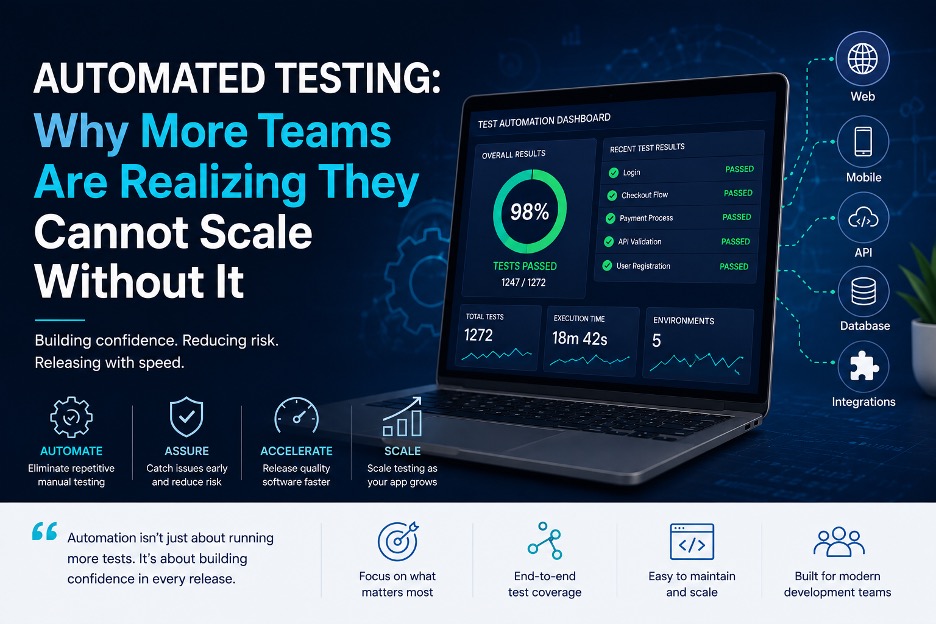
Why Automation Has Become a Necessity
For all the technology changes over the years, testing is still trying to answer the same basic question:
Can people use the application the way they are supposed to?
That sounds simple enough.
The problem is that software is rarely simple anymore.
Most people never think twice about what happens after they submit a form or click a button.
If everything works, the experience feels effortless.
That is exactly what users want.
For testing teams, though, those seemingly simple actions are often where a surprising amount of complexity hides. The challenge is not always what users can see. It is everything happening underneath the surface that also has to work correctly at the same time.
And when one piece behaves differently than expected, the effects can show up in places nobody immediately thinks to look.
Every new feature introduces something else that needs attention. Existing functionality still has to work. Integrations still have to communicate properly. Critical user journeys still need to be validated.
After a while, it can start to feel like there is always one more thing to check before a release goes out.
That is usually when teams start looking at automation differently.
It stops being about running more tests.
It becomes about creating enough confidence to keep moving without constantly wondering what might have been missed.
Why Automated Regression Testing Matters
One area where automation consistently proves its value is automated regression testing.
Most teams have experienced the uncomfortable situation where a release solves the problem it was supposed to solve but somehow creates a completely different one somewhere else.
The tricky part is that nobody intentionally breaks these things.
Software has simply become too connected for every dependency and side effect to be obvious all the time.
That is why regression testing matters so much. It is less about validating what was just changed and more about making sure everything around that change still works the way people expect it to.
Over time, those checks become a safety net around the workflows the business depends on most. Login processes, checkout experiences, customer onboarding, reporting, payments, and integrations. The things users assume will work every single time they open the application.
And the faster development moves, the more valuable that safety net becomes.
Choosing Automation Testing Tools Without Creating New Problems
When teams start discussing automation, the conversation usually turns toward technology fairly quickly.
Which platform should we use?
Which framework is best?
What is everyone else using?
Those questions tend to come up almost immediately once automation enters the conversation.
And honestly, that makes sense.
People naturally want to know which platform is best or what everyone else is using.
But many teams discover that the technology itself is not usually the hardest part.
More often, the bigger challenge is deciding where automation will actually create value. Which workflows need protection. Which areas create the most risk. Which processes are consuming the most manual effort today.
Once those answers become clear, choosing a tool becomes much easier.
The answers often reveal where automation can provide the most value.
Once that foundation is clear, evaluating automation testing tools becomes much easier. The goal is not to automate everything possible. The goal is to automate the areas that create meaningful value for the business and the development team.
Because even the most advanced tool will struggle if teams are automating the wrong things.
That is one reason many organizations have started looking beyond tools that simply run tests.
They want something that can help manage testing across different applications, teams, and environments without creating another layer of complexity to maintain.
Platforms like Qyrus are helping teams take that approach by bringing web, mobile, API, enterprise, and other testing activities together in one place. The goal is not simply to run more tests. It is to make automation easier to manage as testing programs continue to grow.
The Importance of a Strong Test Automation Framework
One thing many teams do not realize at the beginning is that getting automation up and running is often the easy part.
The real challenge comes later.
A few automated tests are easy to manage.
A few hundred is a different story.
That is usually when teams start realizing how important structure becomes.
It’s usually not something teams notice right away.
Automation starts small, everyone follows roughly the same approach, and things feel manageable. But as more tests get added and more people contribute, things can start to drift. Similar tests get created multiple times, maintenance takes longer than expected, and simple application changes suddenly require updates in several different places.
Before long, the challenge is no longer building new tests. It’s keeping the existing ones organized and reliable.
A good test automation framework helps create consistency as automation grows.
While every organization approaches frameworks differently, the strongest ones usually share a few common characteristics:
- Reusable components that prevent teams from solving the same problem repeatedly
- Consistent standards that make tests easier to understand and maintain
- Clear reporting that helps teams quickly identify what actually needs attention
- Scalable execution processes that can grow alongside the application
None of these things are particularly flashy, and they rarely get much attention when teams first start automating. But they are often the difference between automation that continues providing value and automation that gradually becomes another system people struggle to maintain.
Automation Testing Best Practices That Make a Difference
One thing that stands out about successful automation programs is that they are usually much less ambitious in the beginning than people expect.
The teams that get the most value from automation rarely start by trying to automate everything.
Instead, they focus on the parts of the application that matter most.
The workflows customers use every day.
The areas that would create immediate problems if they stopped working.
The functionality the business depends on.
That focused approach tends to create value much faster than trying to build a massive automation suite all at once.
They also understand something many teams learn the hard way.
More tests do not automatically create better coverage.
A smaller group of reliable tests that consistently provide useful feedback is often worth far more than hundreds of tests that require constant maintenance or regularly fail for reasons nobody can explain.
The strongest teams also stop treating automation as something separate from development.
It is not something that gets attention once testing starts or right before a release.
Instead, it becomes part of the normal rhythm of building software.
As changes are made, feedback starts showing up sooner. Issues get identified while people are still actively working on the feature instead of days or weeks later when everyone has already moved on.
Those conversations tend to be easier. The fixes tend to be faster. And teams spend less time scrambling to understand what happened right before a deadline.
Over time, another mindset shift happens as well.
Teams stop thinking about automation as something they will eventually finish.
Because the reality is that software is never finished either.
Applications evolve. Features change. Customer expectations change. Business priorities change.
The automation that provides the most value is usually the automation that grows and adapts alongside all of it.
Final Thoughts
At the end of the day, most teams are not investing in automation because they want more tests.
They are investing in it because software has become increasingly difficult to validate entirely by hand.
Applications are larger. Systems are more connected. Releases happen faster.
But the expectation from users has never really changed.
People still expect software to work every time they open it.
The organizations that get the most value from automation are usually not the ones with the largest test suites or the highest test counts.
They are the ones that have built confidence around the parts of the application that matter most.
When automation is working well, it is not something teams spend all day thinking about. Tests run, feedback arrives quickly, and people trust the results. Less energy gets spent worrying about what might have been missed, and more energy goes toward building better software.
And for many teams, that confidence is where the real value of automation begins.
