
Exynos 2700 Benchmark Leak: What the New Deca-Core CPU Architecture Reveals

Even though the Galaxy S26 series recently hit the market with the current Exynos 2600 processor, the tech industry is already looking ahead. The first traces of what is expected to be Samsung’s next-generation flagship silicon, the Exynos 2700, have appeared on the popular synthetic benchmarking platform, Geekbench. This early look reveals intriguing shifts in the underlying chip architecture and provides clear indicators of the direction the South Korean tech giant is taking with its upcoming components.
A New Deca-Core Architecture and Xclipse 970 Graphics
According to data extracted from the Geekbench database, the prototype processor bears the internal model designation S5E9975. The most notable hardware modification is the transition to a deca-core (10-core) CPU architecture. Unlike the current Exynos 2600, which utilizes a more standard tri-cluster design, Samsung is reportedly experimenting with an unconventional quad-cluster core arrangement for this new SoC.
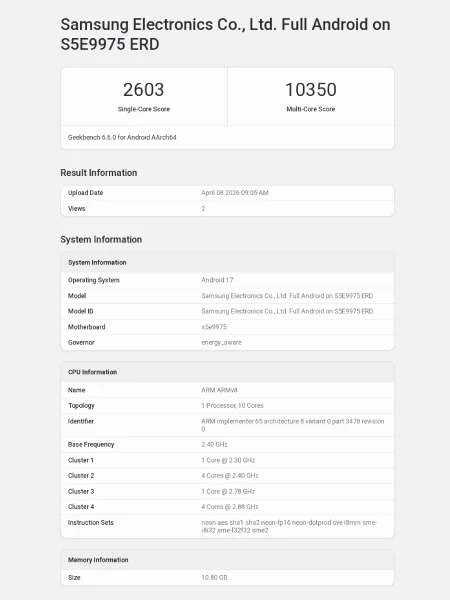
The recorded clock speeds on this engineering sample range from 2.30 GHz up to a peak of 2.88 GHz. On the graphics processing front, the benchmark confirms the presence of a new GPU dubbed the Xclipse 970, which is highly likely to be built upon AMD’s latest graphics architecture.
Synthetic Scores and Testing Context
In the benchmark run, the Exynos 2700 managed to score 2603 points in single-core and 10350 points in multi-core workloads. While these figures appear somewhat modest and align closely with the current generation of mobile chips, industry experts caution against premature disappointment.
The tested unit is an early engineering prototype, and it is standard industry practice to heavily underclock the silicon during these initial phases. For engineers, the primary focus during early testing is evaluating system stability and analyzing thermal behavior under load, rather than demonstrating raw processing horsepower. The test rig was equipped with 12 GB of RAM and was running an early build of the upcoming Android 17 operating system.
The Leap to a 2-Nanometer Process Node
The final retail version of the Exynos 2700 is widely expected to be fabricated using Samsung Foundry’s advanced 2-nanometer process node (SF2P). The primary focus of this generational leap will reportedly be on drastically improving energy efficiency and mitigating thermal throttling issues under peak workloads. Provided development stays on schedule, the Exynos 2700 will serve as the powerhouse for the upcoming Samsung Galaxy S27 series, which is anticipated to launch in early 2027.


