
Motorola Signature 27 vs. Honor Magic 9 Pro Max. A Detailed Comparison
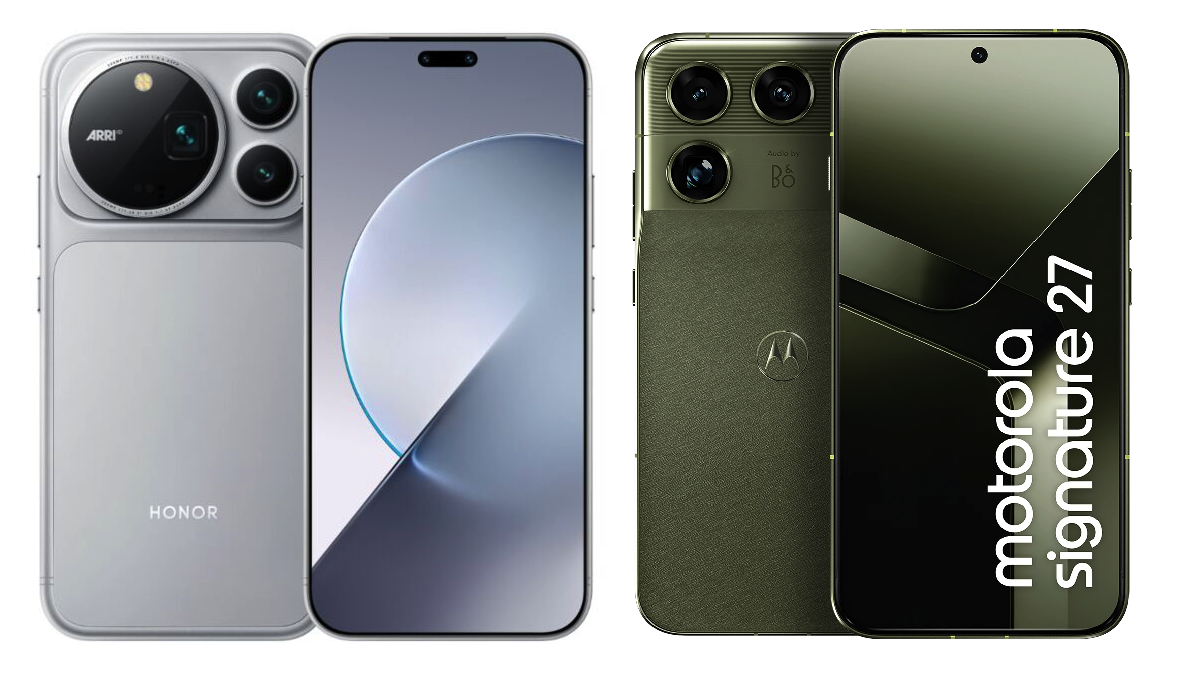
The Motorola Signature 27 and Honor Magic 9 Pro Max share Qualcomm’s Snapdragon 8 Elite Extreme Gen 6 processor, but build very different propositions around it. Motorola combines a Tandem OLED display, a dedicated action sensor and confirmed US availability. Honor emphasises its dual 200MP cameras, ARRI imaging features and a substantially larger battery.
Their quoted prices appear dramatically different: $1,599.99 for Motorola in the United States against CNY 6,499—approximately $910—for Honor in China. That is not a like-for-like comparison, however. The prices cover different markets and storage configurations, while Honor’s European pricing remains unannounced.
There is also a verification caveat. The linked Motorola product page labels its specifications as rumoured and conflicts with the supplied article on several details, including display refresh rate, protective glass and telephoto magnification. The comparison below follows the supplied article, with disputed details treated cautiously rather than presented as independently settled specifications.gizmochina
Key Specifications Compared
| Feature | Motorola Signature 27 | Honor Magic 9 Pro Max |
|---|---|---|
| Processor | Snapdragon 8 Elite Extreme Gen 6 | Snapdragon 8 Elite Extreme Gen 6 |
| Display | 6.8-inch Extreme AMOLED Duo, Tandem OLED | 6.8-inch LTPO OLED |
| Refresh rate | 120Hz in the supplied article | Adaptive 1–120Hz |
| Advertised peak brightness | Up to 12,000 nits | Up to 10,000 nits |
| Main camera | 50MP Sony LYTIA L910 with LOFIC | 200MP, 1/1.28-inch sensor, f/1.57 |
| Telephoto camera | 200MP periscope; 3x optical zoom in the supplied article | 200MP, 1/1.4-inch sensor, f/2.6 |
| Ultrawide camera | 50MP | 50MP, f/2.0 |
| Front camera | Not specified in the supplied comparison | 55MP square sensor, plus 3D depth sensor |
| Additional imaging hardware | EVS Action Sensor | H1 imaging chip |
| Battery | 7,000mAh silicon-carbon | 8,800mAh silicon-carbon |
| Wired charging | 90W | 100W |
| Wireless charging | 50W | 80W |
| Protection ratings | IP68/IP69 | IP68/IP69/IP69K |
| Thickness | 7.99mm | 8.59mm |
| Weight | Not specified in the supplied comparison | 233g |
| Software | Android with Gemini Intelligence and Motorola Qira | Android 17 with MagicOS 11 |
| Stated support | Seven years of OS upgrades and security updates | Seven years of OS upgrades and security updates |
| Listed configurations | 12GB RAM + 512GB storage in the US | From 12GB + 256GB to 16GB + 1TB |
| Starting price | $1,599.99 in the US; £1,299 in the UK | CNY 6,499 in China |
| Availability | US and UK availability described | China and Hong Kong; Europe planned for January 2027 |
Specifications reflect the supplied comparison. The conflicting Motorola product listing means the final display and camera details require confirmation.gizmochina
Performance: The Same Processor Does Not Guarantee Identical Results
Both phones use the same flagship Qualcomm platform, described in the supplied information as a 2nm design with Adreno 850 graphics. The meaningful differences therefore lie in cooling, power management and software rather than processor branding.
Motorola’s ArcticMesh system combines a vapour chamber with diamond-infused thermal gel and liquid metal. The company describes the arrangement as 40 percent larger than its predecessor’s, although the supplied comparison does not identify the precise reference device.
Honor uses Plate-level Cooling System 2.0. It also lists a third-generation C3 radio chip with a seven-core RF architecture, while Motorola highlights a six-antenna design.
These are different engineering approaches, not evidence of a performance winner. Without sustained workload tests, there is no basis to promise identical frame rates, temperatures or battery efficiency simply because the processors match.
Displays: Tandem OLED Versus an Anti-Reflective LTPO Panel
Motorola’s 6.8-inch Extreme AMOLED Duo display uses Tandem OLED technology. The supplied article lists a 120Hz refresh rate, Dolby Vision support and Gorilla Glass Ceramic 3 protection.
Honor’s 6.8-inch LTPO OLED has a resolution of 2868 × 1320 pixels and an adaptive refresh rate ranging from 1Hz to 120Hz. Its listed features include 4320Hz PWM dimming, minimum brightness of 1 nit and an anti-reflective coating with a claimed reflectivity of 1.5 percent.
The headline brightness figures—12,000 nits for Motorola and 10,000 nits for Honor—should not decide the comparison. Without matching measurement conditions, they do not establish sustained outdoor visibility or full-screen brightness.
Motorola’s Tandem OLED construction and Honor’s anti-reflective treatment are more useful points of distinction. Overall display quality still requires comparable measurements and viewing tests.
Main Cameras: Different Hardware, Not Just Different Megapixel Counts
Honor combines a 200MP main camera with a 1/1.28-inch sensor and an f/1.57 lens. Motorola instead uses a 50MP Sony LYTIA L910 main sensor with LOFIC technology, which is intended to preserve information across bright and dark areas of the same scene.
Honor’s higher resolution is a clear specification difference, but it is not proof of better photographs. Exposure, optics, processing and autofocus all influence the result.
Motorola also includes a dedicated EVS Action Sensor. Its stated purpose is to improve clarity when photographing fast-moving subjects, including in low light. That is a more specialised addition than simply increasing main-camera resolution, although its effectiveness needs testing.
The supplied article cites a favourable DXOMARK comparison for Motorola. Without the underlying score, test date and category results, that claim is not a sufficient basis for ranking these two phones.
Telephoto and Video: Honor Offers a More Extensive Creator Package
Both phones have 200MP periscope cameras. Honor specifies a 1/1.4-inch sensor and an f/2.6 lens, while Motorola’s optical zoom is described as 3x in the supplied article.
That Motorola figure is disputed by the linked product page, which instead lists 5x. The final optical specification should therefore be checked before purchase.gizmochina
Honor adds a dedicated H1 imaging chip for RAW noise reduction, 14 included ARRI Looks presets and support for ARRI LogC3 recording. These features give it a more elaborate documented imaging workflow.
Its accessory options extend that approach:
-
The G200 teleconverter provides a 200mm-equivalent focal length and weighs 88g.
-
The G500 teleconverter extends reach to a 500mm-equivalent focal length.
-
A SmallRig cage provides mounting points for equipment such as microphones and lights.
All are sold separately. Their value depends on whether buyers intend to use them, rather than their presence in a catalogue alone.
Motorola advertises zoom extending to 100x through processing. That maximum should not be confused with optical magnification or assumed to match the results of dedicated accessory optics.
Front Cameras and Audio: Distinct Priorities
Honor’s 55MP front camera uses a square sensor, allowing users to switch between square, landscape and portrait framing without rotating the handset. A separate 3D depth sensor supports its front-facing hardware package.
The supplied comparison does not identify Motorola’s front camera, although the linked product page lists a 50MP autofocus unit. Because that page contains other conflicting details, it should not be used to imply that every specification is final.gizmochina
For recording audio, Honor lists four microphones, including a directional microphone that it claims can capture sound from up to 20 metres away. No test conditions are supplied for that distance.
Motorola’s emphasis is playback. Audio by Bang & Olufsen includes modes for music, films, games and podcasts. Those features serve a different purpose from Honor’s recording equipment, so they do not create a straightforward audio winner.
Battery and Charging: Honor Leads on Capacity and Rated Power
Honor’s 8,800mAh battery has 1,800mAh more nominal capacity than Motorola’s 7,000mAh unit—approximately 26 percent more.
That is a substantial starting advantage, but it does not guarantee 26 percent longer runtime. Display behaviour, software, signal conditions and workload remain important.
Honor also lists higher charging power: 100W wired and 80W wireless, compared with Motorola’s 90W and 50W. Those ratings do not establish actual charging times.
The supplied article states that Honor’s wireless charger is sold separately, while Motorola’s wired and wireless chargers are both separate purchases. Buyers comparing total costs should therefore check the accessories required to reach the advertised speeds.
Design: Motorola Is Thinner, Honor Lists More Security Hardware
At 7.99mm, Motorola is thinner than Honor’s 8.59mm body. Their width is almost identical, while Honor is marginally shorter.
Honor weighs 233g and comes in Moss Green, Silver Salt and Shadow Black. It combines 3D face unlocking with an ultrasonic fingerprint reader and carries IP68, IP69 and IP69K ratings.
Motorola offers Pantone Coal Smoke with a Tactical Weave finish and Capulet Olive with a brushed textile-style surface. It lists IP68/IP69 protection and says the phone passed selected MIL-STD-810H procedures.
Those claims should not be interpreted as proof that either device is universally more durable. They describe different tests and protection categories, not a complete ranking of resistance to everyday damage.
Software Support Is a Shared Strength
Both phones promise seven years of Android upgrades and security updates. Long support is therefore not an exclusive reason to choose Motorola.
Its differentiators are Gemini Intelligence and Motorola Qira. Qira is designed to help retrieve information across applications and requires a Motorola or Lenovo account, alongside at least 12GB of RAM.
Motorola’s RAM Boost can increase the advertised available memory to 24GB, but that is not equivalent to 24GB of physical RAM.
Honor’s MagicOS 11 includes the YOYO assistant and a dedicated AI button. The supplied description also lists scheduled tasks, video-highlight capture and integration features involving iPhones, Apple Watches and Macs.
Support duration alone does not establish update quality or speed. Neither phone’s delivery cadence is detailed in the supplied comparison.
Price and Availability: The Most Important Qualification
Motorola’s $1,599.99 US price covers 12GB of RAM and 512GB of storage. Honor’s CNY 6,499 Chinese starting price covers 12GB and 256GB.
The apparent price gap therefore combines two different markets and storage capacities. It is not a direct comparison of equivalent local offers.
The supplied article places Motorola pre-orders on November 19 and sales on November 26. Those dates differ from earlier reporting, so buyers should confirm the current schedule with the retailer. The phone is described as unlocked and compatible with Verizon, AT&T and T-Mobile.
Honor launched in China on September 28 and reached Hong Kong on November 4. A European rollout, including the UK and France, is planned for January 2027. No US release has been announced.
For US buyers, Motorola is consequently the only one of the two with confirmed local availability in the supplied information. In Europe, Honor’s eventual regional price will be central to a meaningful value comparison.
Verdict: Honor for Imaging Hardware, Motorola for Confirmed US Access
The Honor Magic 9 Pro Max offers the more extensive specification-led package for imaging and battery capacity. Its dual 200MP cameras, ARRI video features, larger battery and optional accessories give it a clear identity for photography and video enthusiasts.
Motorola combines its own distinctive hardware—Tandem OLED, LOFIC main-camera technology, an action sensor and Bang & Olufsen audio—with a thinner design and confirmed US distribution.
Honor appears more aggressive on value, but its Chinese starting price cannot settle the comparison for US or European buyers. Motorola’s premium also demands scrutiny, particularly while published specifications and availability dates remain inconsistent.
The practical decision depends on local availability, final regional pricing and verified specifications. Camera quality, endurance and sustained performance still need direct testing.


