
Samsung Galaxy S26 Ultra vs Vivo X500 Pro Max: Ultimate 2026 Comparison
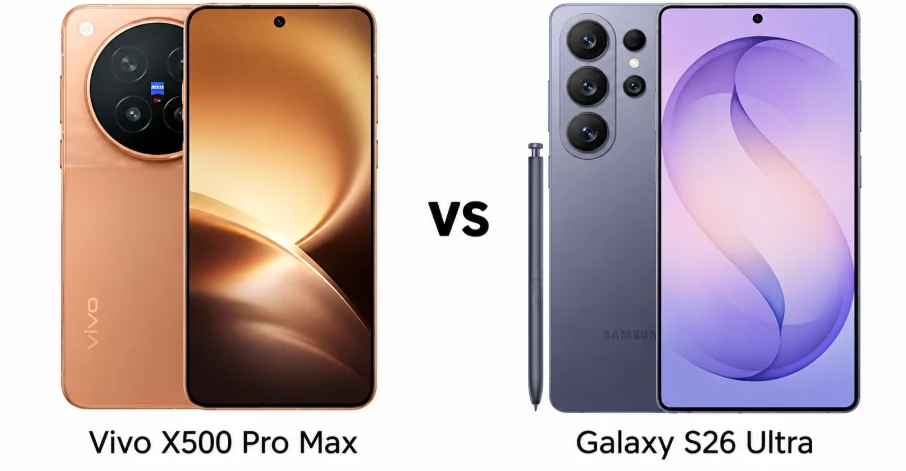
The ultra-premium smartphone market is witnessing a fascinating divergence in strategy. On one side, the Vivo X500 Pro Max pushes the boundaries of raw hardware, boasting an unprecedented silicon-carbon battery and aggressive imaging technology. On the other, the Samsung Galaxy S26 Ultra refines its legacy of productivity, leaning heavily into software longevity, versatile quad-cameras, and its signature S Pen. Deciding between these two heavyweights requires looking beyond the spec sheet to understand which overarching philosophy aligns with your daily workflow.
Samsung Galaxy S26 Ultra vs Vivo X500 Pro Max Specs Comparison
|
Category |
Vivo X500 Pro Max |
Samsung Galaxy S26 Ultra |
Advantage |
|
Design & Build |
Glass/fiber-reinforced plastic back, aluminum frame, IP68/IP69 |
Gorilla Armor 2 front, Gorilla Glass Victus 2 back, Armor Aluminum 2, IP68, S Pen |
Samsung (Premium materials, S Pen) |
|
Display |
6.85″ LTPO AMOLED, 144Hz, Dolby Vision, 4,400 nits peak |
6.9″ Dynamic AMOLED 2X, 120Hz, 2,600 nits peak, anti-reflective coating |
Vivo (Higher refresh rate, brightness) |
|
Performance |
Dimensity 9600 Pro (2nm), up to 16GB RAM |
Snapdragon 8 Elite Gen 5 (3nm), up to 16GB RAM |
Samsung (Mature optimization) |
|
Software |
Android 17 / OriginOS 7 (5 major OS updates) |
Android 16 / One UI 9 (7 major OS updates) |
Samsung (Longer support lifecycle) |
|
Rear Cameras |
50MP main, 200MP 3.5x periscope, 50MP ultrawide |
200MP main, 10MP 3x telephoto, 50MP 5x periscope, 50MP ultrawide |
Samsung (Greater focal versatility) |
|
Selfie Camera |
50MP autofocus, 4K video |
12MP autofocus, 4K video |
Vivo (Higher-resolution sensor) |
|
Battery & Power |
8,000mAh, 90W wired, 40W wireless |
5,000mAh, 60W wired, 25W wireless |
Vivo (Massive capacity, faster charging) |
|
Connectivity |
Wi-Fi 7, NFC, IR blaster, USB 3.2, select satellite support |
Wi-Fi 7, NFC, UWB, DeX / Wireless DeX, USB 3.2 DisplayPort |
Samsung (Desktop productivity features) |
|
Pricing |
~$1,000 / ₹100,000 |
~$1,300 / ₹140,000 |
Vivo (Aggressive value-to-hardware ratio) |
Design, Durability, and Display
Samsung constructs the Galaxy S26 Ultra like a modern fortress. Encased in Armor Aluminum 2 and shielded by Gorilla Armor 2, the device is unapologetically built for the enterprise and productivity crowd, complete with its integrated S Pen. Vivo counters with a highly resilient chassis of its own, offering glass or glass-fiber reinforced plastic. While it lacks a stylus, the X500 Pro Max achieves an IP69 rating, giving it a unique edge in surviving high-pressure water jets compared to Samsung’s standard IP68 submersion rating.
The visual experiences cater to slightly different priorities. Vivo equips the X500 Pro Max with a blindingly bright 6.85-inch LTPO AMOLED panel hitting up to 4,400 nits. Paired with a fluid 144Hz refresh rate and Dolby Vision, it is an absolute powerhouse for media consumption. Samsung opts for a slightly larger 6.9-inch Dynamic AMOLED 2X screen capped at 120Hz and 2,600 nits. However, the Galaxy reclaims ground in everyday usability with its proprietary anti-reflective coating and Privacy Display technology, making it exceptionally legible in harsh glare and secure in crowded environments.
Power, Battery, and Endurance
Under the hood, both devices represent the bleeding edge of mobile silicon. Vivo taps into the 2nm Dimensity 9600 Pro, while Samsung utilizes the 3nm Snapdragon 8 Elite Gen 5. Both pair their respective chips with up to 16GB of RAM and ultra-fast UFS 4 storage architectures. While Vivo boasts a newer fabrication process, Samsung’s real performance advantage lies in its software ecosystem—specifically DeX and Wireless DeX, which transform the handset into a formidable desktop replacement.
Where Vivo completely rewrites the rulebook is battery endurance. The X500 Pro Max houses a colossal 8,000mAh silicon-carbon cell, dwarfing the S26 Ultra’s traditional 5,000mAh battery. When it is time to recharge, Vivo’s 90W wired and 40W wireless speeds leave Samsung’s 60W wired and 25W wireless charging firmly in the rearview mirror. For users who prioritize multi-day endurance and rapid top-ups, Vivo’s hardware advantage is undeniable.
The Camera Battle
Imaging philosophies differ sharply between the two brands. Samsung relies on its proven multi-lens versatility, anchoring its quad-camera system with a 200MP primary sensor and backing it with dedicated 3x and 5x telephoto lenses, plus a 50MP ultrawide. This setup offers unparalleled native zoom flexibility.
Vivo takes a more specialized approach, co-engineered with Zeiss. While it features a standard 50MP main and 50MP ultrawide, the showstopper is an ambitious 200MP periscope telephoto lens offering 3.5x optical zoom. Augmented by Zeiss T* coating and advanced Log video recording, the Vivo appeals heavily to videographers and optical enthusiasts. Vivo also dominates the front-facing camera war on paper, offering a 50MP autofocus selfie shooter against Samsung’s capable but lower-resolution 12MP unit.
Pricing and Value
At roughly $1,000, the Vivo X500 Pro Max undercuts the $1,300 Samsung Galaxy S26 Ultra by a significant margin. This $300 gap highlights the core contrast in their value propositions. The Galaxy S26 Ultra demands a premium for its unmatched seven-year software support lifecycle, S Pen functionality, UWB, and comprehensive enterprise ecosystem.
For buyers who view a smartphone primarily through the lens of pure hardware—seeking maximum battery life, blindingly fast displays, and massive camera sensors—the Vivo X500 Pro Max delivers a knockout blow for the price. Conversely, for professionals deeply entrenched in desktop productivity and those who keep their devices for over half a decade, Samsung’s premium remains a worthwhile investment.
Related Posts
-
 HyperOS 3.1 Global Rollout Lands on First Xiaomi, Redmi and POCO Devices
-
 Samsung Galaxy A18 Specs Leaked: Helio G99, Android 17, and Staggered Release Strategy
-
 CMF Headphone Pro in India: Full Specs, Price, and Sale Date Revealed
-
 OxygenOS 16 rollout: OnePlus confirms Android 16 update starting in November