
Pixel 11 Pro Fold vs. Samsung Galaxy Z Fold8: Which Foldable Wins?
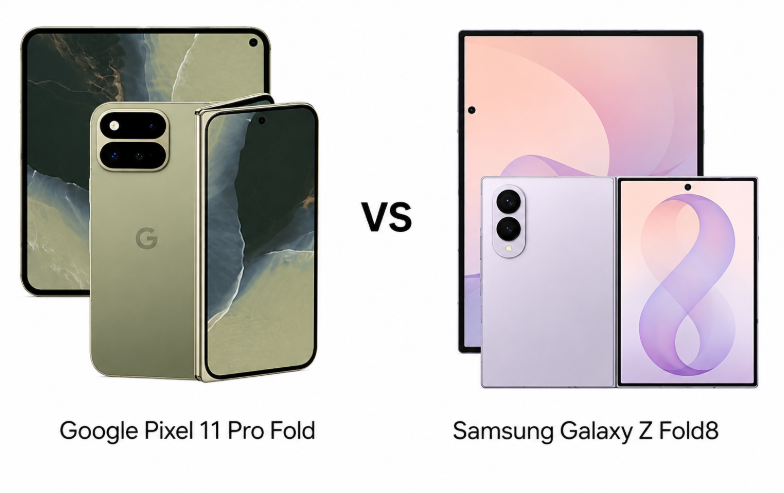
The foldable smartphone market is no longer just about the novelty of bending screens; it has become a battleground for distinct technological philosophies. The Google Pixel 11 Pro Fold and the Samsung Galaxy Z Fold8 illustrate two wildly different approaches to building an ultra-premium device. While Google focuses heavily on computational photography, blindingly bright displays, and intelligent software, Samsung continues to champion brute-force performance, lightning-fast charging, and unmatched multitasking capabilities.
With both devices commanding a staggering $1,900 price tag, choosing between them comes down to what a user values most in a flagship experience. Here is an in-depth look at how these two foldable titans stack up against one another.
Design and Display: Durability Meets Brilliance
When evaluating build quality, it is clear that durability has taken center stage. The Google Pixel 11 Pro Fold pairs a glass-ceramic front with a Gorilla Glass Victus 2 back and an aluminum frame. Most notably, it boasts an IP68 rating, offering genuine peace of mind against dust and water. On the other side, Samsung utilizes Gorilla Glass Ceramic 3, Victus 2, and its proprietary Armor Aluminum, alongside a new Flex Titanium technology. However, the Galaxy Z Fold8 only manages an IP48 rating, making Google the undisputed winner in environmental protection.
Display technology is where the Pixel truly shines. Google has equipped the Pixel 11 Pro Fold with a massive 8-inch LTPO OLED inner display. Featuring a 1:1 aspect ratio and a staggering peak brightness of 3600 nits, it is an absolute media powerhouse. The cover display is equally impressive at 6.5 inches.
Samsung’s Galaxy Z Fold8 is slightly more compact, offering a 7.6-inch Dynamic LTPO AMOLED 2X inner panel and a 5.5-inch cover display. While its 3000-nit peak brightness falls short of Google’s offering, Samsung’s anti-reflective coating provides a tangible advantage for outdoor visibility. Nonetheless, for sheer size and luminance, the Pixel claims the display crown.
Performance and Battery: Raw Power vs. Everyday Endurance
Under the hood, the philosophies of the two tech giants diverge sharply. The Pixel 11 Pro Fold is powered by the 3nm Google Tensor G6, backed by a standard 16GB of RAM across all storage tiers. Running Android 17, the Pixel is heavily optimized for Google’s suite of AI features.
Conversely, the Galaxy Z Fold8 is an absolute powerhouse. Equipped with Qualcomm’s 3nm Snapdragon 8 Elite Gen 5 and up to 16GB of RAM, it easily outpaces the Tensor chip in raw benchmarking and sustained gaming performance. Combined with Samsung DeX, the Fold8 remains the unrivaled king of mobile productivity.
Battery life and charging present another trade-off. The Pixel features a slightly larger 4806mAh battery with 30W wired charging, but it stands out with its 25W magnetic Qi2.2 wireless charging and battery-preserving bypass charging. Samsung’s 4800mAh cell supports a much faster 45W wired charging speeds and offers 4.5W reverse wireless charging, making it the better choice for users who need a rapid power top-up on the go.
Cameras: Computational Magic vs. High-Res Video
Camera systems on foldables have historically lagged behind traditional flagships, but this generation closes the gap. The Pixel 11 Pro Fold utilizes a versatile triple-camera array: a 48MP main sensor, a 10.5MP ultrawide, and a highly capable 10.8MP telephoto lens with 5x optical zoom. Paired with Pixel-exclusive software like Zoom Enhance, Best Take, and Ultra-HDR, we expect the Pixel to deliver superior still photography, particularly at long distances.
Surprisingly, the Galaxy Z Fold8 drops the dedicated telephoto lens, opting instead for a dual-camera setup featuring a 50MP main sensor and a 50MP ultrawide lens. While it loses the optical zoom battle, Samsung compensates heavily in the video department, offering 8K recording at 30fps and incredibly smooth 4K recording at 120fps.
Pricing and Final Verdict
Both foldables launch at the $1,900 mark globally, though regional variances exist (the Galaxy is slightly cheaper in India at roughly ₹180,000 compared to the Pixel’s ₹187,000).
Ultimately, the Google Pixel 11 Pro Fold emerges as the stronger overall package for the average premium buyer. Its larger, brighter displays, superior IP68 protection, and dedicated 5x telephoto lens offer a more complete flagship experience.
However, it should be noted that power users may still prefer the Samsung Galaxy Z Fold8. For those who prioritize heavy multitasking, elite mobile gaming, Samsung DeX, and rapid charging, the Snapdragon 8 Elite Gen 5 makes the Galaxy an unstoppable productivity machine.
Pixel 11 Pro Fold & Samsung Galaxy Z Fold8 Specs Comparison
| Feature | Google Pixel 11 Pro Fold | Samsung Galaxy Z Fold8 |
| Build & Protection | Glass-ceramic, Victus 2, Aluminum, IP68 | Ceramic 3, Victus 2, Flex Titanium, IP48 |
| Inner Display | 8.0″ LTPO OLED (120Hz, 3600 nits) | 7.6″ Dynamic AMOLED 2X (120Hz, 3000 nits) |
| Cover Display | 6.5″ OLED (120Hz, 3600 nits) | 5.5″ Dynamic AMOLED 2X (120Hz) |
| Processor | Google Tensor G6 (3nm) | Snapdragon 8 Elite Gen 5 (3nm) |
| RAM | 16GB Standard | 12GB / 16GB |
| Storage Options | 256GB / 512GB / 1TB | 256GB / 512GB / 1TB |
| Rear Cameras | 48MP Main, 10.5MP Ultrawide, 10.8MP 5x Telephoto | 50MP Main, 50MP Ultrawide |
| Front/Cover Cameras | 10MP Inner, 10MP Cover | 10MP Inner, 10MP Cover |
| Video Capabilities | Up to 4K at 60fps | Up to 8K at 30fps, 4K at 120fps |
| Battery | 4806mAh | 4800mAh |
| Charging (Wired) | 30W | 45W |
| Charging (Wireless) | 25W magnetic Qi2.2 | 20W (plus 4.5W reverse wireless) |
| Software | Android 17 (7 years of updates) | Android 17 / One UI 9 (7 years of updates) |
| Special Features | Bypass charging, Satellite SOS, UWB | Samsung DeX, UWB, High-bitrate audio |
| Estimated Price | ~$1,900 / ₹187,000 | ~$1,900 / ₹180,000 |
Related Posts
-
 iQOO 15 Ultra Design Revealed: Features Active Cooling and “2077” Color Scheme
-
 Samsung Android 17 Update: Full List of Galaxy Devices Getting the New Software
-
 Top 5 Upcoming Smartphones in October 2026: Massive Batteries and 200MP Cameras
-
 ‘RAMageddon’ Strikes: Samsung Galaxy S26 Series Gets Massive Price Hike in India