
Pixel 11 Pro XL vs Galaxy S26 Ultra: The Ultimate Smartphone Comparison
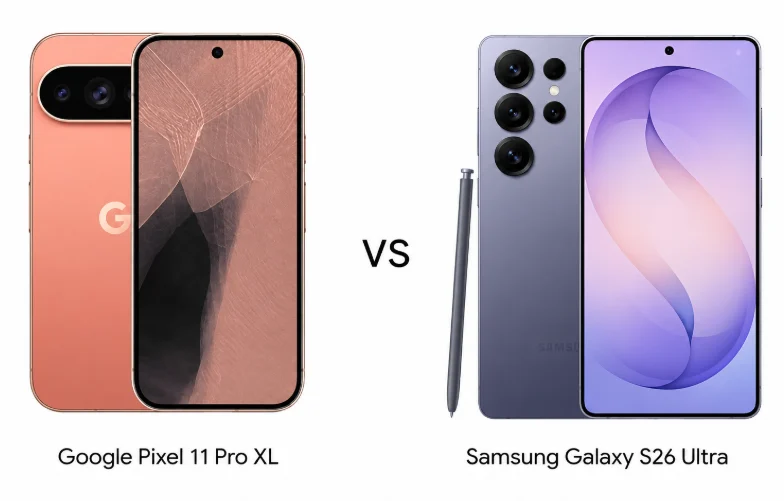
The premium smartphone market has fractured into two distinct philosophies. On one side, Google’s Pixel 11 Pro XL doubles down on artificial intelligence, computational photography, and a pristine, bloat-free Android experience. On the other, Samsung’s Galaxy S26 Ultra champions brute-force hardware versatility, offering a powerhouse Snapdragon chip, a stylus, desktop-like productivity, and an expansive camera array.
With both devices commanding a staggering $1,300 price tag, the deciding factor is no longer about which phone is objectively “better”—it is about which device better serves your specific digital lifestyle.
Design and Display: Durability Meets Brilliance
Both manufacturers utilize premium materials—titanium-grade armor aluminum and IP68 water resistance—but their approaches to glass differ. Samsung equips the Galaxy S26 Ultra with Gorilla Armor 2 on the front, providing a tougher barrier against scratches and featuring a highly effective anti-reflective coating. Google opts for Gorilla Glass Victus 2.
When it comes to the screens, it is a battle of brightness versus clarity.
-
Google Pixel 11 Pro XL: Features a 6.8-inch LTPO OLED display that pushes a blinding 3,600 nits of peak brightness, ensuring perfect legibility even under the harshest sunlight.
-
Samsung Galaxy S26 Ultra: Offers a slightly larger 6.9-inch Dynamic LTPO AMOLED 2X panel. While its peak brightness caps at 2,600 nits, Samsung compensates with a sharper resolution, superior anti-reflective treatments, and a Privacy Display feature.
The Verdict: Samsung takes a slight edge for everyday viewing comfort thanks to its anti-reflective coating, though the Pixel remains the undeniable champion of raw brightness.
Performance and Battery: AI vs. Pure Power
Under the hood, these flagships serve completely different masters. The Pixel 11 Pro XL is powered by Google’s custom Tensor G6, a chip purposefully built to handle heavy, on-device AI processing and machine learning tasks. It also ships with the bleeding-edge Android 17 OS.
Samsung, however, brings a sledgehammer to the performance fight. Powered by the Snapdragon 8 Elite Gen 5 (running on Android 16 with One UI 8.5), the Galaxy S26 Ultra is a benchmark-crushing beast, better suited for intensive gaming, heavy multitasking, and running Samsung DeX.
In terms of endurance:
-
Google: Packs a slightly larger 5,115mAh battery with 45W wired charging and 25W magnetic Qi2.2 support.
-
Samsung: Houses a 5,000mAh battery but offers significantly faster 60W wired charging.
The Verdict: Power users will gravitate toward the Galaxy’s Snapdragon supremacy and rapid charging, while Google loyalists will appreciate the Tensor’s AI capabilities and the larger battery.
Cameras: Computational Magic vs. Optical Flexibility
Smartphone photography is the main event for both devices.
The Pixel 11 Pro XL utilizes a streamlined but potent trio: a 50MP main sensor, a 48MP ultrawide, and a 48MP 5x periscope telephoto. Google relies heavily on its legendary computational algorithms—like Best Take and Zoom Enhance—to process stunning images. Furthermore, it boasts a massive 42MP ultrawide selfie camera, easily beating Samsung’s 12MP front-facing shooter.
Samsung counters with overwhelming optical hardware. The Galaxy S26 Ultra features a staggering 200MP main sensor, a 50MP ultrawide, and two telephoto lenses (a 10MP 3x and a 50MP 5x periscope). This quad-camera setup offers unmatched focal-length flexibility, alongside superior high-frame-rate video recording (up to 4K at 120fps).
The Verdict: Samsung wins on sheer versatility and video capabilities. However, for users who prefer point-and-shoot reliability and world-class selfies, the Pixel’s software magic remains highly alluring.
Pixel 11 Pro XL vs. Samsung Galaxy S26 Ultra Specs
| Feature | Google Pixel 11 Pro XL | Samsung Galaxy S26 Ultra |
| Display | 6.8″ LTPO OLED (120Hz, 3600 nits) | 6.9″ Dynamic AMOLED 2X (120Hz, 2600 nits) |
| Processor | Google Tensor G6 | Snapdragon 8 Elite Gen 5 |
| Software | Android 17 | Android 16 (One UI 8.5) |
| Rear Cameras | 50MP Main, 48MP Ultrawide, 48MP 5x Tele | 200MP Main, 50MP Ultrawide, 10MP 3x & 50MP 5x Tele |
| Front Camera | 42MP Ultrawide | 12MP Wide |
| Battery & Charging | 5115mAh, 45W wired, 25W magnetic | 5000mAh, 60W wired, 25W wireless |
| Productivity | Google AI Suite | S Pen, Samsung DeX |
The Final Word
At roughly $1,300 (with slight regional variations, such as Samsung being marginally more expensive in India), both phones justify their premium price tags, but they cater to very different crowds.
The Samsung Galaxy S26 Ultra is the ultimate technological Swiss Army knife. With its S Pen, desktop-class DeX capabilities, versatile quad-camera array, and raw Snapdragon performance, it is the undisputed choice for power users who want their smartphone to do everything.
The Google Pixel 11 Pro XL, on the other hand, is a masterclass in software harmony. If you prioritize a clean, deeply integrated AI experience, industry-leading computational photography, and being first in line for Android updates, the Pixel is the smarter buy.


