
Vivo Y500 vs POCO M8 Power Comparison: Displays, Batteries, and Specs Ranked
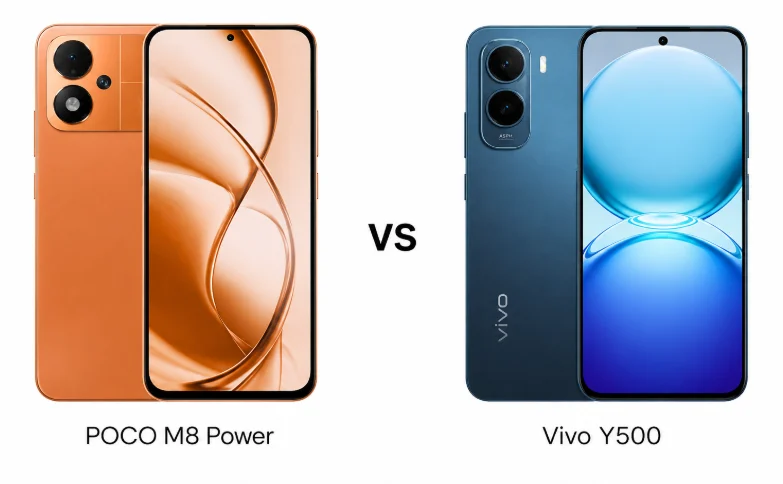
The affordable smartphone segment is currently witnessing a fascinating arms race. Manufacturers are no longer just competing on price; they are pushing the boundaries of battery capacity, display technology, and software longevity. Two of the most compelling new entrants, the POCO M8 Power and the Vivo Y500, perfectly illustrate this shift.
Both devices arrive armed with massive silicon-carbon batteries, vibrant AMOLED displays, stereo speakers, and Android 16. However, a closer look reveals two very different philosophies regarding what makes a budget smartphone great. POCO doubles down on processing power and long-term software support, while Vivo aggressively targets display brilliance, rugged durability, and superior camera hardware.
Here is a comprehensive breakdown to help you decide which powerhouse deserves your money.
The Tale of the Tape: Spec Comparison
| Feature | POCO M8 Power | Vivo Y500 | The Edge |
| Display | 7.0-inch AMOLED, 120Hz, 1,800 nits | 6.83-inch AMOLED, HDR, 120Hz, 5,000 nits peak | Vivo (Sharper, brighter HDR panel) |
| Durability | IP65, Gorilla Glass 7i | IP68/IP69, MIL-STD-810H | Vivo (Military-grade ruggedness) |
| Processor | Snapdragon 4 Gen 4 | Unisoc T7300 | POCO (Superior CPU/GPU efficiency) |
| Software | Android 16 (4 promised OS upgrades) | Android 16 | POCO (Unmatched budget longevity) |
| Cameras (Rear) | 50MP Primary | 50MP Primary + Auxiliary sensor | Vivo (More versatile setup) |
| Camera (Front) | 8MP | 32MP | Vivo (Significantly sharper selfies) |
| Battery & Tech | 8,000mAh, 45W, PD3.0, 22.5W reverse charging | 8,100mAh, 44W, bypass charging | POCO (Better charging flexibility) |
| Connectivity | Wi-Fi 6, NFC, IR Blaster | Wi-Fi 5, Bluetooth 5.4 | POCO (Broader modern standards) |
| Estimated Price | ~$250 / ₹25,000 | ~$250 / ₹22,000 | Vivo (Slightly better upfront value) |
Design and Display: Rugged Elegance vs. Practicality
Both smartphones feature contemporary flat designs and under-display fingerprint scanners, but their build priorities diverge sharply.
The Vivo Y500 is an absolute tank wrapped in a sleek chassis. Boasting IP68/IP69 ratings and MIL-STD-810H certification, it offers flagship-level resistance against water, dust, and drops. For outdoor enthusiasts or those prone to dropping their devices, this peace of mind is invaluable. The POCO M8 Power takes a more urban approach. While its IP65 rating is only splash-resistant, it features Gorilla Glass 7i protection and practical hardware additions like an IR blaster and NFC.
When you turn the screens on, Vivo pulls ahead. The Y500’s 6.83-inch AMOLED panel supports HDR and reaches a blinding peak brightness of 5,000 nits, paired with a sharp 1260 x 2800 resolution. POCO’s massive 7.0-inch 120Hz AMOLED is by no means poor—it delivers fluid animations and a respectable 1,800 nits—but Vivo simply offers a richer, more vibrant canvas for multimedia consumption.
Performance and Software: The Long Game
If you prioritize raw performance and software longevity, the POCO M8 Power is the undisputed champion.
Powered by Qualcomm’s modern Snapdragon 4 Gen 4 chipset, the POCO delivers superior CPU efficiency and significantly better Adreno graphics processing compared to the Vivo’s Unisoc T7300. While both handle daily tasks effortlessly, the POCO will age much more gracefully, especially when multitasking or gaming.
Furthermore, POCO’s commitment to four major Android OS upgrades is virtually unheard of in this price bracket. While Vivo offers higher storage configurations (up to 256GB), POCO guarantees that your phone’s software will remain modern and secure for years to come.
Battery and Charging: multi-Day Monsters
Both phones house ridiculously large silicon-carbon batteries that redefine battery anxiety.
The Vivo Y500 packs a slightly larger 8,100mAh unit with 44W charging and a gamer-friendly “bypass charging” feature that draws power directly from the cable to reduce heat. However, the POCO M8 Power (8,000mAh) offers a more versatile power suite. Its 45W charging supports the universal PD3.0 standard, and it features an incredibly useful 22.5W wired reverse charging capability—effectively turning the phone into a high-speed power bank for your other accessories.
Cameras: A Clear Winner for Social Media
Neither of these devices is aimed at professional photographers, but the Vivo Y500 offers a noticeably more complete imaging package.
While both feature capable 50MP primary rear sensors that produce dependable daylight shots, Vivo includes an auxiliary rear sensor for better depth processing. More importantly, Vivo dominates the front-facing camera category. Its 32MP selfie shooter captures vastly more detail and dynamic range than POCO’s modest 8MP sensor, making the Y500 the obvious choice for social media creators and frequent video callers.
Vivo Y500 or Poco M8: Which One Should You Buy?
At a global average of around $250—though Vivo undercuts POCO slightly in the Indian market (₹22,000 vs. ₹25,000)—both devices represent outstanding value. Your choice boils down to your daily habits:
-
Buy the POCO M8 Power if: You view your smartphone as a long-term investment. Its faster Snapdragon processor, four years of Android updates, flexible reverse charging, and robust connectivity (Wi-Fi 6, NFC, IR) make it a highly practical, future-proof workhorse.
-
Buy the Vivo Y500 if: You consume a lot of media, work outdoors, or love taking selfies. Its brilliant 5,000-nit HDR display, military-grade ruggedness, and superior 32MP front camera make it a multimedia and durability champion at an aggressive price.
Related Posts
-
 Motorola Signature 27 US Release Confirmed: Snapdragon 8 Elite Extreme Gen 6 and 200MP Camera
-
 Don’t Buy the iPhone 18 Pro Until You’ve Seen These 5 Android Alternatives
-
 Poco F8 Pro and Ultra: Launch Date Confirmed, Here Are the Expected Specs
-
 Honor Win Turbo could be one of the biggest battery phones of the year