
Which Budget Phone Wins? Vivo Y500 vs. Honor X7e Plus Comparison
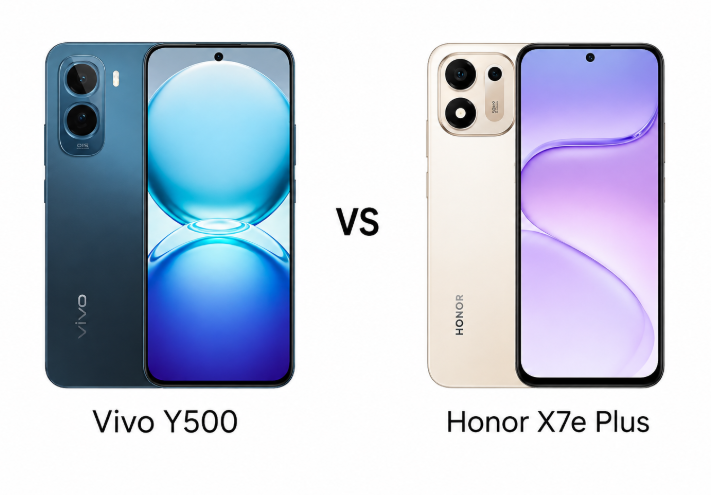
The budget smartphone arena is shifting its focus toward extreme endurance and rugged durability. Enter the Vivo Y500 and the Honor X7e Plus—two highly capable devices that boast jaw-dropping 8,100mAh batteries and run on the latest Android 16 software.
While both phones promise multi-day battery life and tank-like builds, they take drastically different approaches to display technology, processing power, and photography. If you are in the market for an affordable, long-lasting Android device, here is a definitive breakdown of how these two heavyweights compare and which one truly deserves your hard-earned cash.
Vivo Y500 vs. Honor X7e Plus: The Spec Showdown
| Feature | Vivo Y500 | Honor X7e Plus | Winner |
| Durability | IP68/IP69, MIL-STD-810H | IP68/IP69K, 2.5m drop resistance | Vivo |
| Display | 6.83″ AMOLED (120Hz, 1260×2800) | 6.87″ TFT LCD (120Hz, 720×1592) | Vivo |
| Processor | Unisoc T7300 | Snapdragon 4 Gen 4 | Honor |
| Base Memory | 8GB RAM / UFS 2.2 Storage | 6GB RAM | Vivo |
| Rear Camera | 50MP + Auxiliary | 50MP (Autofocus) + Auxiliary | Honor |
| Front Camera | 32MP | 5MP | Vivo |
| Battery & Charge | 8,100mAh (44W, bypass charging) | 8,100mAh (45W) | Vivo |
| Estimated Price | ~$250 (₹22,000) | ~$275 (₹23,000) | Vivo |
Design and Display: A Tale of Two Screens
Built to Last
Both manufacturers have engineered these phones to survive the elements. They each feature a glass front, a plastic chassis, and stellar IP68/IP69 ratings for top-tier dust and water resistance. Honor advertises an impressive 2.5-meter drop resistance that will appeal to the notoriously clumsy. However, Vivo strikes back with an official MIL-STD-810H military-grade certification, providing a slightly higher level of verified confidence against harsh environments.
The Display Divide
Turn the screens on, and the competition becomes heavily skewed. The Vivo Y500 completely outclasses the Honor X7e Plus in visual fidelity. Vivo packs a gorgeous 6.83-inch AMOLED panel boasting a crisp 1260×2800 resolution, HDR support, and a blinding peak brightness of 5,000 nits.
Conversely, Honor opted for a 6.87-inch TFT LCD. While it matches Vivo’s 120Hz refresh rate, it suffers from a much lower HD+ resolution and significantly dimmer output. For media consumption, gaming, or simply scrolling in direct sunlight, Vivo’s AMOLED screen is a night-and-day upgrade.
Under the Hood: Processing and Power
Performance Metrics
When it comes to raw processing, the Honor X7e Plus claws back some ground. Powered by Qualcomm’s Snapdragon 4 Gen 4, it benefits from a superior Adreno GPU and faster CPU clocks, making it the better choice for mobile gamers.
Vivo relies on the Unisoc T7300 chip. While its GPU trails slightly behind the Snapdragon, Vivo compensates by offering 8GB of RAM on its base model and faster UFS 2.2 storage across the board. In daily, casual use, both phones will feel incredibly snappy, but multitaskers will appreciate Vivo’s extra memory headroom.
Battery Innovation
Endurance is the main selling point for both devices. A colossal 8,100mAh battery guarantees that either phone will easily survive two full days away from a charger. Honor holds a microscopic edge in charging speed (45W vs. 44W), but Vivo includes a highly coveted feature: bypass charging. This allows gamers to plug in their phone and power the device directly from the wall—bypassing the battery to reduce heat and preserve battery health over the years.
Vivo Y500 vs. Honor X7e Plus Cameras: The Selfie Massacre
On the rear, both phones utilize a 50MP primary sensor capable of 1080p video at 30fps. Honor’s inclusion of autofocus gives it a slight edge for quick snaps, while Vivo leans on robust HDR processing. For casual social media posts, both main cameras get the job done.
Flip to the front, however, and the Honor X7e Plus falls flat. Its basic 5MP front-facing sensor feels remarkably dated in 2026. The Vivo Y500 dominates this category with a sharp 32MP selfie camera, delivering vastly superior portraits and high-quality video calls.
The Verdict: Which Should You Buy?
At roughly $250, the Vivo Y500 is undeniably the smarter purchase. It offers a spectacular AMOLED display, a far superior selfie camera, military-grade durability, and thoughtful gaming features like bypass charging—all while undercutting its rival’s price.
The Honor X7e Plus, priced slightly higher at around $275, is a tough sell. While its Snapdragon processor and 2.5m drop resistance are commendable, its low-resolution LCD screen and 5MP front camera are major compromises. Unless you absolutely require Qualcomm hardware or NFC support (which is region-dependent on the Honor), the Vivo Y500 provides a significantly more premium experience for less money.


