
OPPO Reno 16 vs. OnePlus 15: Which Premium Android is Right for You?
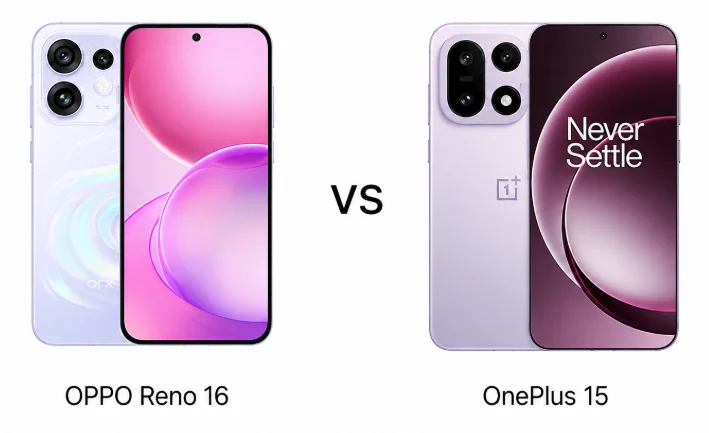
In the fiercely competitive arena of premium Android smartphones, the upcoming OPPO Reno 16 and OnePlus 15 are taking two distinctly different paths to win over consumers. While OPPO champions a value-driven, “flagship-lite” experience tailored for portability and practicality, OnePlus holds nothing back, delivering an uncompromising, spec-heavy powerhouse.
If you are torn between saving a few hundred dollars or going all-in on top-tier performance, here is an in-depth breakdown of how these two heavyweights stack up in design, display technology, raw power, and photographic prowess.
Design and Display: Compact Elegance vs. Premium Immersion
The Build
The OPPO Reno 16 leans into a compact, pocket-friendly design. Framed in aluminum and backed by glass or composite materials, it boasts an IP68/IP69 rating for top-tier water and dust resistance. OPPO’s inclusion of Crystal Guard protection ensures the phone feels robust, making it an ideal choice for users who prioritize one-handed usability.
Conversely, the OnePlus 15 takes the premium flagship route. It upgrades the armor to Gorilla Glass Victus 2 while maintaining the same IP68/IP69 certification and aluminum frame. The inclusion of an ultrasonic fingerprint scanner—compared to OPPO’s optical sensor—adds a layer of refinement that makes the OnePlus feel slightly more sophisticated in the hand.
The Screen
On the display front, OPPO equips the Reno 16 with a vibrant 6.32-inch AMOLED panel. Sporting a 120Hz refresh rate, HDR10+ support, and a blinding peak brightness of 3,600 nits, it is a stellar screen for media consumption.
However, OnePlus edges ahead for spec enthusiasts. It boasts a larger 6.78-inch LTPO AMOLED display with a buttery-smooth 165Hz refresh rate. While its peak brightness might look lower on paper, the integration of Dolby Vision, Ultra HDR, and adaptive refresh technology yields a superior, highly dynamic multimedia experience.
Under the Hood: Performance and Battery Life
Processing Power
The performance gap between these two devices highlights their differing target audiences. The OPPO Reno 16 is powered by Qualcomm’s Snapdragon 7 Gen 4, paired with up to 12GB of RAM and UFS 3.1 storage. It handles daily tasks, multitasking, and moderate gaming with ease, firmly cementing its status as an elite mid-range device.
The OnePlus 15, however, is a true performance monster. Driven by the cutting-edge Snapdragon 8 Elite Gen 5 chip, up to 16GB of RAM, and lightning-fast UFS 4.1 storage, it devours heavy gaming, AI workloads, and intensive video editing. This immense headroom makes the OnePlus 15 a highly future-proof investment.
Battery Endurance
Battery life is excellent on both devices, but the approaches differ. The Reno 16 packs a massive 6,700mAh battery (6,000mAh in European markets) with 80W wired charging. It easily powers through a full day of heavy use.
OnePlus shatters expectations with a gargantuan 7,300mAh battery. It pairs this massive cell with 120W wired charging, 50W wireless charging, and bypass charging for gamers. For users who demand the fastest and most versatile power delivery, OnePlus is the undisputed winner.
Cameras: Selfies vs. Cinematography
Both smartphones feature a triple 50MP rear camera array, but the similarities end there.
The OPPO Reno 16 offers a versatile, stabilized main sensor, a 3.5x telephoto lens with OIS, and an autofocus ultrawide camera. It shines brightest on the front, sporting a massive 50MP autofocus ultrawide selfie camera capable of 4K60 video—making it a vlogger’s dream.
The OnePlus 15 upgrades the primary sensor size and swaps the standard telephoto for a periscope lens. It introduces professional-grade features like Laser Autofocus, LUT previews, and Dolby Vision recording. While its 32MP front camera lacks OPPO’s ultra-wide field of view, its rear system supports staggering 8K30 and 4K120 video capture, making it the superior tool for content creators.
The Verdict: Which Should You Buy?
At roughly $600, the OPPO Reno 16 is a triumph of value. It offers flagship-inspired features, an exceptional selfie camera, and a compact design at a highly digestible price point. It is the smarter choice for budget-conscious buyers who still want a premium feel.
Priced around $800, the OnePlus 15 justifies its premium with tangible hardware superiority. From the Snapdragon 8 Elite Gen 5 processor and 165Hz LTPO display to the massive 7,300mAh battery and wireless charging capabilities, it is the better overall smartphone for power users and tech enthusiasts.
Comprehensive Specifications & Pricing Comparison
| Feature / Category | OPPO Reno 16 | OnePlus 15 |
| Estimated Price | ~$600 (₹62,000) | ~$800 (₹73,000) |
| Build & Protection | Aluminum frame, IP68/IP69, Crystal Guard | Aluminum frame, IP68/IP69, Gorilla Glass Victus 2 |
| Display | 6.32″ AMOLED, 120Hz, 3600 nits peak, HDR10+ | 6.78″ LTPO AMOLED, 165Hz, Dolby Vision, Ultra HDR |
| Processor | Snapdragon 7 Gen 4 (Adreno 722) | Snapdragon 8 Elite Gen 5 (Adreno 840) |
| RAM & Storage | Up to 12GB RAM / 512GB UFS 3.1 | Up to 16GB RAM / 1TB UFS 4.1 |
| Rear Cameras | 50MP Main + 50MP Telephoto (3.5x) + 50MP Ultrawide | 50MP Main + 50MP Periscope + 50MP Ultrawide |
| Front Camera | 50MP AF Ultrawide (4K60 video) | 32MP AF (4K60 video) |
| Video Recording | Up to 4K at 60fps | Up to 8K at 30fps, 4K at 120fps, Dolby Vision |
| Battery & Charging | 6,700mAh, 80W Wired Charging | 7,300mAh, 120W Wired, 50W Wireless, Bypass Charging |
| Biometrics | Optical Under-Display Fingerprint | Ultrasonic Under-Display Fingerprint |
| Connectivity | Wi-Fi 6, Bluetooth 5.4, USB 2.0 | Wi-Fi 7, Bluetooth 6.0, USB 3.2 |
| Software | Android 16 (ColorOS 16) | Android 16 (OxygenOS 16) |
Editor’s Note: Specifications and prices are based on current available data and regional variations. Always verify details with official sources prior to purchase.


