
A Lot Of Players Still Wonder If Satisfactory Would Work Well On Xbox
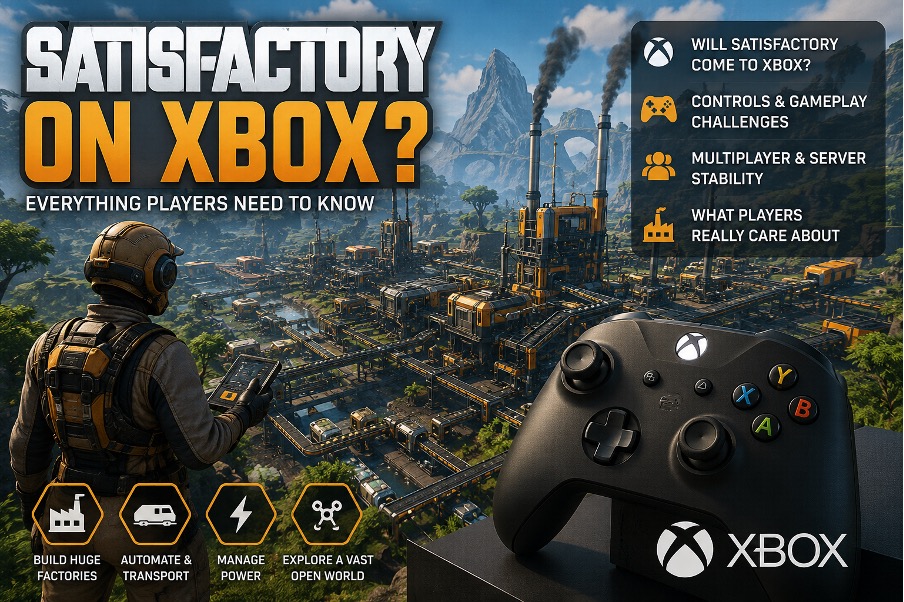
Every few months the same discussion appears again.
People ask about satisfactory game xbox support because the game honestly feels like something that could work really well on console.
Big factories. Exploration. Multiplayer building sessions. Long progression systems.
It sounds perfect for sitting on a couch after work.
But the game becomes way more complicated later than most people expect.
And that’s where the console discussion gets tricky.
Early Satisfactory Feels Pretty Relaxed
The beginning is simple.
You build miners, place a few conveyor belts, automate basic materials, and slowly unlock new technology.
Nothing feels overwhelming yet.
The factory stays small. Power usage stays manageable. The map feels huge and mostly empty.
And honestly, that stage would probably feel great on Xbox.
The controls would not seem too complicated early on because building remains fairly basic.
But later the game changes completely.
The Factory Never Really Stops Growing
This is the thing newer players underestimate most.
You think your current setup is enough.
Then suddenly you need:
- more steel
- bigger train systems
- extra fuel production
- larger storage networks
- nuclear power
- aluminum factories
And every new production line creates three more logistics problems immediately after.
That’s why Satisfactory worlds slowly turn into giant long-term projects instead of casual survival sessions.
The save file keeps expanding forever.
Controllers Might Feel Hard During Late Game
Moving around with a controller would probably feel fine.
Building giant factories is the harder part.
Late-game Satisfactory requires constant placement of:
- conveyor belts
- splitters
- mergers
- train stations
- pipes
- power lines
And precision starts mattering a lot once factories become huge.
Mouse and keyboard make fast adjustments easier during giant construction projects.
That does not mean console controls could never work.
But factory games usually become much slower once the building systems grow more complicated.
Especially after hundreds of machines start connecting together.
Multiplayer Makes Everything Heavier
Singleplayer already pushes hardware hard later on.
Multiplayer becomes much heavier.
One player builds giant oil systems. Another creates absurd train networks crossing the map nonstop. Somebody else covers an entire biome with fuel generators.
And now the server constantly processes huge amounts of background activity.
Machines never stop updating. Belts move continuously. Vehicles calculate routes all the time.
That’s why stable multiplayer matters a lot more later than people expect early on.
Especially once friends spend months inside the same world together.
Big Factories Create Performance Problems Slowly
This part catches players off guard.
Performance usually does not collapse immediately.
Problems build up gradually.
At first everything runs perfectly fine.
Then autosaves become slower. Trains stutter occasionally. Conveyor belts stop syncing properly during multiplayer sessions.
And eventually giant factory zones start creating noticeable lag.
That’s honestly why some players wonder how console hardware would handle very large endgame worlds long-term.
Small factories are manageable.
Huge late-game saves are the real challenge.
Multiplayer Stability Matters More Than Graphics
Most players do not care if shadows look slightly better.
They care if the world stays stable.
Because Satisfactory is one of those games where people spend hundreds of hours inside one save file.
Factories spread across entire regions. Train systems become enormous. Nuclear production chains start feeding half the map.
And once autosaves start freezing for a few seconds every time somebody enters the main factory.
Nobody wants giant factory projects ruined by crashes or unstable multiplayer.
Dedicated Servers Become Important Later
Early multiplayer sessions work fine through simple peer-to-peer hosting.
But giant long-term worlds usually become more demanding.
That’s where proper hosting satisfactory server setups start helping a lot more.
Not because dedicated servers magically fix everything.
Messy factories still hurt performance. Oversized train systems still create lag spikes.
But stable hosting removes a lot of random problems that happen with weaker local setups.
Stuff like:
- unstable uptime
- overloaded home internet
- random disconnects
- hardware bottlenecks
- host PC crashes
And those problems matter much more once the world becomes valuable to the whole group.
Factory Planning Starts Mattering More Than Building
This is another thing players slowly realize later.
Good planning matters more than building speed.
Random factories look funny early on. Late-game chaos becomes a technical problem.
Thousands of overlapping belts and giant centralized production systems can absolutely destroy performance once the world grows large enough.
That’s why experienced players usually spread major production into different regions.
Oil somewhere else. Aluminum far away. Nuclear setups isolated completely.
Not because it looks cleaner.
Because giant mega-factories become difficult for both servers and players to manage smoothly.
Mods Would Probably Complicate Console Versions Too
The PC community already builds ridiculous factories using mods.
Extra logistics systems, decoration packs, transportation tools — all of that creates even more strain on saves.
Console versions usually struggle with heavy mod support because stability becomes harder to maintain.
And honestly, modded Satisfactory worlds can already stress strong PCs pretty badly once factories become oversized.
So supporting giant multiplayer saves on console would probably require a lot of compromises somewhere.
Most Players Just Want Stable Multiplayer Sessions
That’s honestly the whole thing.
People remember giant conveyor highways, ridiculous train crashes, power failures, and factories spreading across entire deserts.
But unstable performance ruins those moments really fast.
Especially in multiplayer.
So whether Satisfactory eventually reaches Xbox or stays focused on PC, stability is probably what matters most long-term.
Because giant factories are fun.
Watching your multiplayer world break apart after hundreds of hours definitely is not.


