
Beyond the Hype: Ensuring Authenticity in the Age of Mobile-First AI Generation
The mobile technology landscape has completely transformed how we create and consume information. From the early days of basic word processors on smartphones to modern mobile workstations, our devices have become extensions of our minds. However, 2026 has brought a new disruption to the palm of our hands: the normalization of hyper-advanced generative AI.
With models like OpenAI’s GPT-5, Google’s mobile-optimized Gemini, Anthropic’s Claude, and Meta’s open-source LLaMA running seamlessly across servers and hardware, text generation is instantaneous. While this supercharges productivity for mobile professionals, journalists, and students, it introduces a critical digital crisis: the collapse of content authenticity.
When anyone can tap a button on their phone and generate an entire article, report, or essay, how do we protect the integrity of human thought? More importantly, how do we distinguish between genuine human perspective and machine-generated echoes?
The Illusion of Free AI Paraphrasers
As AI generation grew popular, a massive influx of “AI bypassers” and basic article spinners flooded the market. Creators, worried about algorithmic penalties or academic filters, started using these tools to modify machine-generated text.
Most of these tools operate on a very primitive level: they perform a surface-level synonym swap. If an AI writes “important,” the spinner changes it to “crucial.” If the AI writes “fast,” the spinner changes it to “rapid.”
This creates two major issues:
- The Text Becomes Unreadable: Basic spinners ruin the narrative flow, often introducing strange grammatical errors and altering the author’s original meaning.
- Legacy Checkers Fail: Traditional detection algorithms get completely confused by these minor word swaps, returning false positives and letting synthetic content slip through as “human.”
To survive this environment, technology platforms must move away from superficial scanning and adopt deep semantic analysis.
Why Legacy Verification Is Breaking Down
If you run a text generated by DeepSeek or an advanced Claude iteration through a standard, free online checker, it will likely tell you the content is 100% original. This happens because legacy tools are calibrated for yesterday’s algorithms. They look for predictable word frequencies and basic sentence lengths.
Modern language models have learned to randomize these patterns. Furthermore, when text is modified to appear “humanized,” old tools completely lose the scent.
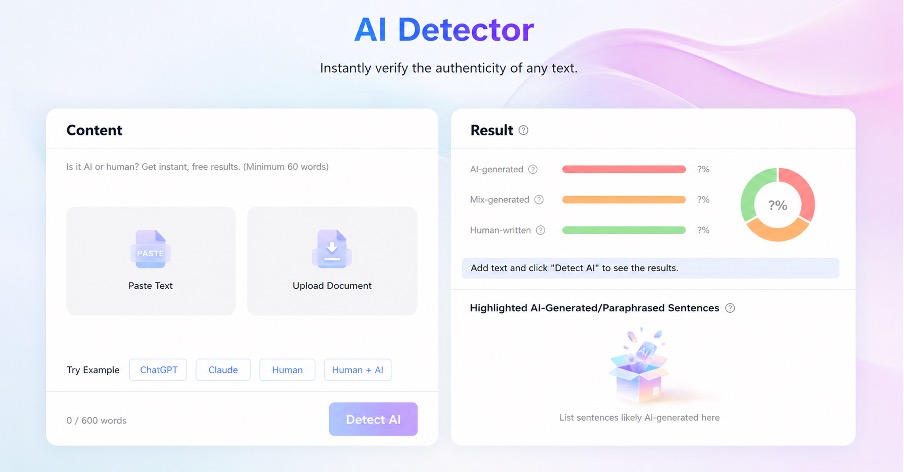
This is where next-generation verification architectures change the game. A truly effective AI detector cannot rely on a simple checklist. It must analyze the underlying logical architecture of the text. It looks past the clever vocabulary and looks at the semantic DNA to see if the ideas progress like a human mind or mirror the mathematical parameters of an LLM.
Furthermore, digital communication is inherently global. A verification tool that only works in English is obsolete for today’s connected world. True security requires cross-border, native multilingual processing that can accurately track synthetic structures in Spanish, French, Portuguese, German, and dozens of other languages without losing precision.
Redefining Content Integrity: The Lynote.ai Ecosystem
In the tech industry, a select few platforms are successfully bridging the gap between high-precision detection and ethical AI utilization. The approach pioneered by Lynote.ai highlights what a modern, comprehensive solution looks like, establishing a 99% accuracy rate by rewriting the rules of text analysis.
True Multi-Model Scanning
Unlike standard tools that are only trained on one specific ecosystem (like early ChatGPT data), a modern enterprise-grade detector scans against the digital footprints of all leading architectures simultaneously. Whether the text originated from a closed-source ecosystem or an open-source framework like LLaMA, advanced heuristics spot the machine signatures immediately.
Catching Disguised Content
The true benchmark of a premium detector is its ability to identify text that has been intentionally masked by basic rewriting tools. By analyzing conceptual density and contextual continuity rather than individual words, it catches “pseudo-humanized” content that lesser software misses entirely.
The Ethical Counter-Need: Context-Aware Humanization
While keeping spam off the internet is vital, there is another side to the story. Many professional writers, non-native English speakers, and mobile creators use AI legitimately as a brainstorming assistant. The problem is that raw AI outputs sound incredibly robotic, cold, and rigid.
When these creators need to refine their drafts, they don’t need an old-school article spinner that destroys their work. They need true Context-Aware Transformation.
| Feature / Capability | Legacy Article Spinners | Advanced AI Humanizer |
| Operational Logic | Replaces individual words with synonyms | Rewrites sentences based on overarching context |
| Meaning Retention | Low (often skews technical definitions) | Perfect (maintains the original core message) |
| Output Readability | Awkward, choppy, and robotic | Natural, engaging, and indistinguishable from human writing |
| Detection Guarantee | Easily flagged by advanced security | 99% Undetectable Guarantee across platforms |
| Customization | One-size-fits-all | Customizable bypass modes with 80+ languages |
Advanced context-aware humanization treats text the way an experienced editor would. Instead of just replacing words, the system analyzes the logical intent of the paragraph. It alters sentence lengths, injects stylistic variation, improves readability, and eliminates robotic repetition while keeping the underlying facts completely intact.
Conclusion: Driving the Future of Authentic Text
As mobile devices become even more integrated with artificial intelligence, the line between automated text and authentic human voice will continue to challenge digital publishing. Relying on basic software to verify or clean up text is no longer an option for serious tech professionals.
By implementing dual-capacity systems that offer both flawless, multi-model detection and natural, contextual humanization, we can confidently embrace AI productivity—without ever sacrificing the irreplaceable power of genuine human expression.

