
The Business Behind the Gadgets: How Modern Supply Chains Power the Tech Accessory E-commerce Boom
The consumer electronics landscape has transformed dramatically over the past decade. Today, a brilliant product design is only half the battle. The invisible machinery of global supply chains and fulfillment networks ultimately dictates retail success.
The Exponential Growth of the Smartphone Accessory Market
The market for mobile peripherals is expanding at an unprecedented, exponential rate. Consumers no longer treat protective cases, fast chargers, and wireless audio gear as mere afterthoughts. They are essential lifestyle investments.
Why Tech Gadgets Dominate E-commerce
Tech accessories are undeniably the perfect products for borderless digital retail. Their unique physical and economic characteristics create an ideal, highly scalable online business model.
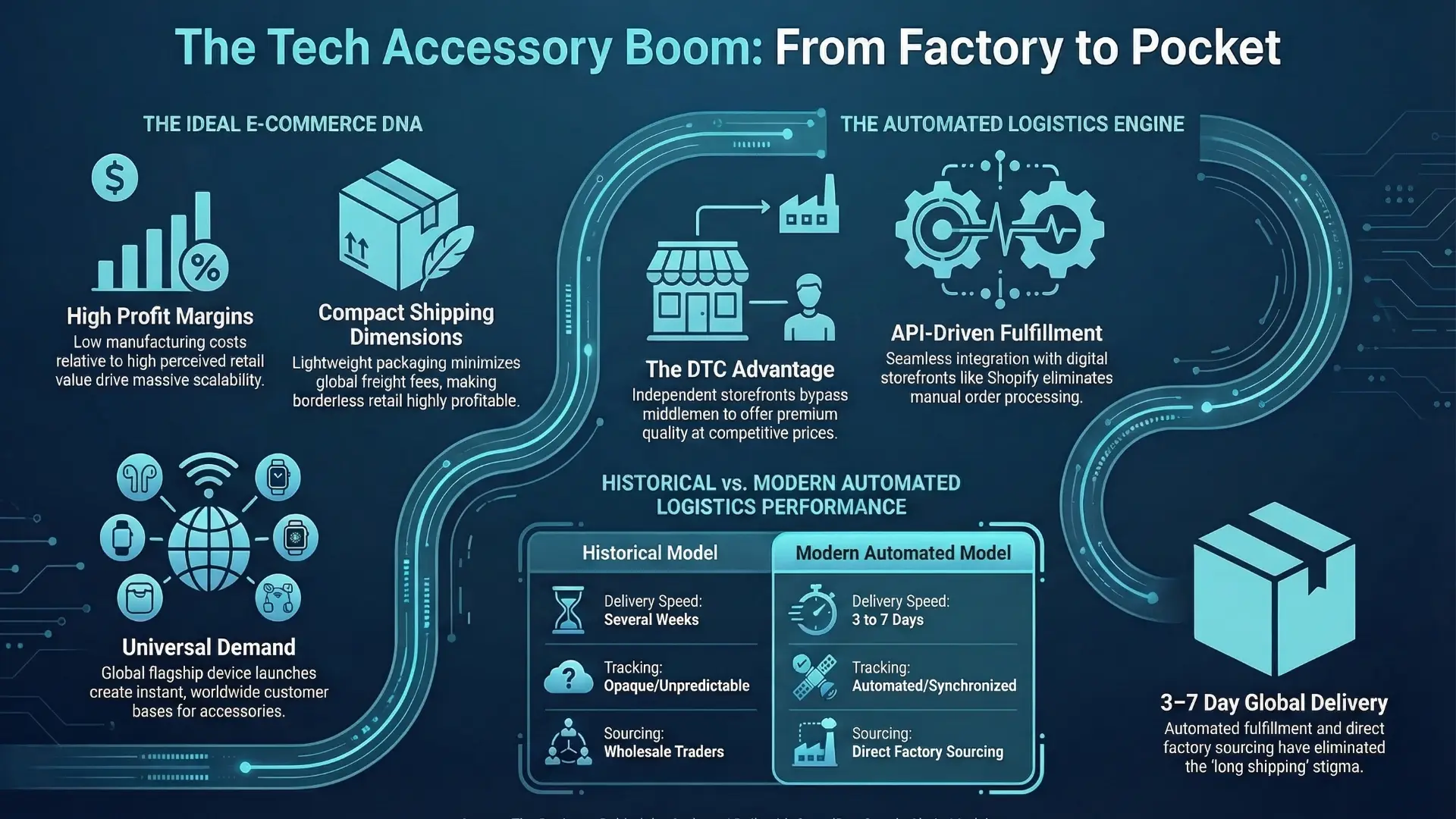
- High Profit Margins: Manufacturing costs remain relatively low compared to the high perceived retail value.
- Compact Shipping Dimensions: Small, lightweight packaging drastically minimizes expensive global freight fees.
- Universal Demand: Every new flagship device launch instantly creates a massive, worldwide customer base.
The Shift to Direct-to-Consumer (DTC) Brands
The traditional wholesale retail model is rapidly losing ground to independent online storefronts. Tech enthusiasts now prefer buying niche, highly specialized gear directly from the source. This agile DTC model eliminates expensive middlemen, allowing brands to offer premium products at competitive prices. Before completing a purchase, modern consumers actively seek out detailed Smartphone reviews to ensure accessory compatibility and quality.
The Backbone of Global E-commerce: Modern Logistics & Fulfillment
A beautifully designed tech gadget is useless if it cannot reach the consumer efficiently. Behind every successful independent electronics brand lies a highly optimized, automated global logistics network.
Overcoming the “Long Shipping Time” Stigma
Historically, cross-border e-commerce was plagued by notoriously slow, unpredictable delivery speeds. Waiting several weeks for a simple phone case destroyed customer trust and localized brand loyalty.
- Lost packages and completely opaque tracking systems frustrated global buyers.
- Complex customs delays created unpredictable and inconsistent delivery windows.
- Resulting high return rates and customer service tickets ate directly into tight e-commerce profit margins.
The Role of Automated Fulfillment Centers
To remain competitive in the fast-paced tech accessory market, relying on specialized fulfillment networks has become an industry standard. According to supply chain models built by The Business Behind the Gadgets: How Modern Supply Chains Power the Tech Accessory E-commerce Boom
The consumer electronics landscape has transformed dramatically over the past decade. Today, a brilliant product design is only half the battle. The invisible machinery of global supply chains and fulfillment networks ultimately dictates retail success.
The Exponential Growth of the Smartphone Accessory Market
The market for mobile peripherals is expanding at an unprecedented, exponential rate. Consumers no longer treat protective cases, fast chargers, and wireless audio gear as mere afterthoughts. They are essential lifestyle investments.
Why Tech Gadgets Dominate E-commerce
Tech accessories are undeniably the perfect products for borderless digital retail. Their unique physical and economic characteristics create an ideal, highly scalable online business model.
- High Profit Margins: Manufacturing costs remain relatively low compared to the high perceived retail value.
- Compact Shipping Dimensions: Small, lightweight packaging drastically minimizes expensive global freight fees.
- Universal Demand: Every new flagship device launch instantly creates a massive, worldwide customer base.
The Shift to Direct-to-Consumer (DTC) Brands
The traditional wholesale retail model is rapidly losing ground to independent online storefronts. Tech enthusiasts now prefer buying niche, highly specialized gear directly from the source. This agile DTC model eliminates expensive middlemen, allowing brands to offer premium products at competitive prices. Before completing a purchase, modern consumers actively seek out detailed Smartphone reviews to ensure accessory compatibility and quality.
The Backbone of Global E-commerce: Modern Logistics & Fulfillment
A beautifully designed tech gadget is useless if it cannot reach the consumer efficiently. Behind every successful independent electronics brand lies a highly optimized, automated global logistics network.
Overcoming the “Long Shipping Time” Stigma
Historically, cross-border e-commerce was plagued by notoriously slow, unpredictable delivery speeds. Waiting several weeks for a simple phone case destroyed customer trust and localized brand loyalty.
- Lost packages and completely opaque tracking systems frustrated global buyers.
- Complex customs delays created unpredictable and inconsistent delivery windows.
- Resulting high return rates and customer service tickets ate directly into tight e-commerce profit margins.
The Role of Automated Fulfillment Centers
To remain competitive in the fast-paced tech accessory market, relying on specialized fulfillment networks has become an industry standard. According to supply chain models built by SpeedBee, leveraging automated order synchronization and direct factory sourcing can guarantee global delivery within 3 to 7 days, which is crucial for reducing customer chargebacks and maintaining brand loyalty in the tech sector.
Modern automated fulfillment centers integrate seamlessly with major digital storefronts like Shopify. This deep API integration completely eliminates the need for manual order processing and data entry. Furthermore, warehouse robotics and smart routing software instantly select the most cost-effective, efficient local couriers. Consequently, independent brands can finally offer expedited, localized shipping speeds on a massive global scale.
Key Challenges in Sourcing Tech Gadgets
Securing reliable manufacturing partners remains a massive hurdle for emerging e-commerce brands. In the highly scrutinized consumer electronics space, rigorous Quality Control (QC) is absolutely paramount. A single defective charging cable or overheating battery can spark a catastrophic public relations crisis. To mitigate these severe risks, top-tier brands implement strict procurement protocols.
- Direct Factory Sourcing: Bypassing generic wholesale traders to negotiate and audit actual manufacturers directly.
- Prototype Testing: Ensuring strict compliance with mandatory international safety certifications (like CE, FCC, and RoHS).
- Reverse Logistics: Efficiently managing product returns and ethically recycling or refurbishing defective hardware units.
Brands must maintain absolute, transparent visibility over their entire upstream procurement network. Without this strict operational oversight, sustaining long-term consumer credibility is nearly impossible.
Key Takeaways
| Area | Key Takeaway | Impact/Data |
| DTC Model | Shift to independent storefronts | High margins, zero middlemen |
| Fulfillment | Automate via APIs & robotics | Guarantees 3-7 day delivery |
| Sourcing | Audit manufacturers directly | Prevents PR crises, passes CE/FCC |
| Future Infra | Deploy predictive analytics | Enables instant last-mile dispatch |
The Future of Tech Gadget Distribution
The next major evolution of tech retail will be defined by hyper-efficient, data-driven supply networks. Predictive analytics will allow smart brands to accurately forecast regional demand spikes before they even happen. This ensures inventory is strategically pre-positioned in local micro-warehouses, ready for instant last-mile dispatch. The rapid rise of highly sophisticated Wearable tech will further complicate, yet enrich, this distribution ecosystem.
This structural shift in the retail landscape is supported by massive economic drivers. In fact, comprehensive market analyses highlight that the global consumer electronics market is expected to experience unprecedented growth over the next decade, fueled by continuous innovations in 5G smartphones, smartwatches, and interconnected IoT devices.
Ultimately, transparent global inventory management and automated procurement will become the absolute baseline. Brands that fail to aggressively modernize their backend infrastructure will simply be left behind by consumers demanding instant gratification.
Brands must maintain absolute, transparent visibility over their entire upstream procurement network. Without this strict operational oversight, sustaining long-term consumer credibility is nearly impossible.


